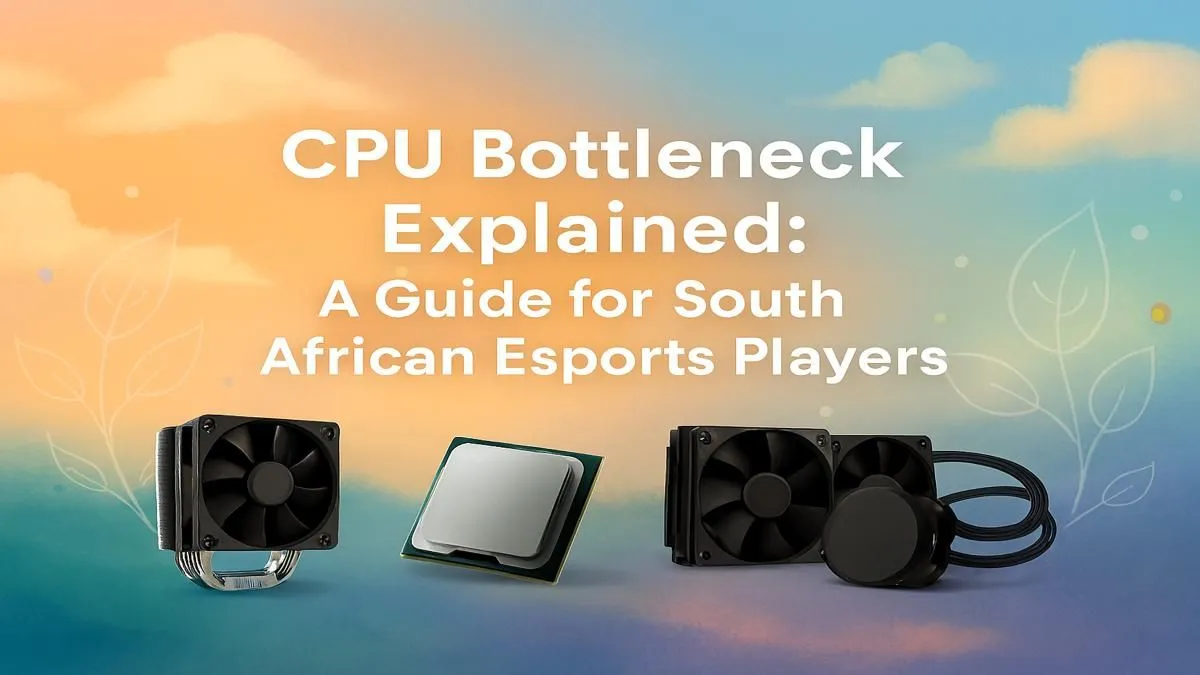
You’ve dropped serious cash on a beastly graphics card, expecting buttery-smooth frames in your Apex Legends ranked matches. Yet, you’re still getting frustrating stutters and lag spikes. What gives? The culprit might not be your GPU, but its often-overlooked partner: your processor. This is the dreaded CPU bottleneck, a common performance gremlin for South African gamers.
Let’s get this CPU bottleneck explained so you can get back to climbing the leaderboards. 🚀
What Exactly is a CPU Bottleneck?
Think of your PC as a high-speed kitchen. Your Graphics Card (GPU) is the master chef, capable of cooking up stunning visuals at an incredible rate. Your Central Processing Unit (CPU), however, is the head of logistics—it prepares the ingredients (game data, physics, AI) and sends them to the chef.
A CPU bottleneck happens when your CPU can't prepare and send those instructions fast enough for your powerful GPU. The chef is left waiting, and your overall performance (your frame rate) drops. This is especially common in esports titles played at 1080p, where the CPU works overtime to push high frame rates.
How to Spot a CPU Bottleneck in Your Rig 🔧
Before you start shopping, you need to confirm if a CPU bottleneck is actually your problem. It's easier than you think. The key is to monitor your component usage while gaming.
The Telltale Signs:
- High CPU Usage: While in-game, if your CPU usage is consistently hitting 90-100% while your GPU usage is sitting well below 90%, you've likely found your bottleneck.
- Frame Drops in Crowded Scenes: Do your frames tank during intense 5v5 team fights in Valorant or when loads of players land together in Warzone? These moments are heavy on CPU calculations.
- Performance Doesn't Improve at Lower Resolutions: If you drop your game's resolution from 1440p to 1080p and see little to no increase in your average FPS, your CPU is holding you back.
Tools like MSI Afterburner with RivaTuner are excellent for displaying your CPU and GPU usage on-screen while you play. Observing these stats is the first step to diagnosing your issue and exploring the range of CPU processors available that could solve it.
Quick Diagnosis Tip ⚡
For a simple test, lower graphics settings that primarily tax the GPU, like textures and anti-aliasing. If your frame rate doesn't improve much, it’s a strong signal that your CPU is the limiting factor. Settings like "object detail," "physics," and "view distance" are often more CPU-bound.
Fixing a CPU Bottleneck for SA Esports
Once you've confirmed a bottleneck, you have a few options. While software tweaks can help, a hardware upgrade is often the most effective long-term solution for a serious imbalance.
Software Optimisations (The Free Fixes)
- Close Background Apps: Make sure browsers, Discord (unless you're using it), and other apps are closed while you game.
- Adjust In-Game Settings: Lower CPU-intensive settings like shadow quality, physics detail, and population density.
- Update Your Drivers: Ensure your chipset drivers are up to date from your motherboard manufacturer's website.
The Hardware Solution: A CPU Upgrade ✨
Sometimes, your processor has simply reached its limit. Upgrading your CPU is the definitive way to eliminate a bottleneck and unlock your GPU's full potential. For competitive gaming, you'll want a CPU with strong single-core performance and enough cores to handle modern titles and background tasks.
Whether you're looking at powerful Intel CPUs known for their raw gaming speed or the excellent multi-core value of AMD's Ryzen processors, a new chip can completely revitalise your gaming experience. A balanced PC is a happy PC.
Ready to Unshackle Your GPU? A CPU bottleneck can be frustrating, but fixing it is the key to unlocking the performance you paid for. A balanced rig is essential for competitive dominance in South Africa. Explore our massive range of CPUs and find the perfect processor to match your graphics card.