Building a new gaming rig in South Africa is a serious investment. You're not just buying a machine for today; you're hoping it chews through tomorrow's AAA titles without breaking a sweat. So, when it comes to the heart of your PC, the central question is one of endurance: what's the real story on CPU longevity for gaming? Does Team Red or Team Blue build a processor that gives you more years for your Rands? Let's investigate.
Understanding CPU Longevity for Gaming
Before we pit the giants against each other, it's crucial to understand what "longevity" really means. It’s not about when the silicon physically gives up—modern CPUs can technically last for decades. The real issue is performance longevity: how long will your CPU remain relevant and powerful enough to run new games smoothly without becoming a bottleneck for your graphics card?
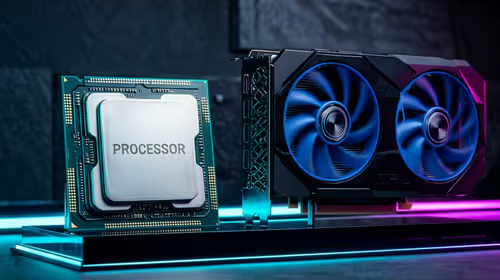
This is where the battle for CPU longevity for gaming is truly fought. It’s a race against evolving game engines, higher core demands, and new software technologies. A chip that’s a beast today could be just average in three or four years. When you're browsing the latest CPU processors, you're essentially betting on its future performance.
AMD vs. Intel: A Look at Long-Term Value
For years, the debate on whether AMD or Intel lasts longer has shifted based on their platform strategies. Each brand has had moments that defined their value proposition for builders looking years ahead.
The AMD Advantage: Platform Stability 🚀
AMD earned massive loyalty with its AM4 socket. Launched in 2017, it supported a staggering five generations of Ryzen CPUs. This meant a gamer who bought a B350 motherboard in 2017 could, with a simple BIOS update, drop in a much more powerful Ryzen 5000 series CPU years later. This upgrade path offered incredible long-term value, making AMD's Ryzen lineup a favourite for budget-conscious builders focused on longevity. While the new AM5 platform required a new motherboard and DDR5 RAM, AMD has suggested a similar long-life strategy.
The Intel Approach: Consistent Evolution
Intel, on the other hand, has historically changed its socket and chipset more frequently. While this often introduced cutting-edge features faster, it meant an upgrade usually required a new motherboard, increasing the long-term cost. However, the current LGA 1700 socket has supported multiple generations, showing a shift in strategy. The top-tier single-core performance of current Intel CPUs also provides a powerful baseline that can stay relevant for a long time, especially for games that still rely heavily on a single fast core.
Cooling Check-Up 🔧
Your CPU's biggest enemy in the South African climate is heat. High temperatures can reduce performance and shorten its effective lifespan. Download a free tool like HWMonitor or Core Temp to check your CPU temperatures under load (while gaming). If you're consistently seeing temps above 85-90°C, it might be time to re-apply thermal paste or upgrade your CPU cooler.
The Verdict: Which CPU Lasts Longer in 2024?
So, who wins the CPU longevity battle? The truth is, it's no longer about the brand name. Both AMD and Intel are on new, modern platforms (AM5 and LGA 1700 respectively) that support DDR5 and PCIe 5.0.
The best indicator of gaming CPU longevity today is buying a processor with enough performance overhead for the future. Don't just meet the recommended specs for today's games; aim higher. A CPU with more cores and threads (e.g., a solid 6-core/12-thread or 8-core/16-thread chip) and high clock speeds is better prepared for the increasingly multi-threaded games on the horizon.
Ultimately, the brand doesn't guarantee a longer life. A smart purchase does. Focus on the performance per Rand, the features of the platform, and choose a chip that gives you headroom for the years to come. ✨
Ready to Build a PC That Lasts?
The AMD vs. Intel debate is about finding the best long-term value for your rig. Your perfect processor is waiting. Explore all PC Components and start building a machine that will dominate for years to come.