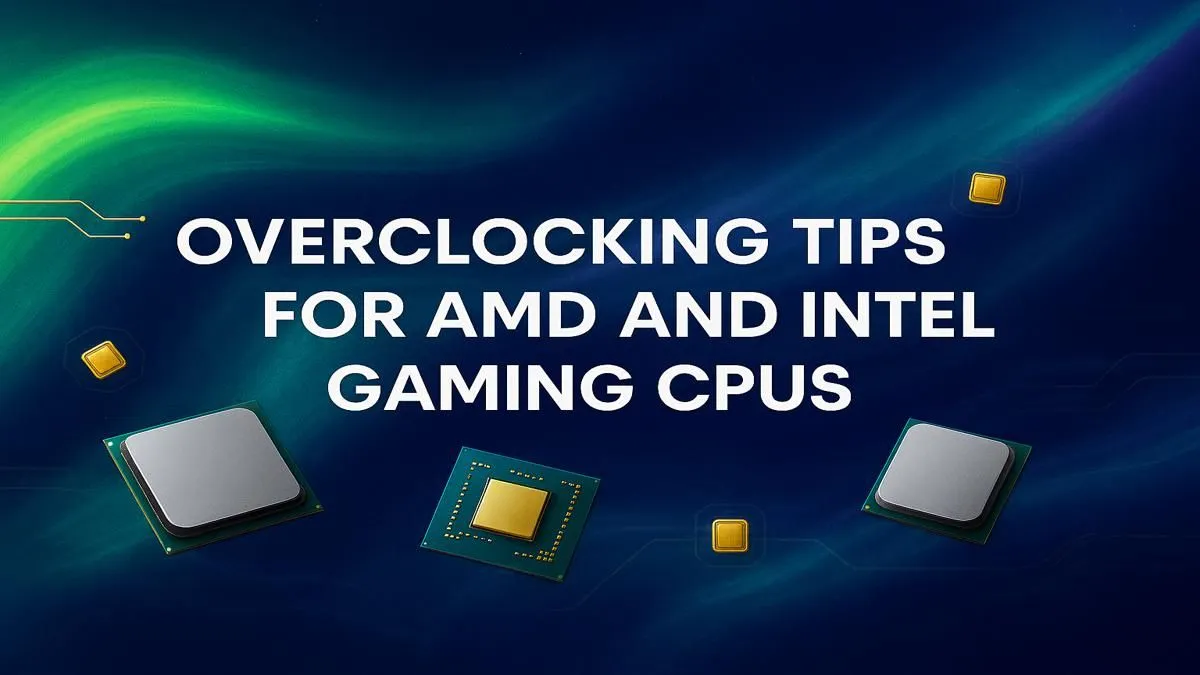
Your gaming rig is a beast, but you know there's more power hiding under the hood. What if you could unlock extra frames in Apex Legends or smoother performance in Helldivers 2 without spending another Rand? That's the magic of overclocking. This CPU overclocking guide is your key to safely pushing your AMD or Intel processor to its limits, giving you the performance you paid for... and then some. Let's get started. 🚀
What is CPU Overclocking, Really?
Think of your CPU's clock speed (measured in gigahertz, or GHz) as the heartbeat of your PC. Each beat is a cycle where it can perform a task. The faster the beat, the more it gets done. Overclocking is simply the process of telling your CPU to run at a higher clock speed than its factory setting.
It's not some dark art; it's about carefully balancing three things:
- Clock Speed/Multiplier: The setting you'll be increasing.
- Voltage (Vcore): The power needed to keep the CPU stable at higher speeds.
- Temperature: The heat generated, which must be kept in check.
A successful overclock gives you "free" performance, making your games run smoother and your applications feel snappier.
The Essential Overclocking Checklist 🔧
Before you even think about entering your BIOS, you need to make sure your hardware is up to the task. Pushing your CPU requires a solid foundation. Here’s what you absolutely need:
- An Unlocked CPU: For Intel, this means a processor with a "K" or "KF" suffix (e.g., Core i7-14700K). For AMD, most Ryzen CPUs are unlocked. This is the most critical part, so when you're looking to buy CPU processors online, check for this feature.
- A Capable Motherboard: Not all motherboards support overclocking. For Intel, you’ll need a Z-series chipset (e.g., Z790). For AMD, B-series (e.g., B650) or X-series (e.g., X670) motherboards are your best bet.
- Robust Cooling: This is non-negotiable. A stock cooler won't cut it. You'll need a high-performance air cooler or, even better, an All-in-One (AIO) liquid cooler to handle the extra heat.
- A Quality Power Supply (PSU): An unstable power supply can ruin your overclocking efforts and even damage components.
A Step-by-Step CPU Overclocking Guide for Beginners
This is a simplified, iterative process. The golden rule is to make small changes and test thoroughly after each one. Patience is key!
Step 1: Establish Your Baseline
Before you change anything, you need to know where you're starting from. Run a stress test like Cinebench R23 or Prime95 for at least 30 minutes. Monitor your CPU temperatures and clock speeds using a tool like HWMonitor. Note down your max temperature and benchmark score. This is your stable starting point.
Step 2: Enter the BIOS/UEFI
Restart your PC and press the designated key (usually Del, F2, or F12) to enter the BIOS. This is your PC's command centre. Every BIOS looks different, but you're looking for settings related to "CPU Frequency," "CPU Multiplier," or "CPU Ratio."
Cooling is King ⚡
Your CPU temperature is the ultimate limit to your overclock. Aim to keep your CPU under 90°C during a stress test. If it gets hotter, you've pushed too far or your cooling isn't sufficient. Never sacrifice the long-term health of your chip for a few extra megahertz!
Step 3: Increase the Multiplier
Find the CPU Core Ratio or Multiplier setting. It might be set to "Auto." Change it to manual and increase it by a small increment (e.g., from 45 to 46, representing 4.5 GHz and 4.6 GHz respectively). Save your settings and reboot into Windows.
Step 4: Test for Stability
If your PC boots successfully, run your stress test again. If it passes for 10-15 minutes without crashing or overheating, you're stable! You can then go back to the BIOS and repeat Step 3, bumping the multiplier up again. Eventually, your PC will fail to boot or crash during the test. That's when you move to the next step.
Step 5: Adjust the Voltage
When your system becomes unstable, it needs a little more power. Go back to the BIOS and find the "CPU Vcore" or "Core Voltage" setting. Increase it by a tiny amount, for example, from 1.250V to 1.265V. Do not make large jumps in voltage, as this can permanently damage your CPU. Save, reboot, and test again. This delicate dance of increasing the multiplier and then the voltage is the core of this CPU overclocking guide.
Key Differences: Overclocking Intel vs. AMD Gaming CPUs
While the principles are the same, Team Blue and Team Red have different approaches.
Intel Overclocking
Intel makes it clear which chips are for enthusiasts. You'll need one of their "K" series processors and a Z-series motherboard to unlock the full potential. The process is very manual, giving you precise control over multipliers and voltage, which many hardcore tweakers prefer. If you're building a rig specifically for this purpose, check out the latest unlocked Intel CPUs to find the perfect starting point.
AMD Overclocking
AMD is generally more flexible, with most of its Ryzen CPUs being unlocked from the factory. They also offer a fantastic tool called Precision Boost Overdrive (PBO), which is a kind of automated overclocking that intelligently pushes the CPU based on its temperature and power limits. It's a great, safe starting point for beginners, though manual overclocking can still yield better results. The versatility of powerful AMD Ryzen CPUs makes them a favourite among gamers who love to tinker. ✨
Is Overclocking Still Worth It?
With modern CPUs having such intelligent boost technologies, is manual overclocking even necessary? For the average user, perhaps not. But for the South African gamer or enthusiast who wants to squeeze every last drop of performance out of their hardware... absolutely. It's a rewarding process that teaches you more about your PC and can give you a tangible boost in your favourite games.
Ready to Unleash Your PC's True Power? 🔥
This CPU overclocking guide gives you the knowledge, but the journey starts with the right hardware. A modern, unlocked processor gives you the best foundation for performance. Explore our massive range of CPUs and find the perfect heart for your gaming rig.