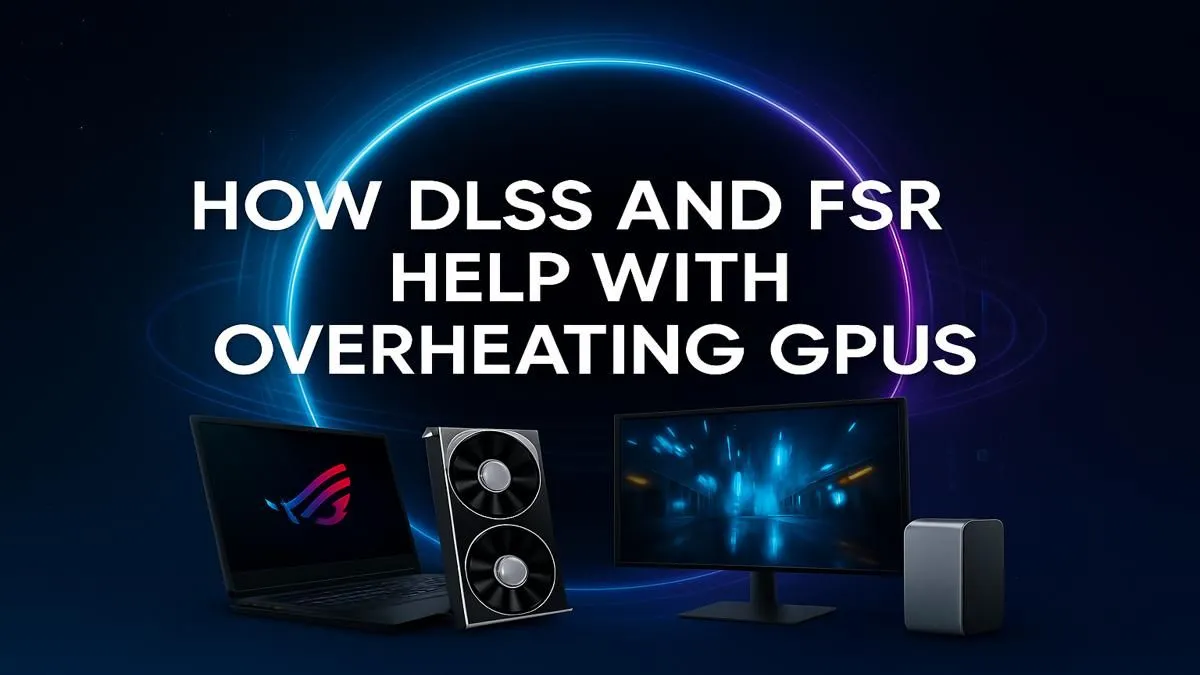
Is your gaming rig starting to sound like a jet engine during this South African summer? We've all been there. You're deep into a session of Apex Legends or Cyberpunk 2077, and your GPU fans are screaming for mercy. You start worrying about your temps. What if the secret to a cooler, quieter graphics card was already hiding in your game settings? Enter NVIDIA DLSS, a smart technology that does more than just boost your frame rates.
Using DLSS for GPU overheating is one of the smartest, simplest tweaks you can make. It’s a powerful tool that can genuinely lower your card's temperature, and understanding how it works is key to unlocking a better gaming experience.
How Upscaling Actually Lowers GPU Workload
So, what’s the magic behind this? DLSS (Deep Learning Super Sampling) is an AI-powered rendering technology. Instead of forcing your GPU to draw every single pixel at your target resolution (like 1440p or 4K), it renders the game at a lower internal resolution. Then, its powerful AI model intelligently reconstructs the image to look just as sharp, sometimes even sharper, than native resolution.
Think of it like this: your GPU is given an easier task. It’s sketching a rough outline instead of a masterpiece from scratch. The AI handles the fine details. Because the initial rendering workload is significantly reduced, your GPU doesn't have to work as hard. Less work means less power consumption, which directly leads to less heat being produced. 🌡️
The Direct Link: Using DLSS to Cool Your GPU
The connection between DLSS and GPU temperatures is simple physics. A graphics card running at 100% utilisation will draw its maximum power and generate the most heat. By enabling DLSS, you reduce that utilisation without sacrificing visual quality.
When you use DLSS to cool your GPU, you'll often notice two immediate benefits:
- Lower Core Temperatures: Your GPU core simply isn't working as hard to push frames, leading to a noticeable drop in degrees Celsius.
- Quieter Fans: Since the card is cooler, the fans don't need to spin as aggressively to dissipate heat. This means a much quieter and more immersive gaming session.
This efficiency is a hallmark of the latest NVIDIA GeForce RTX series graphics cards, which are designed to balance incredible performance with smart power usage.
See the Difference for Yourself! 💡
Download a free tool like MSI Afterburner or HWMonitor. Play your favourite game for 15 minutes with DLSS off and note your peak GPU temperature. Then, quit the game, turn DLSS on to 'Quality' or 'Balanced' mode, and play again for 15 minutes. The drop in temperature might surprise you!
Practical Steps to Reduce GPU Heat with Upscaling
Ready to try it out? Here’s how to get started.
For NVIDIA Cards: Fine-Tuning DLSS
In your game's graphics settings, you'll typically find a few DLSS options:
- Quality: Offers the best image quality with a solid performance boost. A great starting point for cooling.
- Balanced: Provides a good mix of image quality and performance.
- Performance / Ultra Performance: Delivers the highest frame rates, ideal for competitive gaming, and will have the biggest impact on reducing GPU load and heat.
Experiment to find the sweet spot for your setup. Often, 'Quality' mode is enough to significantly reduce GPU heat while keeping visuals crisp.
For AMD Cards: Don't Forget FSR
If you're on Team Red, you have a similar tool called FidelityFX Super Resolution (FSR). It works differently from DLSS (it's not AI-based) but achieves a similar goal: rendering at a lower resolution and upscaling for better performance. This feature is a massive plus for many powerful AMD Radeon graphics cards and is also a great way to ease the thermal load on your GPU.
When Upscaling Isn't a Silver Bullet
While using DLSS for GPU overheating is incredibly effective, it can't fix underlying hardware issues. If your card is still running hot, it might be a sign of other problems like:
- Dusty heatsinks and fans choking your card.
- Poor case airflow trapping hot air.
- Old, dried-out thermal paste.
If you've cleaned your PC and optimised your settings but your old GPU is still struggling, it might just be showing its age. Sometimes, an upgrade is the most effective solution. If that's the case, it's always worth checking out the latest graphics card deals to see if a modern, more efficient GPU is within your budget. ✨
Ready for a Cooler, Faster Gaming Rig? Whether you're looking to harness the power of DLSS with a new NVIDIA card or explore AMD's FSR, a modern GPU is the heart of a great PC. Explore our massive range of graphics cards and find the perfect upgrade to conquer the heat and your favourite games.