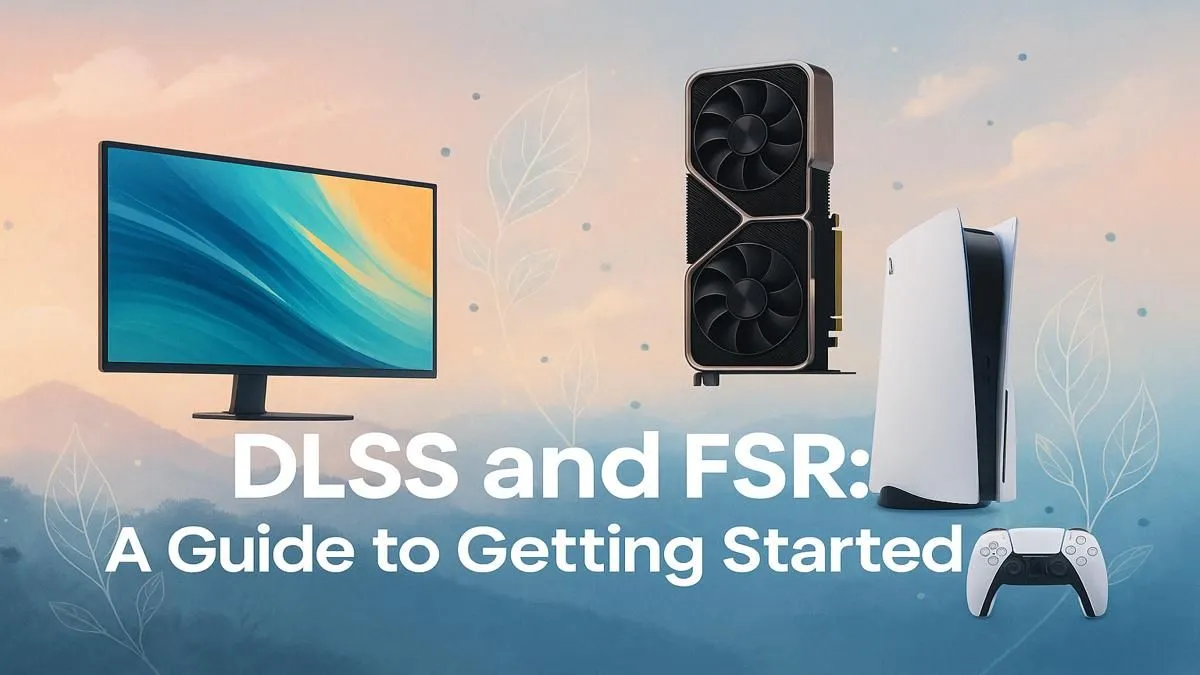
Staring at a stuttering frame rate in the latest AAA title is a uniquely South African kind of pain... You want those buttery-smooth visuals, but upgrading your graphics card isn't always in the budget. What if you could get a massive performance boost for free? Enter DLSS and FSR, two incredible technologies designed to give you more frames without costing you a Rand. This guide will show you how.
Understanding the Magic Behind DLSS and FSR
At its core, this technology is a clever trick called upscaling. Instead of making your graphics card render every single pixel at your monitor's native resolution (like 1440p or 4K), it renders the game at a lower resolution, say 1080p. Then, powerful AI algorithms and sharpening filters step in, intelligently filling in the gaps to "upscale" the image back to your native resolution.
The result? Your GPU has less work to do, which means a significant jump in your frames per second (FPS). 🚀 It's the key to playing modern games with high settings and ray tracing enabled, even on mid-range hardware. Think of it as getting a performance upgrade with a simple software switch.
A Closer Look at NVIDIA's DLSS
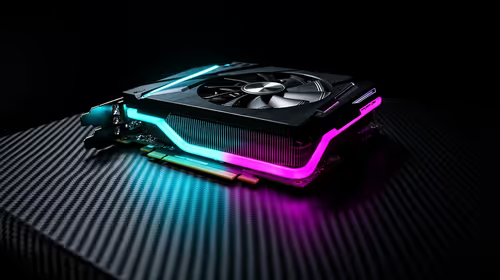
DLSS, or Deep Learning Super Sampling, is NVIDIA's exclusive solution. It uses dedicated hardware called Tensor Cores, found on their RTX graphics cards, along with a deep-learning AI network to produce an upscaled image that is often shockingly close to the native resolution... and sometimes even sharper.
Because it relies on specific hardware, you'll need one of the latest NVIDIA GeForce RTX graphics cards to take advantage of it. With features like DLSS 3's Frame Generation, which intelligently creates brand-new frames, NVIDIA is pushing the boundaries of what's possible for performance. ✨
Quick In-Game Check 🔧
Not sure if your game supports these features? It's easy to check. In the game's graphics or display settings, look for an option labelled "Upscaling," "Resolution Scaling," or the specific terms "DLSS" or "FSR." You'll usually find different quality presets like Quality, Balanced, Performance, and Ultra Performance. Start with "Quality" for the best visuals!
AMD's FSR: The Open-Source Alternative
On the other side, we have AMD's FidelityFX Super Resolution, or FSR. The biggest advantage of FSR is that it's open-source. This means it doesn't require any specialised hardware to run. It works beautifully on a huge range of GPUs, including AMD's own lineup, older NVIDIA cards (like the GTX 10-series), and even Intel's new Arc GPUs.
This incredible compatibility makes FSR a fantastic tool for all gamers. While early versions were a step behind DLSS in image quality, FSR 2.0 and beyond have made massive strides, offering a crisp and detailed picture that provides a serious performance uplift. It's a testament to the power of smart software, and it makes many powerful AMD Radeon graphics cards incredible value propositions.
DLSS vs. FSR: Which Upscaler is Right for You?
So, which one should you use? The answer is simple: it depends on your hardware.
- If you have an NVIDIA RTX 20-series card or newer: DLSS is generally your best bet. The dedicated hardware and mature AI model often deliver a slightly cleaner, more stable image.
- If you have an AMD graphics card or an older NVIDIA card: FSR is your performance hero. It's an amazing, accessible technology that will breathe new life into your GPU.
Ultimately, both are fantastic tools. The best way to boost your gaming performance is to enable whichever option your system supports. Experiment with the different quality modes (Quality, Balanced, Performance) to find the perfect sweet spot between visual fidelity and raw frame rate for your setup. You might be surprised by how much extra performance you can unlock.
Ready to Unleash Maximum Frames?
Whether you're Team Green or Team Red, this DLSS and FSR guide shows that modern GPUs offer incredible performance. The right graphics card is waiting to transform your gaming experience. Explore our best graphics card deals and find the perfect upgrade for your rig today.