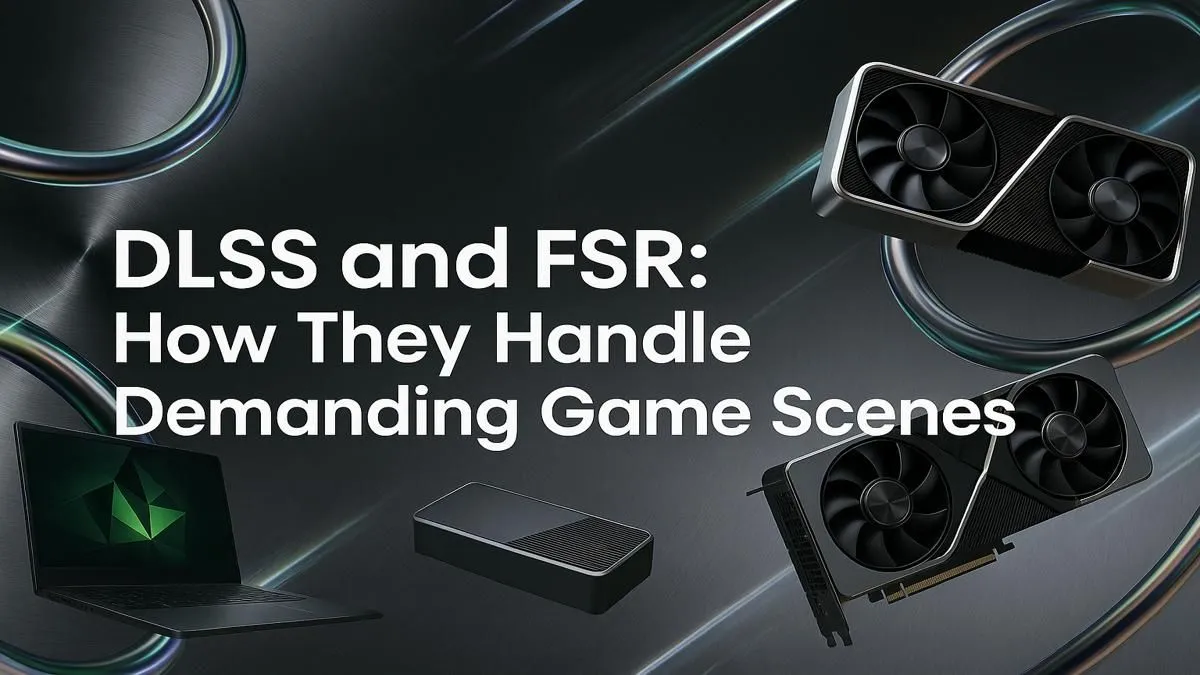
Staring at a stuttering frame rate in the latest AAA title is a uniquely South African pain... especially after dropping serious ZAR on your gaming rig. You crave those silky-smooth visuals at high resolutions, but cranking everything to Ultra can bring even powerful PCs to their knees. What if you could get a massive FPS boost for free? That's the promise of upscaling tech, and the biggest showdown in town is DLSS vs FSR. Let's dive in. 🚀
Understanding the Magic: DLSS vs FSR Explained
At its core, upscaling is a clever trick. Your graphics card renders a game at a lower resolution (like 1080p) and then uses sophisticated algorithms to stretch that image up to your monitor's native resolution (like 1440p or 4K).
Think of it like a specialist artist restoring a photograph. Instead of just making the pixels bigger, they intelligently fill in the missing details. The result? You get performance that feels like you're running at 1080p, with an image that looks incredibly close to native 4K. Both NVIDIA's DLSS and AMD's FSR aim for this goal, but they take very different paths to get there.
The NVIDIA DLSS Approach: AI-Powered Precision
NVIDIA's Deep Learning Super Sampling (DLSS) is the AI-powered veteran in this fight. It leverages dedicated hardware called Tensor Cores, found exclusively on their RTX graphics cards, to work its magic. By training an AI model on super-high-quality offline game renders, DLSS learns how to reconstruct a low-resolution image into a high-resolution one with stunning accuracy.
The main advantage here is image quality. DLSS is widely regarded as the leader for producing a crisp, stable image that can sometimes look even better than native resolution due to its superior anti-aliasing. With features like Frame Generation in DLSS 3, it can literally create new frames to smooth out gameplay even further. The only catch? You need one of the latest NVIDIA GeForce RTX cards to use it.
The AMD FSR Strategy: Open-Source and Accessible
AMD's FidelityFX Super Resolution (FSR) is the people's champion. ✨ Its biggest selling point is that it's open-source, meaning it doesn't require any specialised hardware. FSR can run on almost any modern GPU, including AMD's own powerful Radeon cards, older NVIDIA cards, and even Intel's new Arc GPUs.
This incredible accessibility makes FSR a fantastic tool for gamers on a wider range of budgets. While its image quality in early versions was a step behind DLSS, FSR 2 and the new FSR 3 have closed the gap significantly. It offers a huge performance uplift and gives every gamer a chance to boost their frame rates without being locked into a specific hardware ecosystem.
Which Quality Mode Should You Use? 🔧
Both DLSS and FSR offer different presets like 'Quality', 'Balanced', and 'Performance'. For 1440p or 4K gaming, always start with 'Quality'. It offers the best image fidelity with a substantial FPS boost. Only drop to 'Balanced' or 'Performance' if you're chasing extremely high refresh rates for competitive shooters or if your PC is seriously struggling.
DLSS vs FSR: The Head-to-Head Verdict for SA Gamers
So, who wins the DLSS vs FSR battle? It truly depends on you and your rig.
The Final Breakdown:
- For the Absolute Best Image Quality: If you're building a new high-end PC and demand the most pristine, stable image possible, DLSS on an NVIDIA RTX card is currently the top choice. The AI reconstruction is simply phenomenal.
- For Maximum Compatibility and Flexibility: If you have an older GPU, an AMD card, or just want a solution that works everywhere, FSR is your hero. It brings modern performance-boosting tech to the masses.
- The Bottom Line: For most gamers, the choice between DLSS and FSR will be decided by the graphics card they own or plan to buy. Both technologies are fantastic and represent a massive leap forward for PC performance. The competition is fierce, which is great news for us gamers, as both Team Green and Team Red are constantly pushing to improve.
Ultimately, picking a side isn't as important as picking the right hardware for your budget. Before you make a decision, it's always wise to check out the latest graphics card deals to see what performance you can get for your hard-earned Rands.
Ready to Build Your FPS Beast?
The DLSS vs FSR debate highlights one thing: modern gaming is all about smart performance. Whether you're Team Green or Team Red, the perfect GPU is the heart of your rig. Use our Custom PC Builder to pair your dream card with the right components and build a machine that dominates.