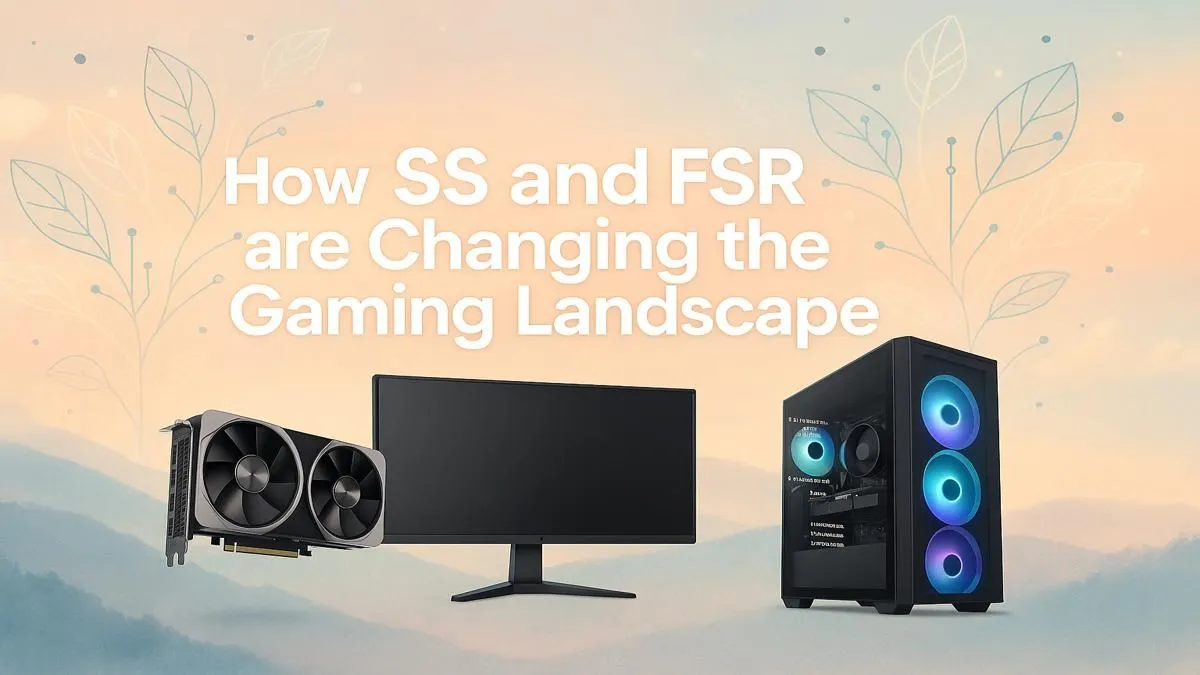
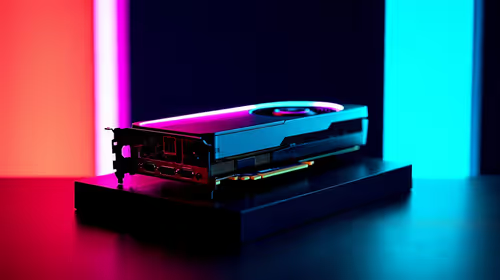
Staring at a stuttering frame rate in the middle of a nail-biting Apex Legends match? We’ve all been there. You want those gorgeous, maxed-out visuals, but not at the cost of silky-smooth gameplay. What if you could have both? 🤔 Enter the world of AI upscaling. This powerful tech is the secret sauce behind boosting your FPS, and the two biggest names in the game are NVIDIA's DLSS and AMD's FSR. Let's settle the DLSS vs FSR debate.
What is AI Upscaling, Anyway?
Before we dive into the specifics of DLSS vs FSR, let's break down the core idea. AI upscaling is a clever technique where your graphics card renders a game at a lower resolution (say, 1080p) and then uses artificial intelligence to intelligently reconstruct the image to fit your higher-resolution monitor (like 1440p or 4K).
Think of it as a highly advanced artist filling in the blanks. The result? You get the performance of running at a lower resolution with visuals that are incredibly close to native quality. It’s a smart way to get more frames without needing a complete rig overhaul. 🚀
Team Green's Secret Weapon: NVIDIA DLSS
NVIDIA’s Deep Learning Super Sampling (DLSS) is the technology that really brought AI upscaling into the mainstream. Its magic lies in its use of dedicated Tensor Cores, specialised AI hardware found only on NVIDIA's RTX graphics cards.
DLSS uses a deep learning network to produce sharp, high-quality images that often look as good as, or even better than, native resolution while providing a significant performance uplift. With features like Frame Generation in DLSS 3, it can create entirely new frames to make gameplay feel even smoother. If you're running a modern NVIDIA card, DLSS is an incredible tool in your arsenal. It's a key reason why many gamers look for the best NVIDIA GeForce graphics cards available.
Team Red's Open Standard: AMD FSR
Not to be outdone, AMD developed FidelityFX Super Resolution (FSR). The biggest difference in the DLSS vs FSR comparison is FSR's open-source nature. It doesn't require specialised hardware like Tensor Cores, which means it works on a massive range of GPUs… including AMD's own cards, older NVIDIA cards, and even integrated graphics.
While early versions were seen as a step behind DLSS in image quality, FSR 2 and FSR 3 have closed the gap considerably. FSR 3 also introduced its own frame generation technology, AMD Fluid Motion Frames (AFMF). This commitment to accessibility makes FSR a fantastic option for gamers across the entire hardware spectrum, and a huge selling point for the latest AMD Radeon graphics cards.
Choosing Your Quality Preset ⚡
Both DLSS and FSR offer presets like 'Quality', 'Balanced', 'Performance', and 'Ultra Performance'. For 1440p gaming, start with the 'Quality' preset. It offers the best image fidelity with a solid FPS boost. If you're chasing every last frame for competitive 4K gaming, the 'Performance' mode is your best bet. Experiment to find what works for your eyes and your rig!
DLSS vs FSR: The Mzansi Showdown
So, which one should you use? The choice often comes down to the hardware in your PC.
Image Quality
Generally, DLSS is considered the king of image quality. Its AI-trained model often does a better job of reconstructing fine details and maintaining stability in motion. However, FSR has improved dramatically and, in many games, the difference is barely noticeable during fast-paced action.
Performance Boost
Both technologies provide a massive FPS boost, often turning unplayable frame rates into a smooth 60+ FPS experience. The exact numbers vary by game, resolution, and the specific GPU, but you can expect significant gains from either side.
Hardware Compatibility
This is FSR's biggest win. If you have an AMD GPU or an older non-RTX NVIDIA card, FSR is your only option, and it's a brilliant one. DLSS is exclusively for NVIDIA RTX 20-series cards and newer.
So, Which Upscaler is Right for You? ✨
The DLSS vs FSR battle isn't about one being universally "better" than the other; it's about which is better for you.
- If you own an NVIDIA RTX 20, 30, or 40-series card: Start with DLSS. It’s tailor-made for your hardware and typically offers the best image quality.
- If you own an AMD graphics card or an older NVIDIA card: FSR is your champion. It will give you that much-needed performance uplift and is supported in a growing library of games.
Ultimately, both technologies are pushing PC gaming forward, allowing us to enjoy higher resolutions and frame rates than ever before. Whichever camp you're in, having a GPU that supports one of these upscalers is essential for modern gaming. Make sure to check out the best graphics card deals to find a card that can unlock this performance for you.
Ready for a Frame Rate Revolution?
The DLSS vs FSR debate shows just how far graphics technology has come. Whether you're Team Green or Team Red, the right GPU can unlock a new level of performance. Explore our massive range of PC deals and find the perfect engine for your gaming rig today.