Staring at a stuttering frame rate when you’ve cranked up the graphics? We’ve all been there. In the quest for buttery-smooth gameplay without selling a kidney, two technologies dominate the conversation: NVIDIA's DLSS and AMD's FSR. But the big question for South African gamers is simple: in the battle of DLSS vs FSR, which upscaling tech is actually best for your GPU and your wallet? Let's dive in and find the answer. 🚀
What is Upscaling, Anyway?
Before we pit DLSS vs FSR against each other, let's quickly cover what they do. Imagine telling your graphics card to draw a game at a lower resolution (like 1080p), and then using clever tech to stretch and sharpen that image to fit your high-resolution monitor (like 1440p or 4K).
The result? Your GPU does less work, giving you a massive frame rate boost. The magic is in how they fill in the missing details to make the image look crisp and native.
Team Green's AI Powerhouse: NVIDIA DLSS
NVIDIA's Deep Learning Super Sampling (DLSS) is the AI-powered option. It uses dedicated Tensor Core hardware inside NVIDIA's GeForce RTX cards to intelligently reconstruct the image. Think of it as an artist who has studied thousands of high-res game images to learn how to perfectly upscale a lower-res one.
Key DLSS Features:
- Superb Image Quality: Thanks to its AI brain, DLSS 2 and later versions often produce an image that is incredibly sharp, sometimes even better than the native resolution.
- Frame Generation (DLSS 3): Exclusive to the RTX 40 Series, this feature generates entirely new frames, providing a monumental performance uplift.
- Hardware Dependant: The biggest catch... you need a compatible NVIDIA RTX GPU to use it.
Team Red's Open Challenger: AMD FSR
AMD's FidelityFX Super Resolution (FSR) takes a different approach. It's a sophisticated spatial upscaling algorithm. Instead of using dedicated AI hardware, it uses smart sharpening and edge-detection techniques to enhance the image. The best part? It's open-source. ✨
Key FSR Features:
- Wide Compatibility: FSR works on almost any modern graphics card, including many of AMD's Radeon GPUs, older NVIDIA cards, and even integrated graphics.
- Great Performance Boost: FSR provides a significant FPS increase, making high-refresh-rate gaming more accessible.
- Constantly Improving: While FSR 1 was a bit soft, FSR 2 and beyond use temporal data (info from previous frames) to seriously rival DLSS in image quality.
Check Your Game's Support List! 🎮
Before you bank on either tech, check if the games you play actually support it. A quick search on sites like PCGamingWiki for a specific game will tell you if it supports DLSS, FSR, or both. This can heavily influence your decision when comparing the upscaling tech that's best for your library.
DLSS vs FSR: The Head-to-Head Breakdown
So, when the pixels settle, which one comes out on top? The choice between DLSS vs FSR really depends on what you value most.
Image Quality
Generally, DLSS holds a slight edge in producing the cleanest, most stable image, especially in fast motion. Its AI model is exceptional at reconstructing fine details. However, FSR 2.0 and newer versions are incredibly competitive, and most gamers would be hard-pressed to spot the difference during intense gameplay.
Performance
Both technologies offer fantastic performance gains, often boosting frame rates by 50% or more, depending on the quality mode and game. DLSS 3's Frame Generation is in a league of its own for raw FPS numbers, but FSR provides a more universal performance uplift across a massive range of hardware.
Hardware Support
This is an easy win for AMD. FSR's open-source nature means almost everyone can benefit from it. DLSS is a powerful, premium feature, but it's locked into the NVIDIA RTX ecosystem.
So, Which Upscaling Tech is Best for Your Rig? 🤔
There's no single winner in the DLSS vs FSR showdown... only the right choice for you.
- Choose DLSS if: You own or are planning to buy an NVIDIA RTX 20-series or newer card. You prioritise the absolute best image reconstruction and, with a 40-series card, want access to the incredible power of Frame Generation.
- Choose FSR if: You have an AMD GPU, an older NVIDIA card, or simply want a great upscaling solution that works everywhere. It's the flexible, democratic choice for boosting performance.
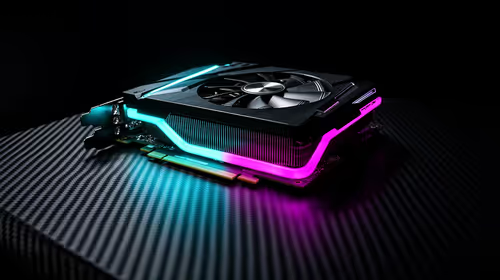
Ultimately, the best upscaling tech is the one that works with the GPU that fits your performance needs and budget. To get the most bang for your Rand, it's always smart to browse the latest graphics card deals and see which card offers the features you need at a price that makes sense.
Ready to Boost Your FPS?
The DLSS vs FSR debate shows there's no single "best" answer... just the best choice for your rig and budget. Whether you're Team Green or Team Red, the right GPU is waiting. Explore our best graphics card deals and find the perfect upgrade to dominate your game.