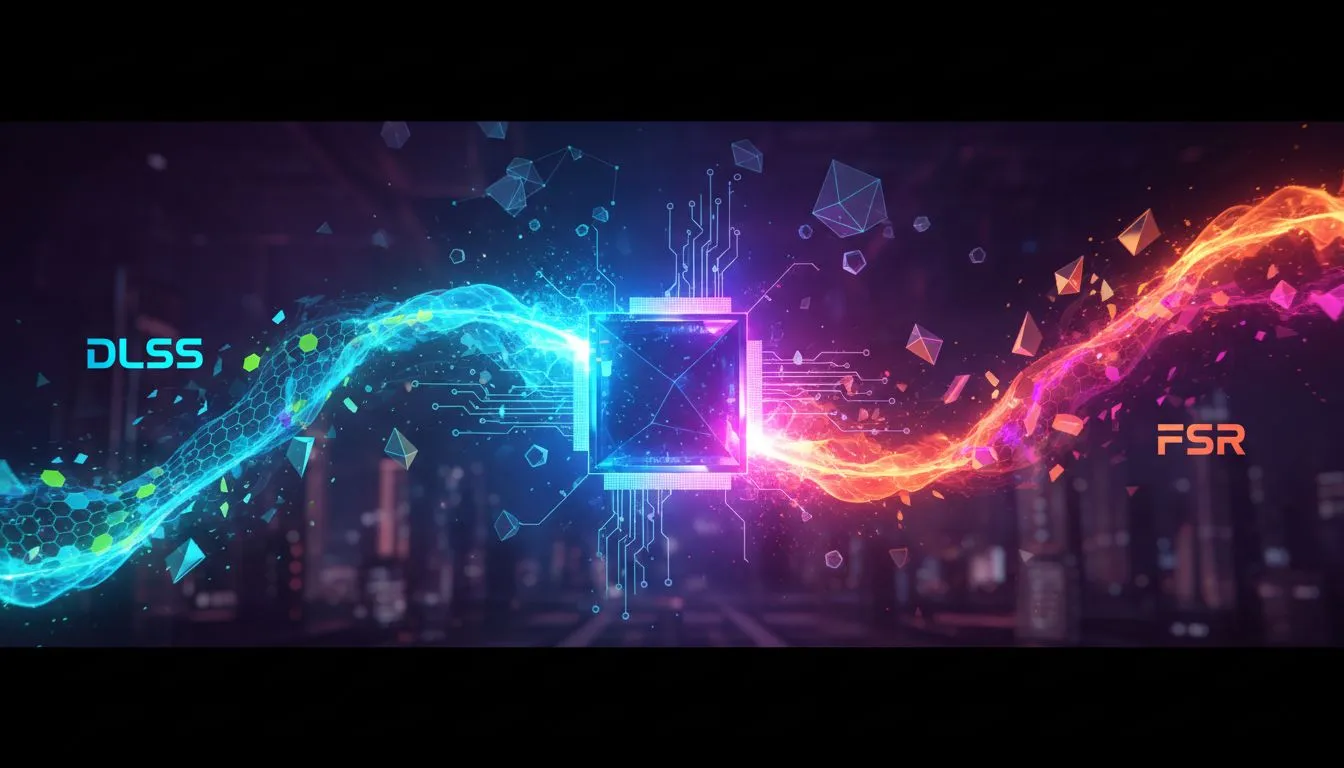
You’re eagerly waiting for the next big thing in PC gaming. Rumours are swirling about NVIDIA's next-gen cards, and for many South African gamers, the RTX 5060 is the one to watch. But raw power is only half the story. The real performance battle will be fought with software smarts. The big question on everyone’s mind is: in the DLSS vs FSR RTX 5060 showdown, which upscaling tech will give you the frames you crave?
Understanding Upscaling: More Frames, Less Fuss
Before we dive deep, what exactly is upscaling? Imagine you're playing a game at a demanding 1440p resolution. Your graphics card is working hard. Upscaling technology renders the game at a lower resolution (like 1080p), and then uses clever algorithms to intelligently stretch the image back up to 1440p.
The result? A massive FPS boost! 🚀 It’s like getting a performance upgrade for free, letting you enable fancy features like ray tracing without turning your game into a slideshow.
The Two Titans of Tech: DLSS vs FSR
The debate between these two technologies is central to choosing your next GPU. They achieve similar goals but through very different methods.
NVIDIA's DLSS: The AI-Powered Artist
Deep Learning Super Sampling (DLSS) is NVIDIA’s secret sauce. It uses Artificial Intelligence and dedicated hardware called Tensor Cores, found exclusively on NVIDIA GeForce graphics cards, to reconstruct the image. Because it's trained on super-high-quality game captures, DLSS can often produce an image that looks as good as, or sometimes even better than, the native resolution, especially when things are in motion.
AMD's FSR: The Open-Source Hero
FidelityFX Super Resolution (FSR) is AMD's answer. It's an open-source spatial upscaler, which is a fancy way of saying it doesn't require specialised AI hardware. Its biggest advantage is compatibility. FSR works on a massive range of GPUs, including AMD's own powerful Radeon graphics cards, older NVIDIA cards, and even integrated graphics. This open approach means more games can adopt it easily.
Check Before You Play 🔧
Game support is key. Before buying a new title, quickly check its store page or official website to see if it supports DLSS or FSR. This can make a huge difference to your experience, especially if you're aiming for high refresh rates on a mid-range card. Enabling it is usually a simple toggle in the game's graphics settings!
The Future Fight: DLSS vs FSR on the RTX 5060
So, what does this all mean for the hypothetical RTX 5060? While the card isn't out yet, we can make some educated predictions based on current trends.
For a future NVIDIA card like the RTX 5060, DLSS will almost certainly be the superior choice. The card will feature next-generation Tensor Cores specifically designed to run advanced versions of DLSS, including features like Frame Generation and Ray Reconstruction. This tight hardware and software integration means maximum performance and image quality. The DLSS vs FSR debate on an RTX 5060 will likely lean heavily in favour of NVIDIA's native solution for the best possible experience.
However, FSR's role as a universal standard cannot be ignored. You'll still be able to use FSR on an RTX 5060, which is fantastic for games that may only support AMD's tech. The real winner is you, the gamer, who gets more choice than ever before. ✨
What This Means for Your Next Upgrade
Thinking about your next build shouldn't just be about hardware specs... it's about the entire ecosystem. While we dream about the 50-series, the groundwork has already been laid by today's best graphics cards.
Looking at current-gen cards from top-tier brands like MSI gives you a perfect preview of this software-driven performance. The choice you make today—and tomorrow—depends on which ecosystem you believe in and which features will best optimise the games you love to play.
Ready to Boost Your FPS?
The battle between upscaling technologies is heating up, but one thing is clear: a modern GPU is your ticket to higher frame rates. Explore our massive range of graphics cards and find the perfect engine to power your gaming world.