

RX 9070 XT Elden Ring Nightreign at 4K: FPS Benchmark & Optimal Settings
RX 9070 XT Elden Ring Nightreign at 4K: FPS. Real-world benchmark data, FPS numbers & performance analysis. What SA gamers can actually expect.
Read moreConfused about DLSS vs FSR? Our complete guide for South African gamers breaks down NVIDIA and AMD's game-changing upscaling tech. Learn how to boost your FPS, understand the key differences, and pick the best settings for your gaming rig. Get ready for smoother gameplay! 🚀🎮
Staring at a stuttering frame rate while your international mates are getting smooth gameplay? Ja, we've all been there. In South Africa, every rand and every frame-per-second (FPS) counts. The biggest battle for your pixels right now is DLSS vs FSR, two incredible technologies designed to boost your FPS without melting your graphics card. But which one is the right choice for your rig? Let's break it down, SA-style.
Before diving into the DLSS vs FSR showdown, what are we even talking about? Both are "upscaling" technologies. In simple terms, they let your graphics card render a game at a lower resolution (like 1080p) and then use clever algorithms to intelligently scale the image up to your monitor's native resolution (like 1440p or 4K).
The result? Your GPU works less, giving you a massive FPS boost. It's like getting a free hardware upgrade with a software switch. 🚀
NVIDIA's Deep Learning Super Sampling (DLSS) uses artificial intelligence and dedicated Tensor Core hardware inside their GPUs to work its magic. It reconstructs the image with incredible detail, often looking as good as—or even better than—the native resolution.
AMD’s FidelityFX Super Resolution (FSR) takes a different approach. It’s an open-source spatial upscaler. This means it doesn't require specialised AI hardware, making it compatible with a much wider array of GPUs.
Before you buy a new card based on either tech, remember that the game itself must support it. Most new AAA titles support both, but it's always worth a quick Google search like "Does Cyberpunk 2077 support DLSS 3?" to confirm. Game support lists are your best friend!
So, after all that, which one is for you? The DLSS vs FSR debate in South Africa often comes down to your current hardware and your budget.
Ultimately, both are incredible innovations. The best choice depends on the gear you have. If you're looking to upgrade and make a decision, it's always smart to see what your budget gets you by checking out the latest graphics card deals available right here in SA.
Ready to Boost Your FPS? The DLSS vs FSR choice depends entirely on your GPU. Whether you're Team Green or Team Red, getting more frames for your rands is the goal. Explore our massive range of graphics card deals and find the perfect engine for your gaming rig today.
It depends on your GPU. DLSS is exclusive to NVIDIA RTX cards and often offers superior AI-based image quality, while AMD's FSR is open-source and compatible with more GPUs.
Yes! Because FSR is an open-source technology, you can enable it on modern NVIDIA and even older AMD graphics cards in supported games to boost your performance.
The key difference is Frame Generation. DLSS 3's version requires an NVIDIA RTX 40 series GPU, while FSR 3's Frame Generation is open-source and works on more cards.
Not necessarily. In its 'Quality' mode, DLSS uses AI to reconstruct an image that is often comparable or even sharper than native resolution, all while boosting your FPS.
Navigate to the game's graphics or display settings menu. Look for an option called 'Upscaling', 'DLSS', or 'FidelityFX Super Resolution' and select your desired preset.
Absolutely. FSR can provide a significant FPS boost at 1080p, especially on mid-range hardware. Using the 'Quality' or 'Balanced' presets offers a great mix of performance.
No, you do not need a special monitor. DLSS and FSR work by rendering the game at a lower resolution and then upscaling it, which is compatible with any standard monitor.
RX 9070 XT Elden Ring Nightreign at 4K: FPS. Real-world benchmark data, FPS numbers & performance analysis. What SA gamers can actually expect.
Read more
RTX 5090 Marvel Rivals FPS: Performance Benchmark. Real-world benchmark data, FPS numbers & performance analysis. What SA gamers can actually expect.
Read more
Intel Arc A770 Escape from Tarkov Performance. Real-world benchmark data, FPS numbers & performance analysis. What SA gamers can actually expect.
Read more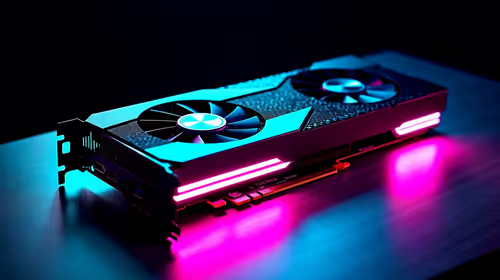
Head-to-head comparison of RX 9070 XT vs RTX 6070: Gaming Performance for SA gamers. Performance benchmarks, Rand pricing & which delivers better value.
Read more
Head-to-head comparison of RTX 5060 Ti Mining vs Gaming: Does It Affect for SA gamers. Performance benchmarks, Rand pricing & which delivers better value.
Read more
Ryzen 7 7800X3D Gaming Benchmark: FPS Across 20. Real-world benchmark data, FPS numbers & performance analysis. What SA gamers can actually expect.
Read more
Complete ATX Case Size Guide: Interior Dimensions. Best deals curated with real SA discounts, price history & tips on getting genuine value.
What GPU Do You Need for AI & Machine Learning. Hardware requirements breakdown with recommended specs & SA pricing for each tier.
Top Settings for RTX 4060 at Ultrawide 1440p picks evaluated on performance, value & SA availability with current Rand pricing from Evetech.
Head-to-head comparison of FreeSync vs G-Sync Explained: Which Should Gamers for SA gamers. Performance benchmarks, Rand pricing & which delivers better value.
Every spec on PCIe 5.0 explained in plain English. What matters for gaming and creator work in 2026, what's marketing fluff, and how each number translates to real-world performance.
Every spec on bios explained in plain English. What matters for gaming and creator work in 2026, what's marketing fluff, and how each number translates to real-world performance.
Every spec on gaming setups explained in plain English. What matters for gaming and creator work in 2026, what's marketing fluff, and how each number translates to real-world performance.
Every spec on cooling systems explained in plain English. What matters for gaming and creator work in 2026, what's marketing fluff, and how each number translates to real-world performance.
Every spec on understanding how much vram is needed explained in plain English. What matters for gaming and creator work in 2026, what's marketing fluff, and how each number translates to real-world.
How to pick the right PCIe 5.0 for your build in 2026: the features worth paying for, ZAR value tiers, and the trade-offs between budget, mid-range and flagship picks.
Every spec on gpu explained in plain English. What matters for gaming and creator work in 2026, what's marketing fluff, and how each number translates to real-world performance.
Every spec on gpu explained in plain English. What matters for gaming and creator work in 2026, what's marketing fluff, and how each number translates to real-world performance for SA buyers.