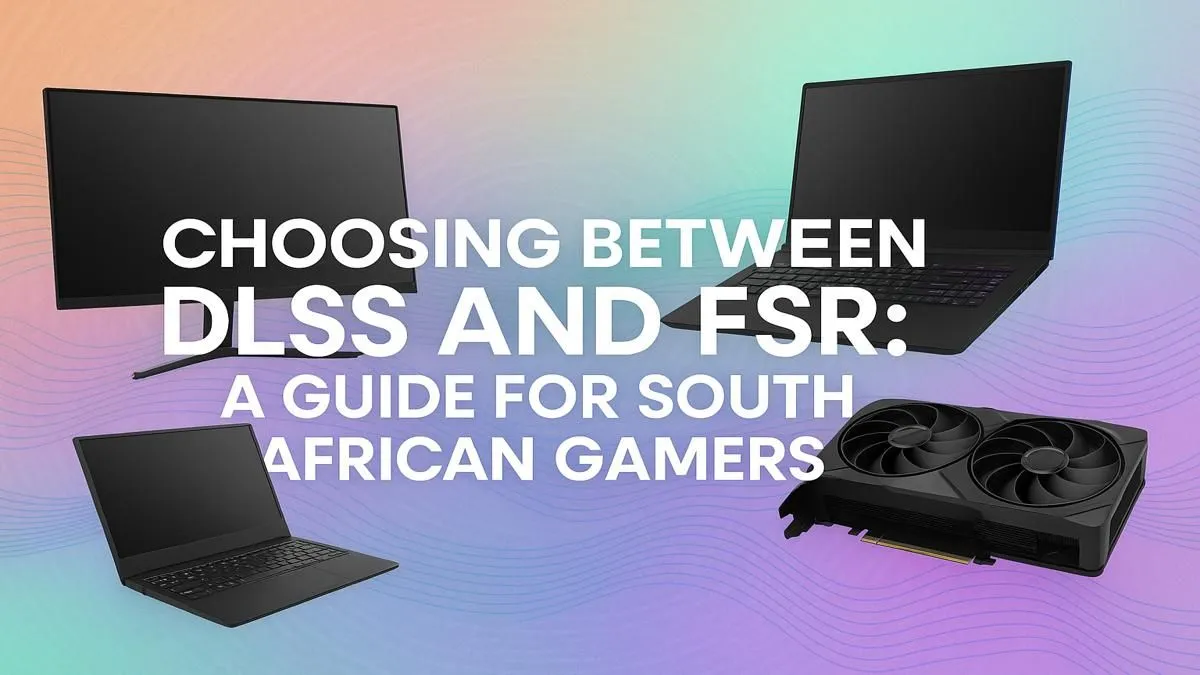
Staring at a stuttering frame rate in your favourite game, praying for more performance? We've all been there. You need more FPS, but a brand-new GPU can be heavy on the wallet. Enter the titans of upscaling: NVIDIA's DLSS and AMD's FSR. These technologies promise a massive performance boost for free. But in the crucial debate of DLSS vs FSR, which is the right choice for your South African gaming rig? Let's dive in.
Cracking the Code: What Are DLSS and FSR?
Before we pick a winner in the DLSS vs FSR battle, let's quickly cover what they do. Both are "upscaling" technologies. In simple terms, they tell your powerful graphics card to render the game at a lower resolution (like 1080p) and then use clever algorithms or AI to stretch that image up to your monitor's native resolution (like 1440p or 4K).
The result? Your GPU works less hard, giving you a huge boost in frames per second (FPS). It's like getting a free hardware upgrade, letting you crank up the eye candy or achieve smoother gameplay. ✨
The NVIDIA Corner: Deep Learning Super Sampling (DLSS)
NVIDIA's DLSS is the AI-powered heavyweight. It uses dedicated hardware called Tensor Cores, found only on NVIDIA's GeForce RTX graphics cards, to perform its magic. By leveraging deep learning, DLSS reconstructs the image with incredible accuracy, often looking as good as—or even better than—the native resolution image.
The main advantage of DLSS is its superb image quality, especially in motion. It's fantastic at cleaning up distracting visual noise like shimmering on thin objects. The catch? It's a closed ecosystem. You need one of the latest NVIDIA GeForce RTX cards to use it. For those who can, the performance uplift is immense.
The AMD Approach: FidelityFX Super Resolution (FSR)
AMD's FSR takes a different path. It's an open-source technology, which is its biggest superpower. FSR doesn't rely on specialised AI hardware, meaning it works on a massive range of graphics cards. This includes not only AMD's powerful Radeon lineup but also older NVIDIA cards (like the GTX 10-series) and even Intel's new Arc GPUs.
This makes FSR an incredible option for gamers on a tighter budget or those wanting to squeeze more life out of their current hardware. While early versions of FSR couldn't quite match DLSS for image clarity, FSR 2.0 and newer versions have closed that gap significantly, making it a seriously competitive choice.
Pro Tip: Finding Your Sweet Spot 🔧
When you enable DLSS or FSR in a game's settings, you'll usually see options like "Quality," "Balanced," "Performance," and "Ultra Performance." Start with "Quality" mode. This gives the best visuals with a solid FPS boost. If you need more frames, move down to "Balanced" or "Performance." "Ultra Performance" is best reserved for pushing extremely high resolutions like 4K or 8K.
The Big Question: So, Which One is Actually Better?
Alright, let's get to the main event. When comparing DLSS vs FSR, the "better" option truly depends on your specific situation.
Image Quality: The Pixel-Peeping Test
Generally, the consensus is that NVIDIA's DLSS 2.0 (and newer versions like DLSS 3 with Frame Generation) holds a slight edge in image reconstruction. It tends to produce a more stable and detailed image, especially when things are moving fast. However, AMD's FSR 2.0 is so close that in the heat of a match, most gamers would be hard-pressed to spot the difference without a side-by-side comparison.
Performance Boost: The FPS Battle 🚀
Both technologies offer game-changing performance increases. You can expect anywhere from a 30% to over 100% FPS boost, depending on the game, your settings, and the mode you choose. Neither has a clear, consistent advantage over the other here; both are exceptional at making games run faster.
Hardware Compatibility: The Deciding Factor
This is where the choice becomes clear for many South African gamers.
- If you own or are buying an NVIDIA RTX 20, 30, or 40-series card: You have the luxury of choice! You can use DLSS, which is often the best-integrated option, and you can also use FSR in games that don't support DLSS.
- If you own an AMD GPU or an older NVIDIA GTX card: FSR is your champion. It's the only way to get this level of performance-boosting tech on your hardware.
Ultimately, the decision isn't just about the software... it's about the hardware you can afford and what makes the most sense for your budget. Before you decide on a team, it's always wise to check out the best graphics card deals to see where you can get the most bang for your buck.
The Verdict: What's the Smart Choice for Your SA Rig?
There's no single loser in the DLSS vs FSR showdown... the real winner is the PC gamer. We now have two incredible technologies that give us more performance for our money.
The right choice for you comes down to your hardware. If you're building a new high-end rig and want the absolute peak of image quality, an NVIDIA RTX card with DLSS is a phenomenal investment. If you value flexibility, are upgrading an older PC, or building a more budget-focused machine, AMD's FSR provides a fantastic, open-standard alternative that delivers amazing results.
Ready to Boost Your FPS? The DLSS vs FSR debate starts with your graphics card. Whether you're leaning towards NVIDIA's AI power or AMD's open-source flexibility, the right GPU is waiting. Explore our unbeatable graphics card deals and find the perfect engine for your rig.