Ever lost a crucial teamfight in the Rosh pit because your screen felt... off? Even if your FPS counter says 144, jittery frame delivery can ruin your landing of that perfect Black Hole. For South African Dota 2 players, where every millisecond counts on our local servers, understanding Dota 2 frame pacing: NVIDIA vs AMD compared is the secret to smoother gameplay.
The Science of Smoothness in Dota 2
Raw frame rates often steal the spotlight, but frame pacing is the actual hero of a fluid experience. It refers to the consistency of time between each frame rendered by your GPU. If one frame takes 6ms and the next takes 20ms, you will perceive stutter... even if your average FPS remains high. When looking at high-performance NVIDIA graphics cards, their driver-level optimisations often aim to standardise these intervals to ensure that late-game 5v5 clashes do not turn into a slideshow.
Performance Pro Tip ⚡
To truly see how your hardware is behaving, use an overlay like MSI Afterburner to monitor "1% Low" FPS rather than just the average. If your 1% lows are significantly lower than your average, you are likely experiencing frame pacing issues that will affect your last-hitting timing.
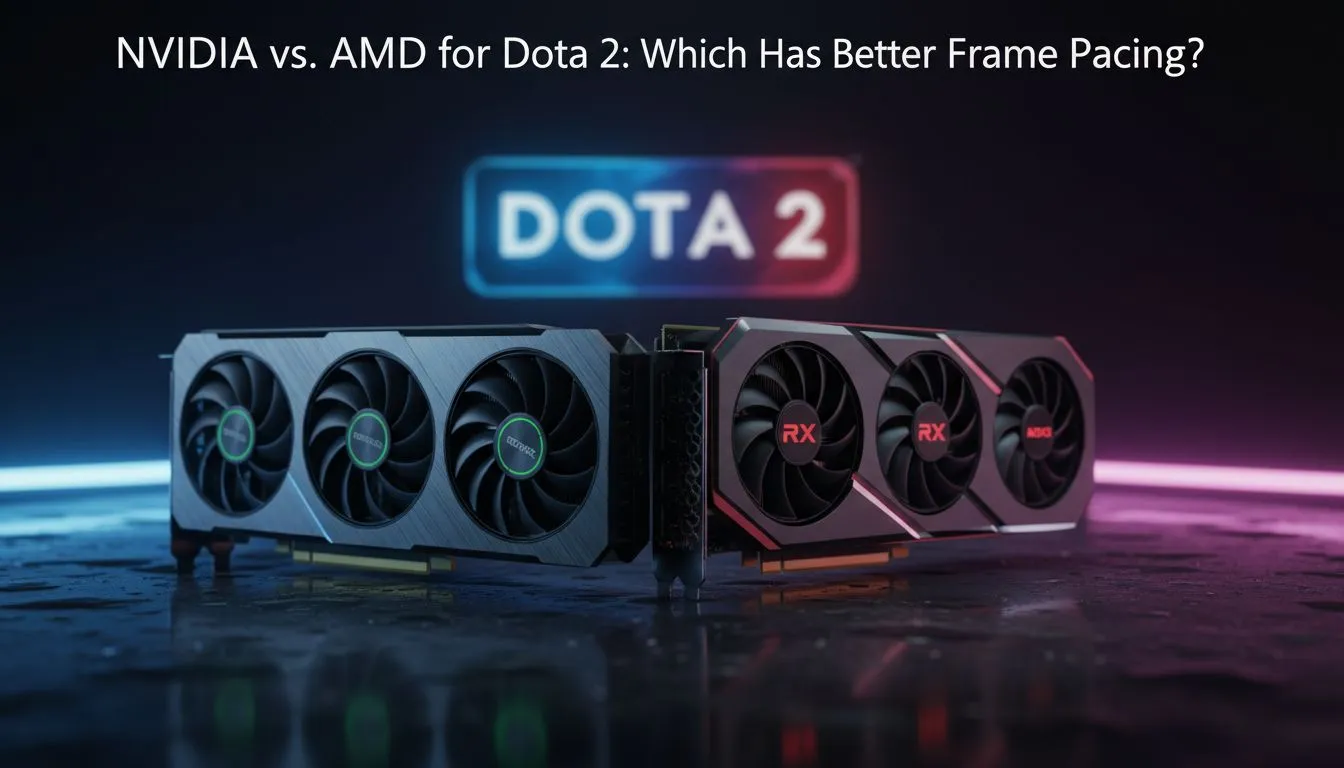
Analysing Dota 2 Frame Pacing: NVIDIA vs AMD Compared
NVIDIA has long touted its Reflex technology to reduce system latency, which works hand-in-hand with frame pacing. By synchronising the CPU and GPU, they minimise the "backlog" of frames. If you prefer a specific aesthetic and cooling profile, the range of MSI graphics cards offers excellent thermal headroom to maintain these steady frame times during long South African summer gaming sessions.
On the other side of the river, Team Red has made massive strides. AMD’s Radeon Anti-Lag and Anti-Lag+ features aim to provide a similar level of responsiveness. When you buy AMD Radeon graphics cards, you often get more VRAM for your ZAR, which can help in Dota 2 when using high-resolution texture packs or playing at 4K. AMD’s driver suite, Adrenalin, includes built-in frame pacing toggles that are incredibly user-friendly for those who want a "plug and play" experience.
Alternative Contenders and Professional Gear
While the big two dominate, the market is expanding. The arrival of Intel Arc graphics cards has introduced a third player that handles the Source 2 engine surprisingly well. Though their drivers are still maturing, the frame pacing in Dota 2 has reached a point where it is competitive for mid-range builds.
For those who use their rigs for more than just defending the Ancient, specialised workstation graphics cards might be on your radar. While designed for CAD and rendering, they offer incredible stability. However, for the best "bang for buck" in gaming, sticking to the consumer-grade GeForce or Radeon lines is usually the smarter move for your wallet.
Final Verdict for the Local Meta
In the battle of Dota 2 frame pacing: NVIDIA vs AMD compared, there is no longer a clear "loser." NVIDIA remains the king of low-latency consistency, while AMD offers incredible value and raw power. If you are playing on a 144Hz or 240Hz monitor, the most important factor is ensuring your GPU choice matches your monitor's adaptive sync technology... G-Sync or FreeSync... to eliminate tearing and maintain that buttery smooth pacing.
Ready to Find Your Perfect Match? The battle between NVIDIA and AMD is fierce, but for the best frame pacing and value in South Africa, Evetech has you covered. Explore our massive range of graphics card specials and find the perfect GPU to conquer the lanes and boost your MMR.