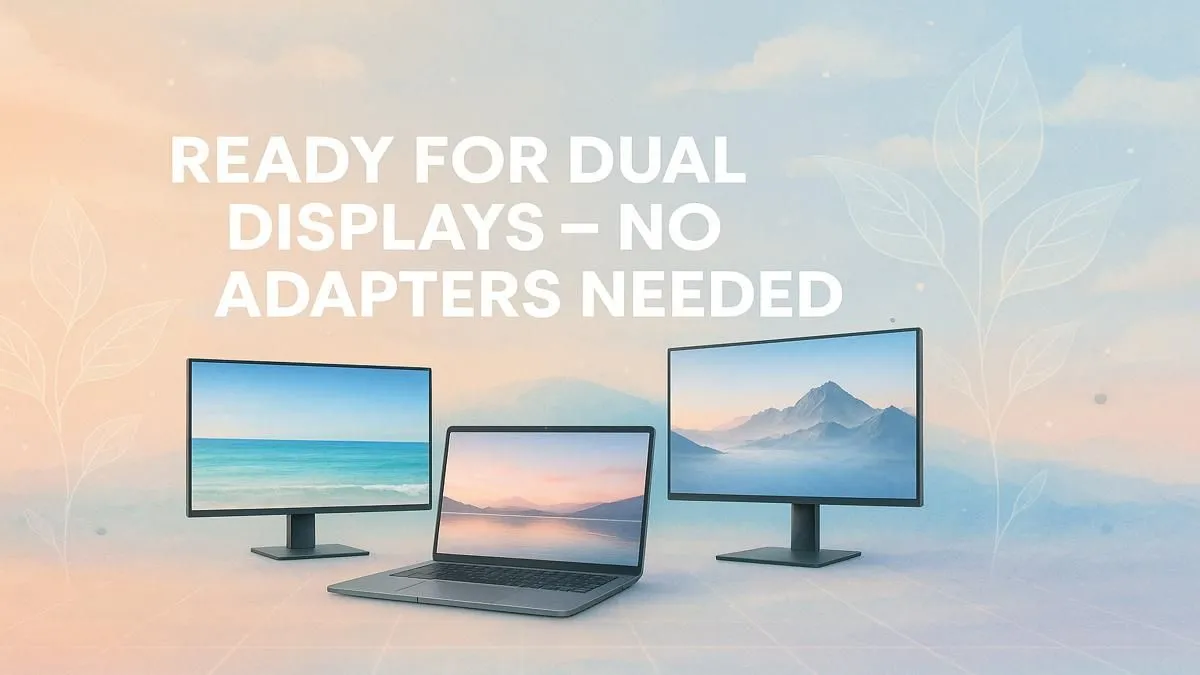
Tired of that tangled mess of adapters behind your desk? In South Africa, creating a dual monitor setup for gaming or work often feels like you need a degree in cable management. But what if you could connect two displays cleanly, without a single dongle? A clutter-free dual monitor setup without adapters is easier than you think. It's all about matching the right ports to create a seamless, high-performance workspace. Let's get your rig looking sleek and running smoothly. 🚀
Understanding Your Ports: The Key to an Adapter-Free Setup
Before you can connect two displays, you need to play detective with your PC's video outputs. The secret to an adapter-free life lies in the ports on the back of your graphics card or motherboard. Most modern PCs come equipped with a combination of these three:
- HDMI (High-Definition Multimedia Interface): The most common port. It’s great for most resolutions and refresh rates up to 4K at 60Hz.
- DisplayPort (DP): A favourite among gamers for its ability to handle higher refresh rates and resolutions. Essential for high-end gaming monitors.
- USB-C (with DisplayPort Alt Mode or Thunderbolt): This versatile port can carry video, data, and power over a single cable. Not all USB-C ports support video, so check your device's specs!
The goal is simple: have at least two video outputs on your PC that match the inputs on your monitors. Many modern Mini PCs, for example, pack multiple HDMI and DisplayPort outputs into a tiny chassis, making them perfect for clean, multi-monitor setups.
How to Connect Two Displays Without Adapters: Step-by-Step
Once you've identified your ports, achieving that dream dual-screen workspace is straightforward. This simple process is the most reliable way to create your dual monitor setup without adapters.
- Confirm PC Outputs: Take a look at the back of your PC. Do you see two HDMI ports? One HDMI and one DisplayPort? Make a note of what you have available.
- Check Monitor Inputs: Now, check the back of your monitors. Ideally, they will have inputs that match your PC's outputs (e.g., your PC has two DisplayPort outputs, and your monitors each have a DisplayPort input).
- Use the Right Cables: Grab two cables that match your ports. A DisplayPort-to-DisplayPort cable for one monitor, and an HDMI-to-HDMI for the other, for instance. Avoid mixing and matching if you can.
- Connect and Configure: Power down your devices. Plug one monitor into the first video port and the second monitor into the other. Power everything back on. Windows should automatically detect both displays.
- Final Tweaks: Right-click on your desktop, go to "Display settings," and arrange your monitors so your mouse moves between them logically. You can also set your primary display here. ✨
Quick Display Switch 🔧
Once connected, use the Windows shortcut Win + P to quickly cycle through display modes. You can choose to duplicate your screen, extend it (the one you want for a dual setup), or show on only one screen.
Daisy-Chaining: The DisplayPort Secret Weapon
For the ultimate clean setup, DisplayPort offers a clever trick called Multi-Stream Transport (MST), or "daisy-chaining." This lets you connect two displays (or more) to a single DisplayPort 1.2 (or newer) port on your PC.
Here’s how it works:
- Connect your PC's DisplayPort output to the "DisplayPort In" on your first monitor.
- Then, connect a second cable from the "DisplayPort Out" on the first monitor to the "DisplayPort In" on the second monitor.
This creates a chain, sending the video signal through the monitors themselves. It’s a fantastic way to minimise cable clutter, but requires monitors that specifically support "DP Out." Many powerful compact systems with modern DisplayPort outputs are perfect candidates for this kind of advanced setup.
Upgrade to a Multi-Monitor Powerhouse Ready for a streamlined multi-display experience? Powerful Minisforum models pack multiple native display outputs into a tiny footprint, helping you ditch the adapters for good.