Understanding PCIe Bandwidth Bottlenecks and Why They Matter
Are you maxing out your new graphics card but still noticing lag or stutter in your favourite games? The culprit might be a PCIe bandwidth bottleneck—a hidden drain on your card’s performance that can seriously hold back smooth gameplay or intense rendering tasks. If you want to unlock every frame-per-second and heat up your rig’s potential, understanding and fixing PCIe bandwidth bottlenecks is key. ⚡
PCI Express (PCIe) slots transfer data between your graphics card and the rest of your PC. If this link is clogged or underpowered, your graphics card can’t perform at its true level, no matter how beastly it looks on paper.
How PCIe Speeds Affect Graphics Card Performance
The version and number of PCIe lanes determine bandwidth size. Newer PCIe 4.0 or 5.0 slots double or even quadruple the data flow compared to older 3.0 or 2.0 standards. A graphics card running on a PCIe 3.0 x8 slot, for example, gets half the bandwidth it would on a PCIe 3.0 x16 slot—which can choke frame rates and texture loading in demanding games.
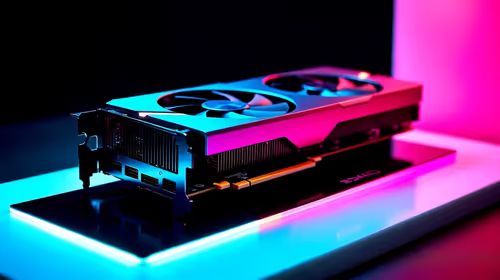
AMD’s Radeon Graphics Cards benefit greatly from higher PCIe bandwidth, especially with recent releases pushing data faster than ever before. Evetech stocks a strong range of Radeon Graphics Cards tailored for South African gamers chasing that smooth 144Hz or higher refresh rate.
Identifying Bottlenecks in Your Setup
Are you running your graphics card in a PCIe 3.0 or older motherboard slot? Upgrading to a motherboard that supports PCIe 4.0 or 5.0 can make a big difference. Also, check if your GPU is seated in the right slot for maximum lanes.
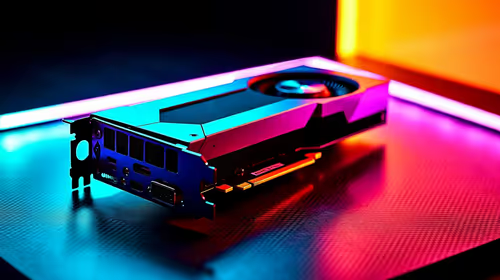
If you’re gaming on a budget, a midrange MSI graphics card paired with a solid PCIe 3.0 x16 slot can be a sweet spot for performance and value. Browse through high-quality MSI graphics cards at Evetech to pair with your current setup.
Quick PCIe Check Tip
Try running GPU-Z or a similar tool to verify PCIe version and lane usage. If your card isn’t using x16 lanes, reseat it or check motherboard settings to unlock full potential.
Practical Steps to Boost Your GPU’s PCIe Bandwidth
- Upgrade your motherboard: Choosing a motherboard that supports PCIe 4.0 or newer lets your graphics card access full bandwidth potential. South African PC builders often choose such boards for future-proofing.
- Use the primary PCIe slot: Most motherboards disable full lanes on secondary slots. Ensuring your graphics card occupies the primary x16 slot is essential.
- Update BIOS and chipset drivers: Manufacturers regularly release updates that optimise PCIe performance and fix lane allocation issues.
For those wanting to push their system further, the latest Nvidia GeForce Graphics Cards line-up combines high-bandwidth PCIe with powerful GPUs. You’ll find a great selection of GeForce Graphics Cards at Evetech – perfect for competitive gaming rigs.
Why Upgrading Your Graphics Card Isn’t Enough Alone
Sometimes, gamers upgrade to a new graphics card but don’t see the expected boost. The bottleneck might lie in the PCIe bandwidth, or even the total system design. Older motherboards and processors can hold back even the best cards.
Evetech’s comprehensive range of Nvidia and ATI graphics cards provides options at every tech tier. Pair them wisely with your motherboard and CPU for optimal PCIe throughput and gaming performance in South Africa’s demanding titles.
Summing It Up: Lightning-Fast GPU Data Transfer Takes Work
Fixing PCIe bandwidth bottlenecks is about more than just swapping parts. It means auditing your whole rig, tuning your BIOS, and selecting the right components for your budget and needs. Ultimately, it lets your graphics card truly shine under load, turning those demanding games into smooth, immersive experiences. 🔧
Maximise Your Gaming Performance Today Don’t let bottlenecks slow your rig — explore the best graphics cards and get the most from your build. Shop now at Evetech for performance that leaves lag in the dust.