Quick Answer
The Fractal Design Pop Air and Gamemax cases sit at different ends of the price and build-quality spectrum, but both target airflow-focused builds. For South African builders, the Pop Air offers premium mesh airflow with excellent build quality, while Gamemax delivers budget-friendly airflow solutions that punch above their price point in the SA market.
Choosing a case is one of the most consequential decisions in a PC build, and it is one that most buyers underestimate. Your case determines how much airflow your components receive, how difficult maintenance will be, how loud your system runs, and whether your build stays thermally stable through South Africa''s warm summers. This deep comparison covers the Fractal Design Pop Air and Gamemax''s airflow-focused lineup to help SA builders make an informed choice.
Fractal Design Pop Air: Premium Mesh Airflow
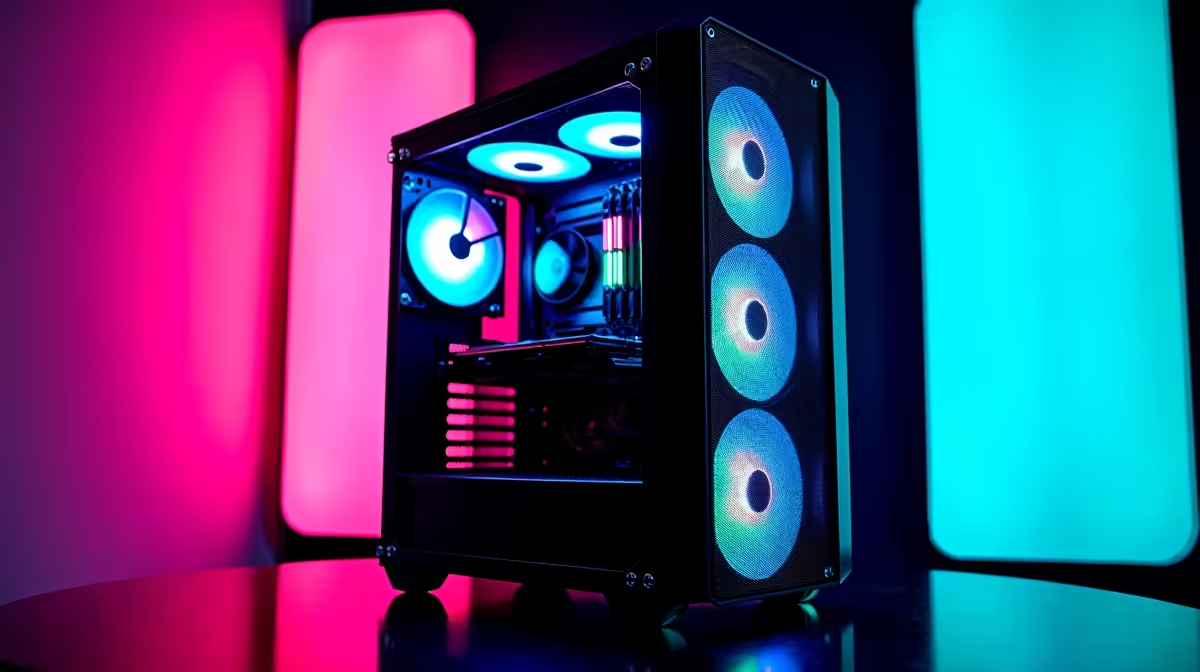
The Fractal Design Pop Air is built around a mesh front panel that provides near-unrestricted airflow into the chassis. Fractal ships the Pop Air with two 140mm front intake fans and one 120mm rear exhaust fan, which is a genuinely useful included fan configuration - many cases ship with fans that experienced builders immediately replace. The Pop Air''s fans are quiet enough to keep at their default speed in a bedroom build without becoming a distraction.
Build quality is a clear strength. The steel panels are thick, the tempered glass side panel is properly fitted, and the interior layout is thoughtful. Cable management channels behind the motherboard tray are generous, and the power supply shroud hides bottom-mounted PSU cables cleanly. For builders who want a chassis that feels premium when they open the side panel, the Pop Air delivers.
In South African conditions, the mesh front panel is particularly valuable. SA summer ambient temperatures mean you need to get as much cool air into the case as possible, and the Pop Air''s front mesh does not restrict that intake the way solid-panel cases with only small side vents do. The result is real-world CPU and GPU temperatures several degrees lower than equivalent sealed-front cases in warm room conditions.
Gamemax Airflow Cases: Budget-Focused Performance
Gamemax has built a following in the South African market by offering mesh-front cases at price points that undercut the established European brands. Their airflow-focused models feature tempered glass side panels, mesh front panels, and RGB lighting - the visual hallmarks that the gaming market expects - at prices that leave more budget for the components inside.
The trade-offs versus the Pop Air are real but manageable. Gamemax cases tend to use thinner steel, which means the panels flex more and the overall feel is less substantial. Included fans are typically lower quality and builders doing serious thermal optimisation will consider swapping them. Cable management options are usable but less refined than in the Fractal offering.
For a first build or a budget-focused system where every Rand counts, Gamemax cases represent strong value. The airflow performance of a mesh-front Gamemax is meaningfully better than an equivalent-priced solid-front case, which is the decision that actually matters for thermals.
Airflow Performance in SA Climate Conditions
Both cases benefit from the same airflow principles. A positive-pressure setup - more intake fans than exhaust fans - reduces dust accumulation by pushing air out through gaps rather than drawing dusty air in through them. SA''s inland regions, particularly Gauteng and the Free State, are dustier than coastal areas, making dust management a genuine consideration.
For both the Pop Air and Gamemax mesh cases, a front-intake-heavy configuration keeps temperatures controlled. Running two front intakes and one rear exhaust creates a straightforward front-to-back airflow path. If your build uses a top-mounted radiator or exhaust fans, ensure the front intake volume exceeds the top exhaust to avoid negative pressure pulling dust in from unfiltered gaps.
Filter maintenance differs between the two cases. The Pop Air''s front filter is easy to remove and clean - a quarterly rinse under a tap and air dry is sufficient. Gamemax filter designs vary by model, so check that your specific model''s filter is accessible without removing the front panel entirely.
Compatibility and Build Considerations
The Pop Air supports ATX, Micro-ATX, and Mini-ITX motherboards in its standard configuration, and accommodates GPU lengths up to 467mm with the drive cage removed. For high-end GPU cards that have grown in physical size, this clearance is adequate for all but the largest triple-fan flagship models.
Gamemax airflow cases vary more by model but generally support ATX and smaller form factors. GPU clearance is comparable in most of their mid-tower offerings. Verify your specific GPU length against the case specification before purchasing, as this is the compatibility check most often overlooked.
Radiator support is another consideration. If you plan to add liquid cooling later, the Pop Air supports up to a 360mm radiator in the front and a 240mm in the top, giving it flexibility for future upgrades. Gamemax support varies by model.
Frequently Asked Questions
Q: Is the Fractal Design Pop Air worth the premium over Gamemax for a gaming build in SA? A: If your budget allows, yes - the Pop Air''s superior build quality, better included fans, and more refined cable management reduce total ownership frustration. But a Gamemax mesh case will cool your components effectively and is a smart choice when component budget is the priority.
Q: Do mesh front panels make gaming PCs significantly louder? A: Mesh panels allow more fan noise to escape the chassis compared to solid fronts. The trade-off is lower temperatures. Running fans at lower RPM to achieve the same cooling performance as a sealed case often results in net-lower noise, so a mesh case used correctly is not inherently louder.
Q: How does load shedding affect case airflow decisions? A: During load shedding, rooms warm up as air conditioning goes offline. A case with strong airflow returns to safe temperatures faster once power is restored and fans spin up again. Poor airflow cases can take longer to shed the heat that builds up during outages if the PC is on a UPS and continues running.
Q: Which case is better for dust management in SA''s dry, dusty inland regions? A: Both benefit from front filters, but the Pop Air''s filter maintenance is more convenient. In very dusty environments, check and clean filters monthly rather than quarterly.
Ready to Find Your Perfect Match? Shop cases, cooling, and complete gaming PC builds at Evetech - built for the South African climate.