Quick Answer
A gaming case prioritises airflow, expansion space, and RGB aesthetics for high-performance builds with multiple components. A compact or mini-ITX case trades expansion slots and cooling headroom for a smaller footprint that is ideal for desk-constrained setups, student rooms, or lan party builds. In South Africa, your choice should be driven by your GPU size, CPU cooler height, and whether loadshedding practicality (portability) matters to you.
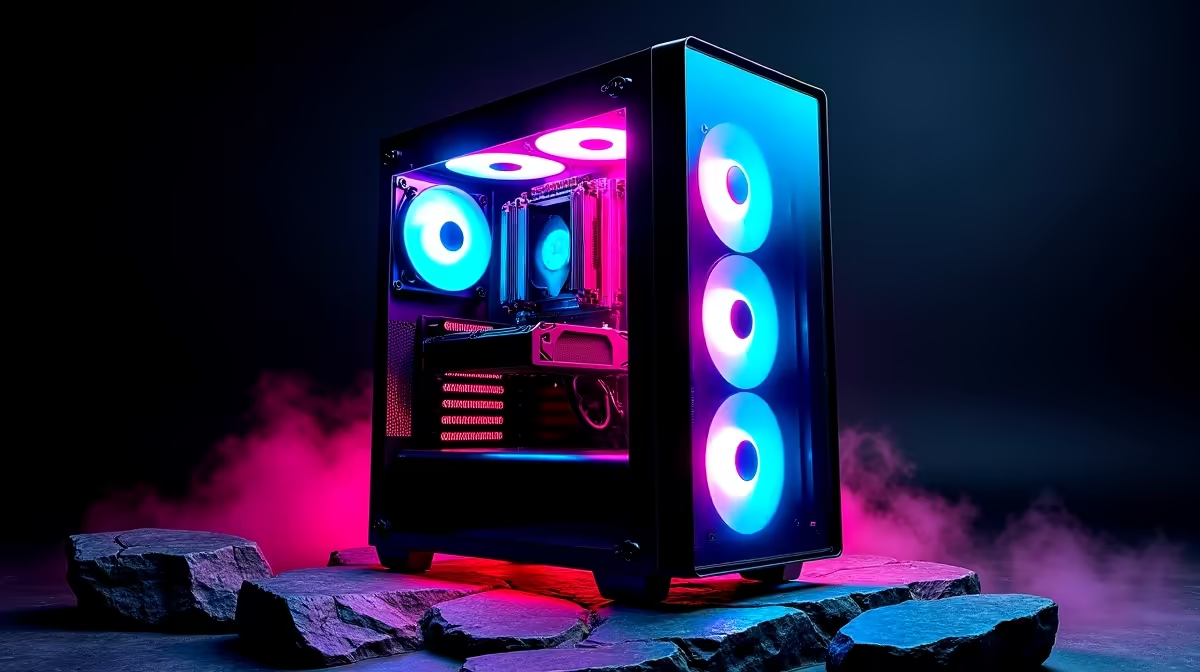
What Defines a Gaming Case vs a Compact Case? A gaming case typically refers to a mid-tower or full-tower ATX chassis with a 360mm or 420mm radiator mounting option, room for six or more fans, space for large AIB graphics cards (300mm or longer), and multiple drive bays. These cases are designed around maximum airflow, cable management, and the ability to house top-tier components without thermal compromise. Compact cases, usually Mini-ITX or Micro-ATX form factors, reduce internal volume to roughly one third to half the size of a mid-tower. The best compact cases in 2026, from brands like Fractal Design (the Terra, Node 304), Lian Li (the O11 Mini and A4-H2O), and Silverstone, achieve surprisingly good thermals through clever fan placement and direct airflow paths, but they demand more careful component selection and tighter build tolerances. In South Africa, both categories are available through local distributors, though compact cases with advanced ventilation designs are sometimes harder to find in stock and may carry a slight price premium over equivalent mid-towers. ## Thermal Performance and Airflow
This is the most significant practical difference. A full-size gaming case like the Fractal Design Meshify 2 or Lian Li Lancool III gives you room for three 120mm or 140mm intake fans at the front, a 120mm or 140mm exhaust at the rear, and up to a 360mm AIO radiator at the top. Temperatures for high-TDP components like the RTX 5080 or Core i9-14900K stay well-managed with this kind of airflow volume. Compact cases, especially Mini-ITX designs, concentrate heat in a smaller internal volume. A GPU running at 300W TDP in a small chassis needs either a blower-style card or precise fan placement to avoid heat soak. The best Mini-ITX cases in 2026 use a dual-chamber design that separates the GPU from the motherboard and PSU to manage this, but they are more expensive and require slim AIO options for CPU cooling. For SA builders who live in warmer climates (Limpopo, Northern Cape, Gauteng in summer), ambient temperature matters. A gaming mid-tower gives more margin in hot conditions. Compact cases can still be built to run cool, but component selection becomes critical. ## Expansion, GPU Size, and Build Flexibility
Modern gaming GPUs in 2026, especially triple-fan AIB models of the RTX 5070 Ti and RTX 5080, can reach 340mm or longer and three slots wide. Mid-tower gaming cases accommodate these easily. Many Mini-ITX cases have a GPU length limit of 320mm and strict slot constraints that rule out certain AIB models entirely. Always check the maximum GPU length in the spec sheet before choosing a compact case. Expansion slots are another consideration. A mid-tower ATX board gives you four or more PCIe slots for capture cards, sound cards, or network cards. A Mini-ITX board has one PCIe slot, full stop. For a focused gaming machine this is fine, but for a build that doubles as a content creation workstation with multiple capture or storage expansion cards, the ATX gaming case wins. ## SA Practicality: Portability, Desk Space, and Load Shedding
For South African students in res at UCT, Wits, or Stellenbosch, desk space in a single room is a genuine constraint. A compact case on a small desk or shelf is more practical than a full tower that dominates the workspace. Mini-ITX builds also pack into a backpack for lan events, which remains a popular part of SA gaming culture. Loadshedding is worth mentioning in the context of portability. A compact build that can be quickly moved to a generator, UPS, or a friend's location during an extended outage is a practical consideration. A 5kg Mini-ITX system is considerably easier to relocate than a 10kg full-tower. That said, for a primary desktop gaming setup where portability is not needed and cooling matters, a mid-tower gaming case is the more forgiving and future-proof choice. You can fit a bigger cooler, add more fans later, and drop in larger GPUs as you upgrade without rebuilding around a new chassis. ## Frequently Asked Questions
Can a compact Mini-ITX case handle an RTX 5080 in 2026? Some can, specifically cases like the Lian Li A4-H2O that are designed for full-length, high-TDP GPUs. But you must verify the GPU length limit and ensure the case supports adequate airflow. Check the specific AIB card dimensions against the case spec before buying. Are compact cases significantly more expensive than mid-towers in South Africa? Premium compact cases with strong thermal performance can cost R2,500 to R4,500, which overlaps with quality mid-towers. Budget compact cases below R1,500 typically compromise on airflow or build quality. The price difference is narrower than it used to be, but high-quality compact cases do carry a premium. Is Micro-ATX a good middle ground between gaming cases and Mini-ITX? Yes. A Micro-ATX case like the Fractal Design Pop Mini Air or Lian Li LANCOOL 207 gives you two to four PCIe slots, room for a 280mm AIO, and a smaller footprint than a full ATX mid-tower. This is often the best balance for SA builds where desk space is limited but component flexibility matters. Which case type runs quieter? Generally, mid-tower gaming cases run quieter because fans spin at lower RPM to achieve the same airflow through a larger volume. Compact cases push air through smaller, faster-spinning fans or restrict airflow choices, which can increase noise under load.
Ready to Find Your Perfect Match? Browse gaming cases and compact PC cases at Evetech and find the right chassis for your South African build.