Stuttering frames, a CPU hitting 100%, and your chat complaining about a laggy stream… sound familiar? For many South African gamers, this is the frustrating reality of trying to broadcast their gameplay. You’ve got the skills, but your PC is struggling to keep up. What if the secret to a buttery-smooth stream and higher in-game FPS was already hiding inside your graphics card? It’s time to talk about GPU encoding for streaming. 🚀
Unlocking Your Graphics Card's Secret Weapon
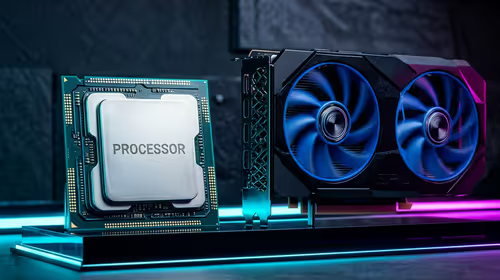
At its core, streaming involves compressing (encoding) your gameplay video in real-time and sending it to platforms like Twitch or YouTube. Traditionally, this heavy lifting was done by your computer's processor (CPU), a method known as x264 encoding. While effective, it puts immense strain on your CPU, forcing it to juggle both running the game and encoding the stream.
This is where GPU encoding for streaming comes in. Modern NVIDIA (NVENC) and AMD (AMF) graphics cards have dedicated hardware chips built specifically for this task. By switching your stream's encoder to your GPU, you offload that entire workload from your processor. The result? Your CPU is free to focus on what it does best: delivering maximum gaming performance.
Why GPU Encoding is a Must for Gamers
Think of it like this: your CPU is your PC's general manager, overseeing everything. Your GPU's encoder is a specialised expert hired just for video. Letting the expert handle the video task frees up the manager to run the main event… your game.
This simple switch can lead to:
- Higher, More Stable FPS: Less CPU usage means more resources for your game.
- A Smoother Stream: Eliminates encoding-related lag and dropped frames for your viewers.
- No Performance Compromise: Stream high-quality gameplay without tanking your own experience.
Ending CPU Bottlenecks for Good
Even with a beastly rig, a CPU bottleneck during a stream can cripple your performance. When your processor is maxed out trying to encode, your game's frame rate will suffer, leading to input lag and a choppy experience. Using your GPU for encoding is the single most effective way to solve this.
However, if you've enabled GPU encoding and still find your system struggling under the load of Discord, browser tabs, and the game itself, it might be a sign that your processor is due for an upgrade. A modern CPU provides a stronger foundation for your entire system, ensuring every component can perform at its peak. When you're ready to look, you can find a wide variety of CPU processors online to suit any budget.
For gamers who demand the highest single-core speeds for maximum frames, the latest generation of Intel CPUs are often the top choice. On the other hand, a powerful multi-core AMD CPU can offer incredible value, providing a fantastic balance for those who game, stream, and create content all on one machine.
OBS Quick-Start Guide ⚡
In OBS Studio, go to Settings > Output. Change Output Mode to Advanced. Under the Streaming tab, select your Encoder. Choose NVIDIA NVENC H.264 if you have a GeForce card, or AMD HW H.264 (AVC) for a Radeon card. Start with the Quality preset and a bitrate of 6000 Kbps for Twitch. This is the best starting point for a high-quality 1080p 60fps stream.
Making the Switch: It's Easier Than You Think
The best part about leveraging GPU encoding for streaming is that it's a completely free performance boost. You don't need new hardware (assuming you have a semi-modern GPU) or complex software. It's a simple setting change in your broadcasting software that takes less than a minute.
By making this small tweak, you're not just improving your own gaming experience; you're creating a more professional and enjoyable broadcast for your audience. No more apologies for lag or stutter. Just pure, smooth gameplay that lets your skills shine. ✨
Ready to Build Your Ultimate Streaming Rig?
A powerful GPU is key, but a balanced system is what truly delivers a flawless stream. From high-refresh-rate monitors to the latest CPUs, we've got the gear to take your content to the next level. Explore our massive range of PC components and build the machine your viewers deserve.