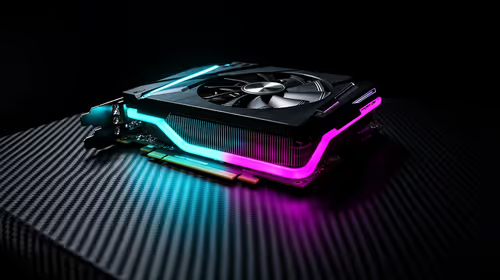
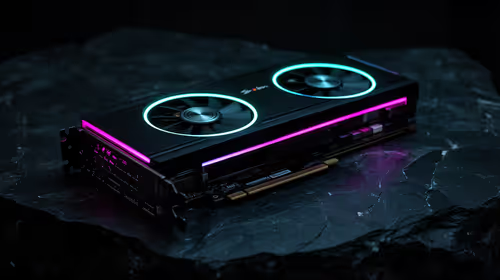
So, you’ve got a beast of a PC, but you’re hungry for more. More frames, smoother gameplay, and the bragging rights that come with pushing your hardware to its absolute limits. What if we told you there’s a way to unlock free performance hiding inside your graphics card? This GPU overclocking guide is your key to squeezing every last drop of power from your rig, turning good frame rates into great ones. Let's get started. 🚀
Understanding GPU Overclocking
Before we dive in, what are we actually doing? In simple terms, GPU overclocking is the process of telling your graphics card to run faster than its factory-set speed. We do this by carefully increasing two main values: the Core Clock (how fast the main processor on the card runs) and the Memory Clock (how fast the card's VRAM operates).
The reward? More frames per second (FPS) in your favourite games. The risk? If pushed too far without proper care, it can lead to instability, visual glitches (called artifacts), or even crashes. But don't worry, this guide focuses on safe GPU overclocking.
Your Pre-Flight Checklist for Safe Overclocking 🔧
Jumping straight into overclocking without preparation is a recipe for a blue screen. A few minutes of prep work will save you hours of frustration.
Cooling is King
Overclocking generates more heat. It's non-negotiable. Before you begin, ensure your PC case has good airflow. If your card is running hot at stock speeds, overclocking will only make it worse. A clean case, dust-free fans, and a well-ventilated room are your best friends.
The Right Software
You'll need a couple of tools. For monitoring and applying the overclock, MSI Afterburner is the gold standard for both NVIDIA and AMD cards. For stress testing, a reliable benchmarking tool like Unigine Heaven or 3DMark is essential to check for stability.
Benchmarking Basics
You can't measure improvement if you don't know where you started. Run a benchmark before you change any settings. Write down your score and average FPS. This is your baseline, the number you'll be trying to beat.
A Step-by-Step GPU Overclocking Guide
Ready to get your hands dirty? Let's begin the process. The key here is patience—small, incremental changes are the secret to a stable and successful overclock.
- Open Your Tools: Fire up MSI Afterburner and your chosen benchmarking software.
- Increase Power Limit: Max out the "Power Limit" and "Temp Limit" sliders in Afterburner. This gives your card the headroom it needs to draw more power and run cooler under load.
- Boost the Core Clock: Start by increasing the Core Clock by a small amount, say +25 MHz. Click apply.
- Stress Test: Run your benchmark for 10-15 minutes. Watch for any crashes, freezes, or weird visual artifacts on screen. If it's stable, great!
- Rinse and Repeat: Go back to step 3, increasing the Core Clock in small increments (+10 to +15 MHz) and stress testing after each change. Eventually, you'll hit a point of instability. When that happens, dial it back to your last stable setting.
- Tune the Memory Clock: Once you've found your max stable Core Clock, repeat the same process for the Memory Clock, using larger increments (e.g., +50 MHz).
Finding that perfect balance is part of the fun. While this process can breathe new life into an older card, sometimes the best performance boost comes from an upgrade. You can always check out the latest graphics card deals to see what's on offer.
The Silicon Lottery ✨
Remember that not all graphics cards are created equal, even if they're the same model. One RTX 4070 might overclock like a dream, while another might barely budge. This is known as the "silicon lottery." Your results will be unique to your specific card, so don't be discouraged if your numbers don't match a guide you saw online.
Overclocking NVIDIA and AMD: What's Different?
While MSI Afterburner is a universal tool, the core experience of overclocking differs slightly between Team Green and Team Red.
For those running one of the latest NVIDIA GeForce cards, the process is exactly as described above. It's a manual, iterative process of finding the limits of your specific GPU.
If you're rocking one of the powerful AMD Radeon GPUs, you have a choice. You can use Afterburner, or you can use the built-in tuning tools within the AMD Adrenalin software. Adrenalin often includes handy auto-overclocking features that can give you a safe, one-click performance boost, which is a great starting point for beginners. ⚡
Ready for a Real Power Boost?
Overclocking is a fantastic way to maximise your hardware, but sometimes you just need more horsepower. If your current card is struggling to keep up, it might be time for an upgrade. Explore our massive range of graphics card deals and find the perfect GPU to dominate the competition.