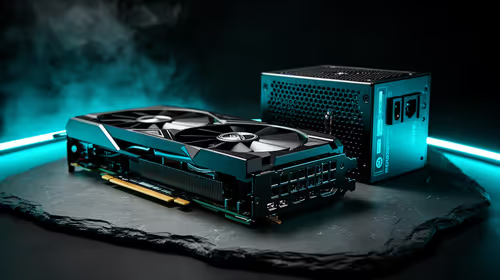
You’ve tweaked your settings, lowered the shadows, and you're still dipping below that sweet 60 FPS. We’ve all been there. With hardware prices in South Africa, buying a new GPU isn't always an option. So, the idea of free performance is tempting. This brings up the big question for local gamers: is GPU overclocking in South Africa a clever hack to boost your rig, or a surefire way to cook your expensive hardware?
Let's dive in.
Understanding GPU Overclocking
So, what are we actually talking about? Think of your graphics card like a car engine. From the factory, it’s tuned to a reliable, safe speed. GPU overclocking is the process of manually pushing your card’s core and memory clocks beyond those default settings. The goal is simple: make your graphics card work harder to render frames faster, giving you a tangible performance boost in games. It’s the digital equivalent of popping the hood and tuning the engine for more power. ⚡
The Promise: Why Gamers Risk It
The appeal of overclocking is undeniable, especially when you're trying to squeeze a bit more life out of an older card.
- More FPS for Mahala: The biggest draw is getting a 5-15% performance boost without spending a Rand. This can be the difference between a choppy experience and silky-smooth gameplay, especially in demanding titles.
- Maximising Your Investment: You paid good money for that GPU. Overclocking lets you unlock its full potential, ensuring you get every drop of performance you paid for. It's a popular hobby for owners of both high-end NVIDIA GeForce graphics cards and their powerful AMD counterparts.
- The Enthusiast's Thrill: For many PC builders, tinkering is half the fun. Successfully overclocking your GPU provides a massive sense of accomplishment. You’ve optimised your machine with your own hands. 🚀
The Reality: Overclocking Risks in South Africa’s Climate
Before you crank those sliders to the max, it’s crucial to understand the risks, which are amplified by our local conditions.
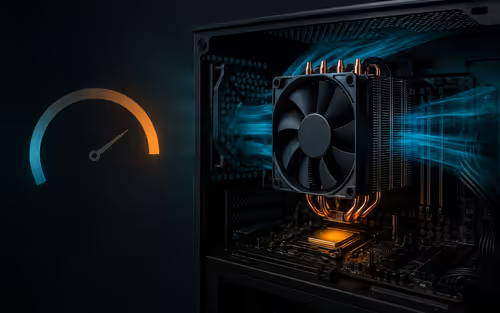
- Heat, Heat, and More Heat: Overclocking generates extra heat. In a country where summer days can easily push ambient room temperatures past 30°C, this is a major concern. Without proper cooling, you risk overheating your GPU, which can lead to thermal throttling (slower performance) or permanent damage.
- Instability & Crashes: An unstable overclock is a recipe for frustration. Picture this: you're in the final circle in Warzone, and your game suddenly crashes to the desktop. This instability can also lead to visual glitches called "artifacts."
- Reduced Lifespan: Pushing any component beyond its rated limits can shorten its lifespan. While a mild overclock is unlikely to kill your card overnight, an aggressive one could degrade the silicon over time.
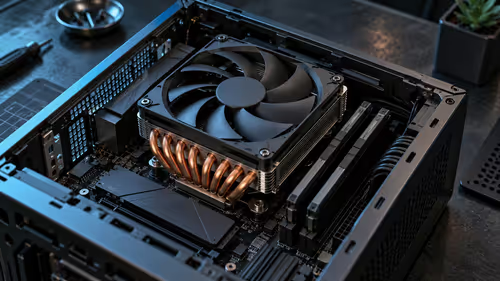
- The Warranty Void: This is the big one. If you push your card too far and it dies, your warranty is likely void. It's a gamble you need to be prepared to lose. That's why having the right graphics card accessories, like high-quality case fans and thermal paste, is non-negotiable.
Monitor Your Temps! 🌡️
Always use a tool like MSI Afterburner or HWInfo64 to watch your GPU temperature while testing. For most modern cards, anything consistently above 85°C under load is entering the danger zone. A good fan curve is your best friend.
A Quick-Start Guide to Safe Overclocking
If you've weighed the risks and still want to proceed, the key is to be patient and methodical. The process is similar whether you're using a mainstream AMD Radeon card or experimenting with one of the newer Intel ARC graphics cards on the market.
Step 1: Get Your Software
Download a reliable utility like MSI Afterburner. It works on almost any card and gives you control over the core clock, memory clock, and fan speed.
Step 2: Set a Baseline
Run a benchmarking tool (like Unigine Heaven or 3DMark) at stock settings. Record your score and monitor your max temperature. This is your starting point.
Step 3: Small, Incremental Bumps 🔧
Increase your core clock by a small amount, say +25MHz. Don't touch the voltage yet. Apply the settings.
Step 4: Stress Test, Repeat
Run the benchmark again for at least 15-20 minutes. If it completes without crashing or showing weird visual artifacts, congratulations! You can go back to Step 3 and add another +15-25MHz. If it crashes, restart, dial back to the last stable setting, and consider that your limit. Repeat the same process for your memory clock.
The Verdict: Is GPU Overclocking Worth It For You?
So, we return to the core question. The truth is... it depends.
GPU overclocking in South Africa can be a rewarding experience if you're a hardware enthusiast with a well-cooled PC who understands and accepts the risks. It’s a fantastic way to breathe new life into a slightly older card.
However, if you rely on your PC for work or competitive gaming where stability is everything, the risk might not be worth the reward. This is especially true for professional hardware like powerful workstation graphics cards, where reliability is far more valuable than a minor performance uplift. For most gamers, the potential for crashes and a voided warranty outweighs the benefit of a few extra frames. ✨
Ready for a Guaranteed Performance Boost? Tinkering is fun, but nothing beats the plug-and-play power and rock-solid stability of a brand-new GPU. Browse the best graphics card deals for performance that leaves lag in the dust.