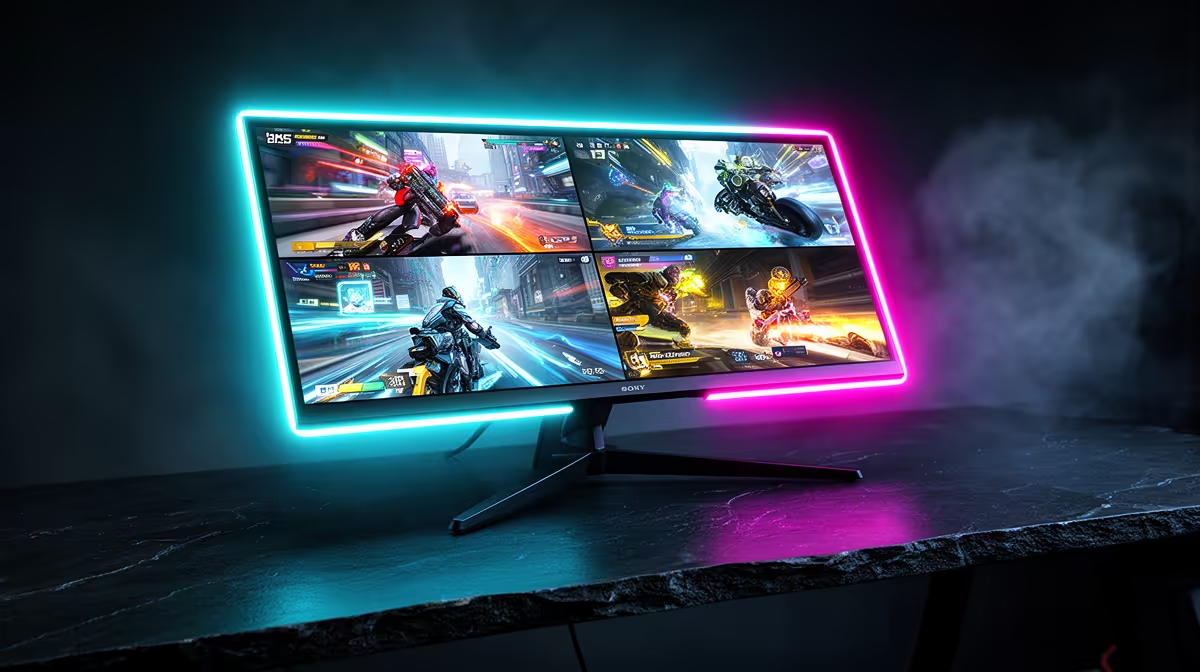
Staring at a choppy, stuttering screen during a clutch moment in Apex Legends or Warzone is beyond frustrating. It’s a guaranteed trip to the Gulag. This screen tearing is the exact problem adaptive sync technology was born to solve. For South African gamers, the big question is always the same: in the battle of G-Sync vs FreeSync performance, which one gives you the smoothest gameplay for your hard-earned Rand? Let's break it down.
What is Adaptive Sync and Why Does it Matter?
Before we dive into the G-Sync vs FreeSync performance debate, let's quickly cover the basics. Your graphics card (GPU) renders frames at a variable rate, while your monitor refreshes its image at a fixed rate (e.g., 144Hz). When these two are out of sync, you see a "tear" where the monitor displays parts of multiple frames at once. It's jarring.
Adaptive sync, also known as Variable Refresh Rate (VRR), fixes this by allowing the monitor to adjust its refresh rate in real-time to match the frame rate of your GPU. The result? Buttery-smooth visuals, no tearing, and reduced input lag. ✨
The Contenders: NVIDIA G-Sync Explained
NVIDIA's G-Sync is the OG of adaptive sync. The premium versions, "G-Sync" and "G-Sync Ultimate," use a dedicated hardware module built right into the monitor. This chip communicates directly with your NVIDIA GeForce GPU to ensure perfect synchronisation across the entire refresh rate range. This hardware approach guarantees a high standard of quality, but it also adds to the cost.
More common today are "G-Sync Compatible" monitors. These are actually FreeSync monitors that NVIDIA has tested and certified to deliver a solid baseline G-Sync experience. This gives gamers more choice across a range of PC monitors without the premium price tag.
The Open Standard: AMD FreeSync Explained
On the other side of the ring is AMD's FreeSync. Its biggest advantage is that it's an open standard built on top of the DisplayPort Adaptive-Sync protocol. This means monitor manufacturers don't need to pay licensing fees or install special hardware, making FreeSync monitors significantly more affordable and widely available.
To tackle the FreeSync vs G-Sync quality gap, AMD introduced tiers:
- FreeSync: The basic tier, preventing tearing.
- FreeSync Premium: Adds mandatory low framerate compensation (LFC) and at least a 120Hz refresh rate at FHD resolution.
- FreeSync Premium Pro: Includes everything from Premium, plus optimised HDR support.
You'll find FreeSync technology in a massive selection of all gaming monitors on the market today.
G-Sync vs FreeSync Performance: The Head-to-Head Breakdown
So, which technology offers better performance for South African gamers? The answer depends on your priorities: budget, GPU, and desired quality.
Visual Quality & Consistency
Years ago, G-Sync monitors with the dedicated module offered noticeably better performance, especially at low frame rates. The hardware provided superior variable overdrive, reducing ghosting and motion blur.
Today, the gap has closed dramatically. A top-tier FreeSync Premium Pro monitor delivers an experience that is virtually indistinguishable from a native G-Sync display for most users. The main variable is in the G-Sync Compatible space; while certified monitors work well, performance can differ between models.
The Cost Factor for SA Gamers 💰
This is where FreeSync lands a major blow. Because it's an open standard, FreeSync monitors are consistently cheaper than their native G-Sync counterparts. For gamers in South Africa looking for the best bang-for-buck, a high-quality FreeSync monitor is often the smartest financial move. You can often find incredible value if you scout for the best PC monitor deals available.
GPU Compatibility
This is simple:
- Have an AMD Radeon GPU? You need a FreeSync monitor.
- Have an NVIDIA GeForce GPU? You can use a G-Sync monitor or a G-Sync Compatible (FreeSync) monitor.
NVIDIA opening up its drivers to support FreeSync monitors was a huge win for gamers, giving Team Green users access to more affordable adaptive sync options.
Pro Tip: Verify G-Sync Compatibility 🔧
Not all FreeSync monitors are created equal when used with an NVIDIA card. Before buying, check trusted reviews from sites like RTINGS.com or Hardware Unboxed. They often do in-depth testing on a monitor's G-Sync Compatible performance, highlighting any issues like screen flickering or a limited VRR range. This little bit of homework can save you a big headache.
Making the Right Choice for Your Rig
Ultimately, the G-Sync vs FreeSync performance question comes down to your specific setup.
If you're an NVIDIA user who demands guaranteed, top-tier performance and has the budget, a native G-Sync monitor is a fantastic, hassle-free choice. The smooth motion is a dream, especially on immersive curved monitors that pull you into the game world.
For everyone else—including most NVIDIA users and all AMD users—a quality FreeSync Premium or Premium Pro monitor offers the best balance of price and performance. The experience is excellent, and the money you save can be put towards a better GPU or more storage. The performance difference on high-resolution 4K and 5K monitors is negligible for most eyes, making FreeSync a very compelling choice.
Beyond the Sync: Other Features to Consider
While adaptive sync is critical, don't forget other key monitor specs. Panel type (IPS for colour, VA for contrast), refresh rate (144Hz is the sweet spot), and response time all play a huge role in your gaming experience. This applies to all displays, from your main desktop screen to specialised displays like portable monitors for LAN parties or travel. 🚀
And remember, a great monitor deserves a great setup. Investing in quality monitor accessories like a VESA mount can improve ergonomics and give you the perfect viewing angle for those long gaming sessions.
Ready for Tear-Free Gaming?
The G-Sync vs FreeSync debate shows there's no single "best" choice, only what's best for your PC and your wallet. For most SA gamers, a high-quality FreeSync monitor delivers incredible value and buttery-smooth performance.
Explore our massive range of monitor deals and find the perfect screen to elevate your game.