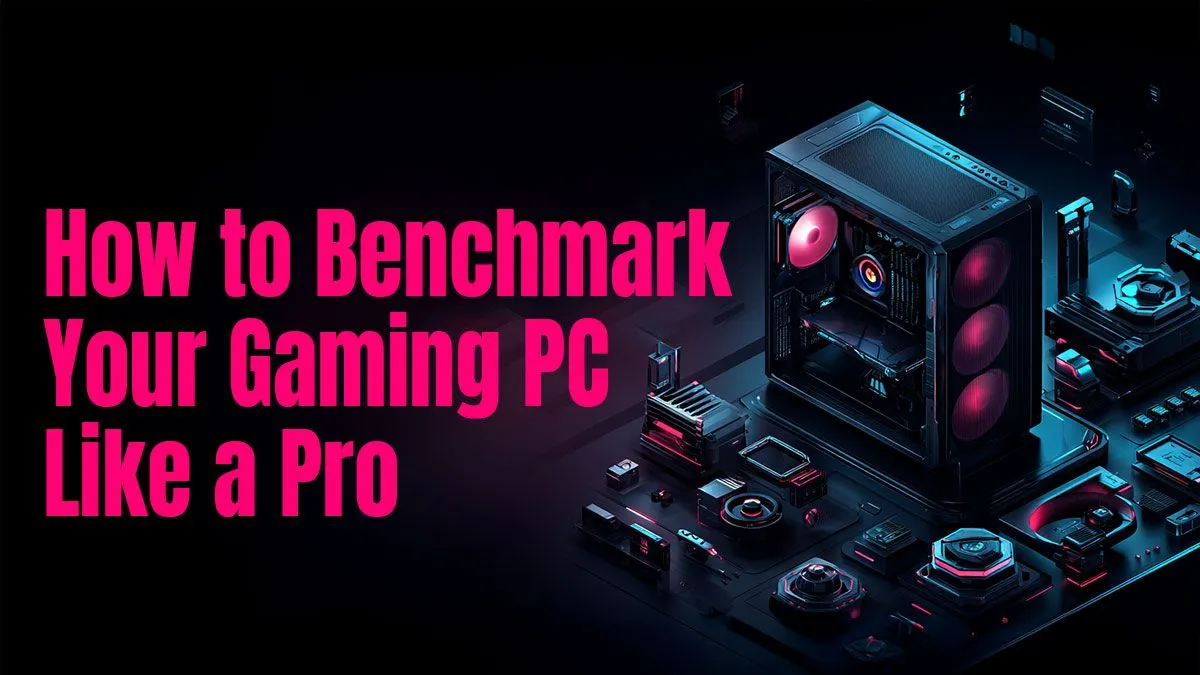
Is your gaming rig feeling a bit sluggish? Dropping frames in the middle of a tense firefight in Apex Legends or stuttering through the streets of Night City? You're not just imagining it. Knowing how to benchmark your gaming PC is the first step to diagnosing issues and unlocking its true potential. It’s like a report card for your hardware, showing you exactly where you’re excelling… and where you might need an upgrade. Let's get you started. 🚀
What is PC Benchmarking, Really?
Think of it as a standardised stress test. To benchmark your gaming PC means running specific software that pushes your components—like your graphics card (GPU) and processor (CPU)—to their absolute limits. It then spits out scores and data, like Frames Per Second (FPS), that you can compare against other systems. This process tells you two crucial things:
- Is your hardware performing as well as it should be?
- Where is your biggest performance bottleneck holding you back?
It's the only way to get objective, hard data on your machine's capabilities.
Getting Started: Your Pre-Benchmark Checklist 🔧
Before you start any test, you need to create a clean and stable environment. Running a benchmark on a cluttered system is like trying to run a race with your shoes untied—the results won't be accurate.
A quick checklist before you begin:
- Update Your Drivers: Ensure your GPU drivers (NVIDIA, AMD, or Intel) are up-to-date. This is the single most important step for accurate results.
- Close Background Apps: Shut down everything that isn't essential. That means your browser, Discord, Spotify… everything.
- Let it Settle: Give your PC a few minutes after a fresh boot to settle down before you run any tests.
Even if you're working with one of our budget-friendly gaming PCs, following these steps will ensure you get the most accurate picture of its performance.
Pro Tip: Consistency is Key ⚡
Always run your benchmarks under the same conditions. Test at the same room temperature and run each benchmark three times, then take the average score. This helps eliminate outliers and gives you a much more reliable performance baseline to work from.
The Best Free Tools to Benchmark Your PC
You don't need to spend a fortune to get solid data. The pros use a mix of synthetic and real-world tests, and many of the best tools are free.
For Your GPU
Your graphics card is the heart of your gaming experience.
- Unigine Superposition: A fantastic and visually impressive tool that heavily stresses your GPU. It gives you a simple score you can use for comparisons.
- In-Game Benchmarks: Many modern games like Cyberpunk 2077, Forza Horizon 5, and Shadow of the Tomb Raider have excellent built-in benchmark modes. This is the best way to see how your PC will actually perform in the games you play.
Getting great results from these tools is the goal for any rig, including the excellent great value PCs under R20k that offer incredible bang for your buck.
For Your CPU
Your processor handles everything from game logic to AI.
- Cinebench R23: This is the industry standard for testing raw CPU performance, especially for multi-core processing power which is vital for modern gaming and streaming.
Understanding the Numbers: What Do Your Scores Mean? ✨
Okay, so you have a bunch of numbers. Now what? The most important metric for gamers is Frames Per Second (FPS). A higher FPS means smoother gameplay. You also want to look at the "1% lows," which represent the worst-case stutters you'll experience. High average FPS with low "1% lows" is the dream.
Once you have your scores, Google them! Search for "RTX 4070 Super Unigine Superposition 1080p Extreme score" to see if your hardware is hitting the mark. If your scores are significantly lower than average, you might have a cooling or software issue. If they're right where they should be but you still want more power, it might be time to look at an upgrade to one of the high-end rigs over R20k for that top-tier performance.
Your Benchmark Results are in… Now What?
Benchmarking your gaming PC gives you clarity.
- Low GPU Score? Your graphics card is likely your bottleneck. This is the most common scenario for gamers.
- Low CPU Score? Your processor might be holding back a powerful GPU, especially in strategy or simulation games.
- Everything looks good? Awesome! Your PC is a well-balanced machine.
If your results confirm that your rig is getting a bit long in the tooth, you have options. You could upgrade individual parts or simplify the process entirely by exploring some powerful pre-built PC deals that are optimised and ready to go. For a complete system refresh, you can always check out Evetech's best gaming PC deals for the latest and greatest in performance.
Ready to Unleash Peak Performance? Now that you know how to benchmark your PC, you have the power to identify your weakest link. Whether it’s a new GPU, a faster CPU, or more RAM, taking the next step is easy. Browse our massive range of PC components and give your rig the upgrade it deserves.