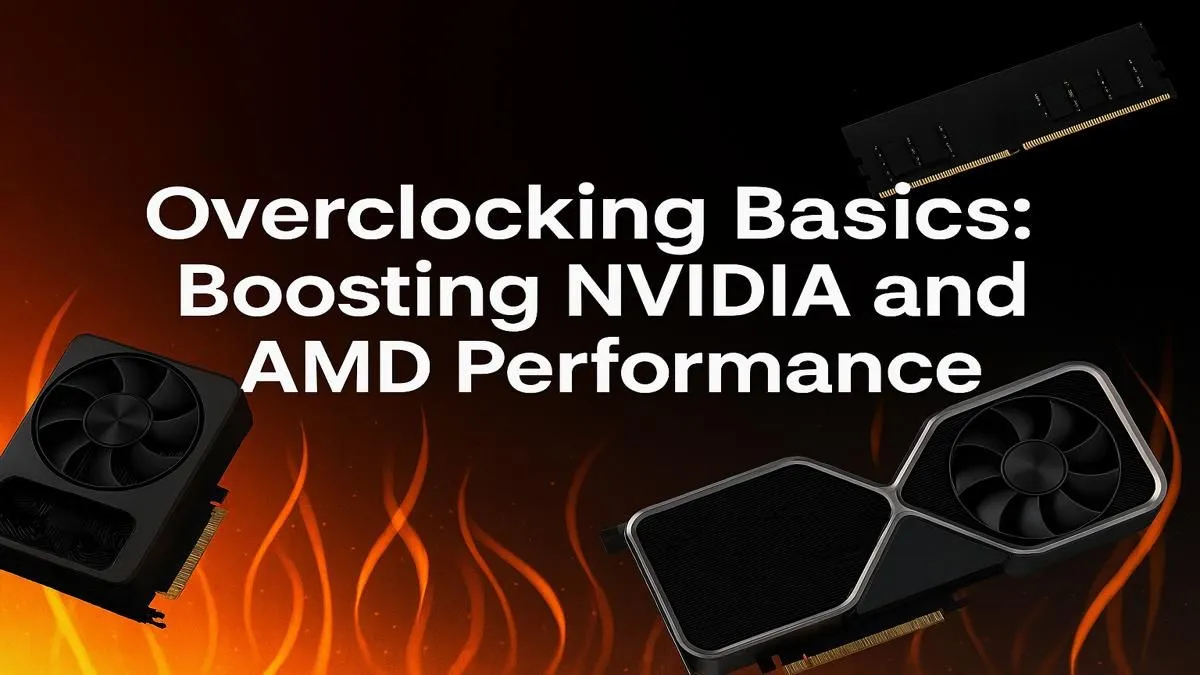
Staring at your FPS counter, wishing for a few extra frames in Apex Legends or Warzone? What if you could unlock free performance from the graphics card you already own? Learning how to overclock your GPU is one of the best ways for South African PC gamers to get more bang for their buck. It sounds intimidating, but with the right tools and a careful approach, you can safely boost your gaming experience without spending a Rand. Let's get started. 🚀
Understanding GPU Overclocking: More Power, No Extra Cost
So, what exactly is GPU overclocking? In simple terms, it’s the process of pushing your graphics card to run faster than its official factory settings. Manufacturers often leave a little performance headroom in their cards for stability across millions of units. By carefully tapping into this reserve, you can gain a noticeable boost in frame rates and overall smoothness in your games.
Is it safe? Absolutely, if you do it correctly. Modern GPUs have built-in safety features to prevent them from overheating or drawing too much power. The worst-case scenario from a clumsy overclock is usually a system crash or visual glitches, both of which are easily reversible by resetting to default settings.
Your Essential Overclocking Toolkit 🔧
Before you begin this performance-tuning journey, you’ll need two key pieces of free software.
- MSI Afterburner: This is the gold standard for GPU overclocking. Don't let the name fool you; it works perfectly with both NVIDIA and AMD cards from any brand (not just MSI). It gives you precise control over your GPU's core clock, memory clock, voltage, and fan speed.
- A Benchmarking Tool: You need a way to test your overclock for stability and measure performance gains. Unigine Heaven or 3DMark's Time Spy are excellent choices. They put a consistent, heavy load on your GPU, making it easy to spot instability that might not show up immediately in-game.
How to Overclock Your GPU: A Step-by-Step Guide
Ready to squeeze out some extra frames? Follow these steps carefully. The key is to make small, incremental changes and test thoroughly at every stage.
Step 1: Establish Your Baseline
Before you change a single setting, run your chosen benchmark. Write down your score, average FPS, and the maximum temperature your GPU reaches. This is your starting point—everything you do from now on will be measured against it.
Step 2: Increase Power & Temperature Limits
In MSI Afterburner, you’ll see sliders for "Power Limit" and "Temp Limit." Max these out. This doesn’t automatically overclock the card; it simply gives it the headroom to draw more power and run slightly warmer if needed, preventing these limits from throttling your overclock later on.
Step 3: Find Your Core Clock Sweet Spot
This is where the real magic happens. Start by increasing the "Core Clock" slider by a small amount, say +25 MHz. Click "Apply." Now, run your benchmark again. If it completes without crashing or showing weird visual glitches (known as "artifacts"), you’re good to go. Repeat the process: add another +15-25 MHz, apply, and test again.
Eventually, you’ll hit a point where the benchmark crashes or you see artifacts. When that happens, dial back the Core Clock by 10-15 MHz to a previously stable value. This is likely your card's stable limit.
Step 4: Tune Your Memory Clock
Once you have a stable core overclock, it's time to do the same for the "Memory Clock." Using the same incremental process, add +50 MHz at a time, apply, and run your benchmark. Memory instability often shows up as strange textures or flashing pixels. Once you find the limit, back it off slightly for long-term stability.
Step 5: Stress Test and Save ✨
With both your core and memory clocks dialled in, run your benchmark for at least 30 minutes, or better yet, play a demanding game for an hour. If it’s completely stable, congratulations! Click the "Save" icon in MSI Afterburner and save your settings to a profile so you can easily apply them every time you start your PC. Whether you're pushing an older card or a brand new beast, you can often find some incredible value among the latest graphics card deals.
Overclocking an NVIDIA vs. AMD GPU: What's Different?
While MSI Afterburner is the universal tool, both Team Green and Team Red offer their own unique approaches.
For owners of the latest NVIDIA GeForce graphics cards, the process is streamlined thanks to the "OC Scanner" feature in Afterburner. It's an automated tool that finds a modest, stable overclock for you with a single click. It's a great starting point if you're nervous about manual tuning.
Meanwhile, those on Team Red with a powerful AMD Radeon card can use the excellent performance tuning utility built directly into the AMD Software: Adrenalin Edition driver suite. It offers auto-overclocking presets and manual controls similar to Afterburner, giving you a choice of tools.
Cooling Pro Tip ⚡
Don't just rely on the default fan settings! In MSI Afterburner's settings, head to the 'Fan' tab and enable 'user defined software automatic fan control'. You can create a custom curve that ramps up your GPU fans more aggressively as temperatures rise. A steeper curve can keep your card cooler under load, allowing for a higher, more stable overclock.
The Final Step: Cooling and Long-Term Stability
Remember, overclocking generates more heat. The performance you can achieve is directly linked to how well you can cool your GPU. A custom fan curve is a great start, but ensuring your PC case has good overall airflow is just as crucial. A stable, moderate overclock that you can run 24/7 is always better than an ambitious one that crashes your game during a critical moment. Happy gaming!
Ready for a Real Power Boost? Overclocking breathes new life into your rig, but for the ultimate upgrade, nothing beats a new GPU. Explore our massive range of graphics card deals and find the perfect hardware to dominate your favourite games.