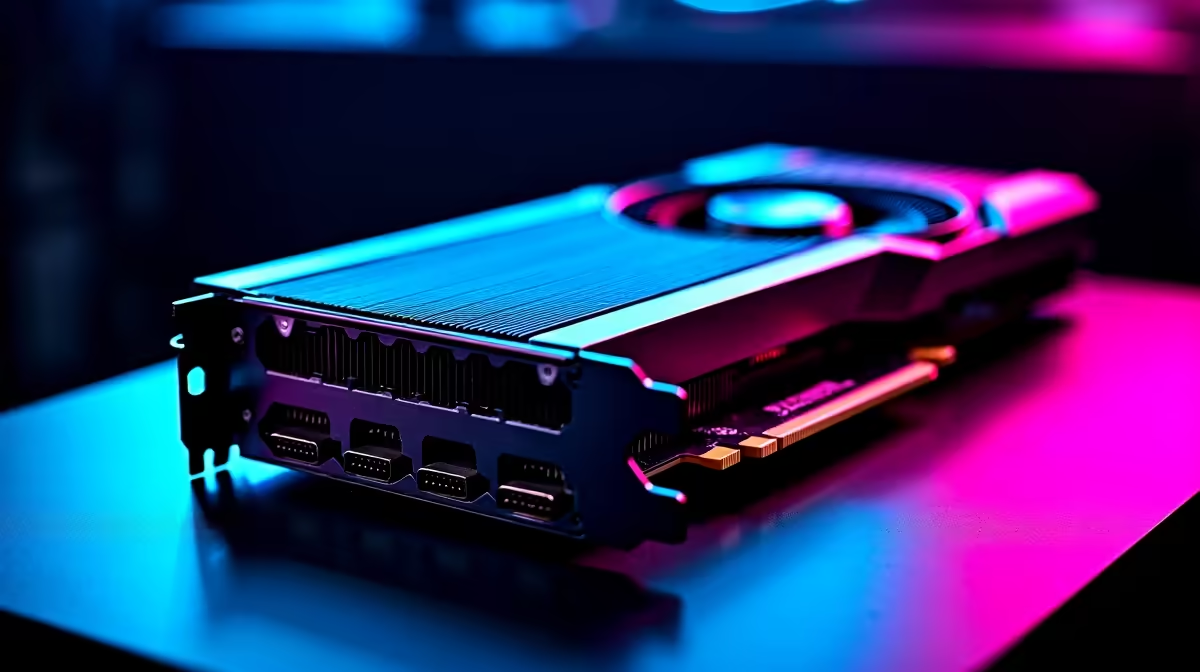
The Intel Arc B580 is one of the most talked-about mid-range GPUs of 2025, and one recurring question is whether running it on an older PCIe Gen 3 motherboard versus a Gen 4 platform meaningfully affects performance. The answer is more nuanced than a simple yes or no.
Quick Answer
Does PCIe Gen 3 vs Gen 4 matter for the Intel Arc B580? At 1080p and 1440p gaming, the performance difference between PCIe Gen 3 x16 and Gen 4 x16 is minimal - typically 1–3%. The gap widens slightly in VRAM-intensive workloads and at very high resolutions, but for most gaming use cases, an older Gen 3 board does not meaningfully bottleneck the B580.
🔧 Understanding PCIe Bandwidth and the B580
The Intel Arc B580 is an Xe2 (Battlemage) architecture GPU with 12 GB GDDR6 VRAM on a 192-bit memory bus. It connects via PCIe x16, which provides the following theoretical bandwidth:
| Interface | Theoretical Bandwidth (x16) |
|---|---|
| PCIe 3.0 x16 | 15.75 GB/s |
| PCIe 4.0 x16 | 31.5 GB/s |
| PCIe 5.0 x16 | 63.0 GB/s |
At first glance, the 2x bandwidth difference between Gen 3 and Gen 4 looks significant. In practice, however, GPU-to-system communication (command buffers, texture streaming, frame buffer readback) rarely approaches the bandwidth ceiling at gaming resolutions. The GPU's internal bandwidth between its compute units and VRAM is orders of magnitude higher and unaffected by PCIe generation.
Benchmark data consistently shows the Arc B580 performing within 2–4% between PCIe 3.0 and 4.0 x16 configurations in rasterisation gaming workloads. This margin falls within normal run-to-run benchmark variance, meaning the practical difference is negligible.
📊 When PCIe Generation Actually Matters
There are specific scenarios where PCIe bandwidth becomes relevant for the B580:
High-resolution texture streaming - at 4K with Ultra texture settings, the GPU occasionally needs to stream assets from system RAM when VRAM is full. Gen 4 handles this more gracefully, though the B580's 12 GB VRAM reduces how often this occurs at typical gaming resolutions.
Compute workloads - AI inference, video transcoding, and other tasks that move large data sets between CPU and GPU see more meaningful PCIe generation differences. If you use the B580 for creative or compute workloads alongside gaming, Gen 4 provides a measurable advantage.
PCIe x8 and x4 configurations - if your older board runs the GPU slot at x8 or x4 (common on older HEDT or value platforms), the bandwidth reduction is more significant. Running a B580 at PCIe 3.0 x8 (7.87 GB/s) starts to show tangible impact in bandwidth-sensitive scenarios. Always verify your board runs its primary GPU slot at x16.
💡 Should You Upgrade Your Platform for the B580?
For SA builders on older Z370, Z390, or X470 motherboards with PCIe 3.0, there is no compelling reason to upgrade the platform solely to get PCIe 4.0 for the B580. The 2–3% performance gain does not justify a motherboard and potentially CPU replacement cost.
However, if your platform is genuinely aging (pre-2018 CPU, DDR3 or DDR4 at 2133 MHz, no NVMe support), the platform as a whole may be bottlenecking your system in ways unrelated to PCIe generation. In that case, a broader platform upgrade makes sense and PCIe 4.0 support is a beneficial side effect.
For SA gamers building new in 2026, choose a PCIe 4.0 or 5.0 platform not because the B580 strictly requires it, but because it is the sensible baseline for a build that will remain relevant for the next 3–4 years.
❓ Frequently Asked Questions
Does Intel Arc B580 use PCIe 4.0 or 5.0? The Arc B580 uses a PCIe 4.0 x16 interface. It is physically compatible with PCIe 5.0 and 3.0 slots (all PCIe generations are backward compatible), but its native specification is 4.0.
Will running the B580 at PCIe 3.0 x8 cause noticeable frame drops? In most gaming scenarios, no. Occasional micro-stutter may occur in VRAM-heavy situations where the GPU needs to stream from system memory, but regular 1080p and 1440p gaming at standard settings is not significantly affected by x8 vs x16 bandwidth.
Is the Arc B580 a good buy for older platform SA users in 2026? Yes - the B580's price-to-performance ratio makes it an excellent mid-range option regardless of PCIe generation, provided the rest of your system (CPU, RAM) is not severely bottlenecking it. The PCIe generation concern is one of the least significant factors in the purchase decision.
Evetech stocks Intel Arc B580 Gaming PCs and All Graphics Cards — shop online with fast delivery across South Africa.
Ready to Find Your Perfect Match? Shop at Evetech