You're in the final minute of your EA FC 24 match. It's a dead heat. You spot an opening, thread a perfect through-ball... and then it happens. A split-second freeze. Your player stutters, the opponent's defender intercepts, and just like that, the chance is gone. 😩 Sound familiar? In South Africa, we often blame our internet connection, but the real culprit behind your gaming woes might be more nuanced. Let's dive into what internet speed for gaming really means.
The Holy Trinity of Online Gaming: Ping, Bandwidth & Jitter
When we talk about a "fast" internet connection, most people think of download speed. But for online gaming, especially fast-paced sports titles, that's only one part of the story. The quality of your internet speed for gaming actually hinges on three key factors.
Ping (Latency): The Real MVP
If you only pay attention to one metric, make it this one. Ping, or latency, is the time it takes for data to travel from your PC to the game server and back. It's measured in milliseconds (ms). A lower ping is always better.
- Excellent: Below 20ms
- Good: 20ms - 50ms
- Playable: 50ms - 100ms
- Lag City: 100ms+
Think of it like a conversation. A low ping is a snappy, real-time chat. A high ping is like talking to someone on a satellite phone with that awkward delay. In a game, that delay means your actions—passing, shooting, or tackling—are registered later than your opponent's.
Bandwidth (Download/Upload Speed)
This is the number your ISP advertises—how much data your connection can handle per second, measured in Megabits per second (Mbps). While important for downloading massive game updates for titles like Call of Duty: Warzone 2.0, online gaming itself uses surprisingly little data. A stable 10-25 Mbps connection is often more than enough for a smooth gameplay experience.
Jitter & Packet Loss
These are the silent killers of a stable connection. Jitter is the variation in your ping over time. If your ping jumps wildly from 30ms to 150ms and back, that's high jitter, causing inconsistent lag spikes. Packet loss is when data packets get lost in transit between you and the server, resulting in stuttering or your character teleporting across the screen.
How Your Internet Connection Affects Sports Titles ⚽
In sports games, timing is everything. A high ping can turn a perfectly timed tackle into a red card. It can make your Formula 1 car feel sluggish and unresponsive around tight corners. The required internet speed for gaming isn't about raw Mbps; it's about a low-latency, stable connection that ensures your inputs are registered instantly.
This principle extends to all reaction-based games. Whether you're landing a headshot in Counter-Strike 2 or deploying a perfectly timed ability in Overwatch 2, low latency gives you a significant competitive edge. Even in vast open worlds like GTA V, a stable connection is key for a smooth online experience with other players.
Pro Gamer Tip ⚡
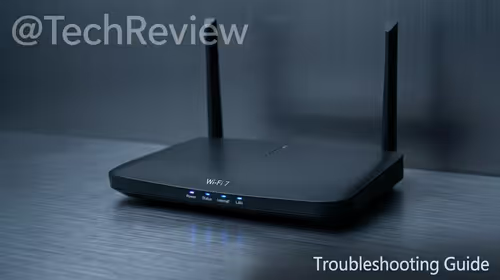
For the most stable gaming connection, always choose a wired Ethernet cable over Wi-Fi. Wi-Fi is susceptible to interference from other devices, walls, and even your microwave. A direct cable to your router drastically reduces latency and eliminates packet loss, giving you the most reliable internet for gaming.
Is Your PC the Real Bottleneck?
So, you've got a fantastic fibre line with a 20ms ping, but you're still getting stutters and frame drops. What gives? Your internet can be perfect, but if your PC can't keep up, you'll still ha ve a poor experience.
Your PC needs to render every single frame of the game. If your frame rate (FPS) drops below your monitor's refresh rate, it will feel like lag, even with a perfect connection. This is common in graphically intense games that demand a powerful CPU and GPU.
For example, soaring over a photorealistic Johannesburg in Microsoft Flight Simulator or exploring the dense, neon-lit streets of Night City in Cyberpunk 2077 requires immense processing power. Similarly, dropping into a 100-player lobby in Fortnite or PUBG puts a heavy load on your system. Even a heavily modded Minecraft world can bring a mid-range PC to its knees.
Ultimately, a great gaming experience is a partnership: a stable, low-latency internet connection and a powerful gaming rig that can consistently deliver high frame rates. One without the other is a recipe for frustration.
Ready to Eliminate the Lag? A fast internet connection is only half the battle. To truly dominate the competition, you need a rig that can keep up. Explore our wide range of custom-built Gaming PCs and find the perfect machine to achieve victory.