Quick Answer
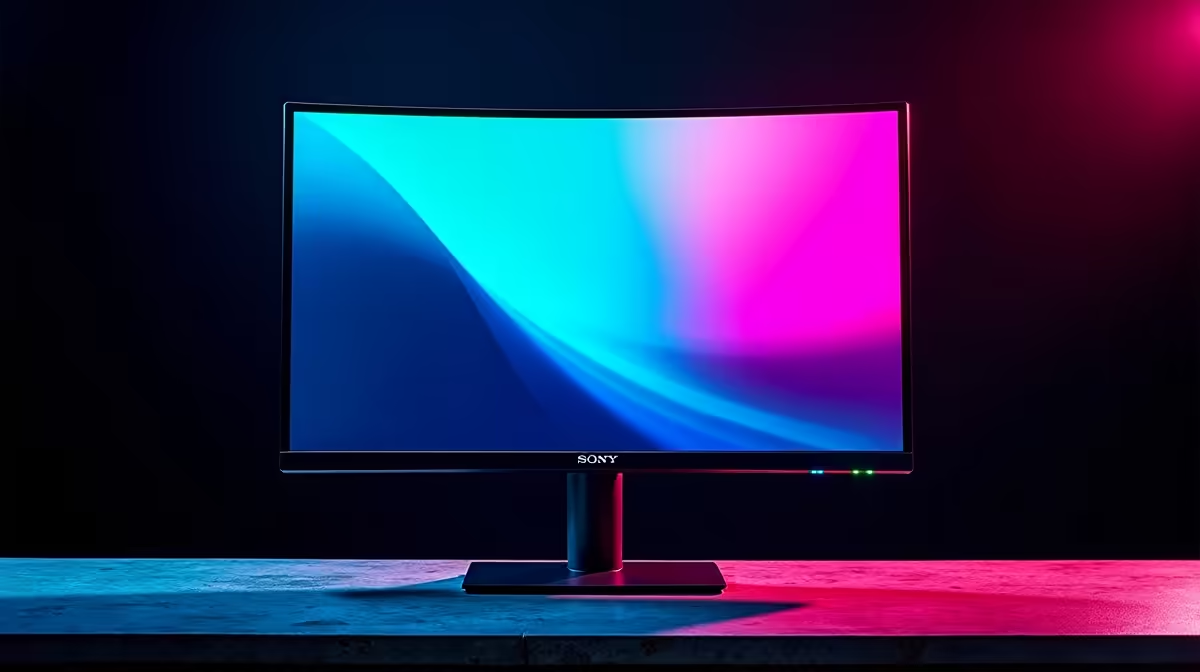
A 1040Hz monitor refreshes the screen over 1,000 times per second, which sounds extraordinary but delivers diminishing perceptual returns for most users. At that refresh rate, the scientific gains over 500Hz or even 360Hz are marginal for the vast majority of gamers, though professional esports players in specific scenarios may notice differences. For South African gamers, the price-to-performance case for 1040Hz is difficult to justify against 240Hz or 360Hz options.
The Physics of Ultra-High Refresh Rates
Every time a monitor refreshes, it draws a new frame from your GPU. At 60Hz that happens 60 times per second. At 1040Hz it happens over 1,000 times per second, reducing the time between frames to under one millisecond.
The key benefit is reduced motion blur and lower system latency. When you move your mouse, fewer milliseconds pass before the result appears on screen. In theory, this should improve aim and reaction time in fast-paced titles like CS2 or Valorant.
The problem is human perception. Most research suggests the human visual system has limited ability to distinguish frame intervals below about 10ms - which corresponds to around 100Hz. Above that threshold, the improvements are real but increasingly subtle. The jump from 60Hz to 144Hz is dramatic and immediately visible. From 360Hz to 1040Hz, you are working in territory where controlled studies struggle to find measurable competitive benefit for the general population.
Where 1040Hz Might Actually Matter
For professional esports players competing at the highest level, every marginal advantage matters. If a tournament is won by reaction-time differences of single milliseconds, ultra-high refresh rates become relevant. But this applies to a small fraction of the gaming population.
The other use case is testing and research. Display technology labs and esports performance researchers use 1040Hz and higher panels to study human perception and input latency with scientific precision. For that purpose, the investment is justified.
The Hardware Requirement Problem
Running a monitor at 1040Hz requires your GPU to render frames at 1040fps or higher. In a game like CS2 with reduced settings, top-tier hardware can approach this. In any graphically demanding title, it is impossible. This means 1040Hz monitors are only useful if your entire PC is built specifically around frame-rate maximisation with visual quality dialled down.
For South African gamers, that means an extremely expensive GPU combined with a premium monitor at a price point that is difficult to justify for standard gaming use.
What Refresh Rate Actually Makes Sense
144Hz is where the experience becomes noticeably smoother than 60Hz. 240Hz delivers a clean step up for competitive play. 360Hz is the current competitive esports standard that most professionals use. Beyond that, you are spending significantly more for gains that require optimal conditions, specific hardware, and exceptional vision to perceive.
For most SA gamers investing in a monitor upgrade, the performance-to-rand ratio peaks somewhere between 165Hz and 360Hz depending on your GPU and the games you play.
Frequently Asked Questions
Can the human eye actually see 1040Hz?
Not directly. The human visual system does not perceive discrete frames at that speed. What changes is motion clarity and system latency, which can feel smoother even if you cannot consciously count frames. The perceptual gains above 500Hz are very small for most people.
Do I need a special GPU for a 1040Hz monitor?
Yes. Your GPU needs to render frames at or near 1040fps to use the full refresh rate. This requires top-of-the-range hardware and low-quality game settings. In most games, you will not hit that frame count regardless of your GPU.
Is a 360Hz monitor enough for competitive CS2?
For the overwhelming majority of competitive players, yes. Professional CS2 teams predominantly use 240Hz to 360Hz displays and the performance difference above that threshold is not consistently measurable in match outcomes.
Ready to Find Your Perfect Match? Find the right monitor refresh rate for your gaming setup. Shop PC Monitors at Evetech