Quick Answer
For most users, upgrading from a 1TB SSD to an external hard drive is not a straightforward improvement - it is a different kind of storage with lower speed but higher capacity, best suited for backups and media archives rather than replacing your fast internal drive.
Understanding the Speed Difference Between SSD and External HDD
Before deciding whether an external hard drive is worth adding to your setup, it helps to understand what you are actually comparing. A 1TB internal SSD - whether SATA or NVMe - operates at speeds that are orders of magnitude faster than a conventional external hard drive. A SATA SSD reads at around 500MB/s and writes at similar speeds. An NVMe SSD pushes read speeds to 3,500MB/s or beyond. A typical 2.5-inch USB 3.0 external hard drive, on the other hand, reads at 80-130MB/s due to the spinning platter mechanism, regardless of the USB interface speed.
This means that moving your operating system, games, or frequently used applications to an external HDD would result in dramatically slower load times, longer boot durations, and a generally sluggish experience. Windows boot times from an external HDD can take two to three minutes compared to under 20 seconds from a modern NVMe SSD. Game load times in titles like Call of Duty or FIFA can double or triple. For tasks that require repeated small-file access - like running software or loading a browser with many tabs - the latency difference between a hard drive and an SSD is felt immediately.
This does not mean external hard drives lack value. It means their value lies in a different role than your primary SSD. The question should not be whether to replace your SSD with an external HDD, but whether to add an external HDD alongside your existing SSD.
Where External Hard Drives Make Sense in South Africa
External HDDs remain highly relevant in South Africa despite the SSD market maturing significantly. The primary use case is bulk storage at a price per gigabyte that SSDs cannot match. A 4TB or 8TB external hard drive can be purchased for a fraction of the cost of equivalent SSD storage. For South African users who need to store large photo and video libraries, game archives, project backups, or downloaded content, an external HDD offers expansive capacity that would cost several times more in SSD form.
Backup is arguably the strongest argument for adding an external hard drive. With load shedding stressing home office setups and power surges posing a real risk to internal hardware, having a disconnected external drive with a full system backup creates a meaningful safety net. Tools like Windows Backup or Macrium Reflect can run scheduled backups to an external drive, giving you restore points if your internal SSD is ever corrupted or damaged by a power event.
For students and professionals in Johannesburg, Cape Town, and Durban who deal with large project files - architects working with BIM models, videographers managing raw footage, researchers handling large datasets - an external HDD provides the cheap capacity needed to archive completed projects without filling a smaller, faster internal SSD. A typical workflow involves working on active files from the internal SSD, then archiving the completed work to the external drive.
NVMe External SSDs as an Alternative Worth Considering
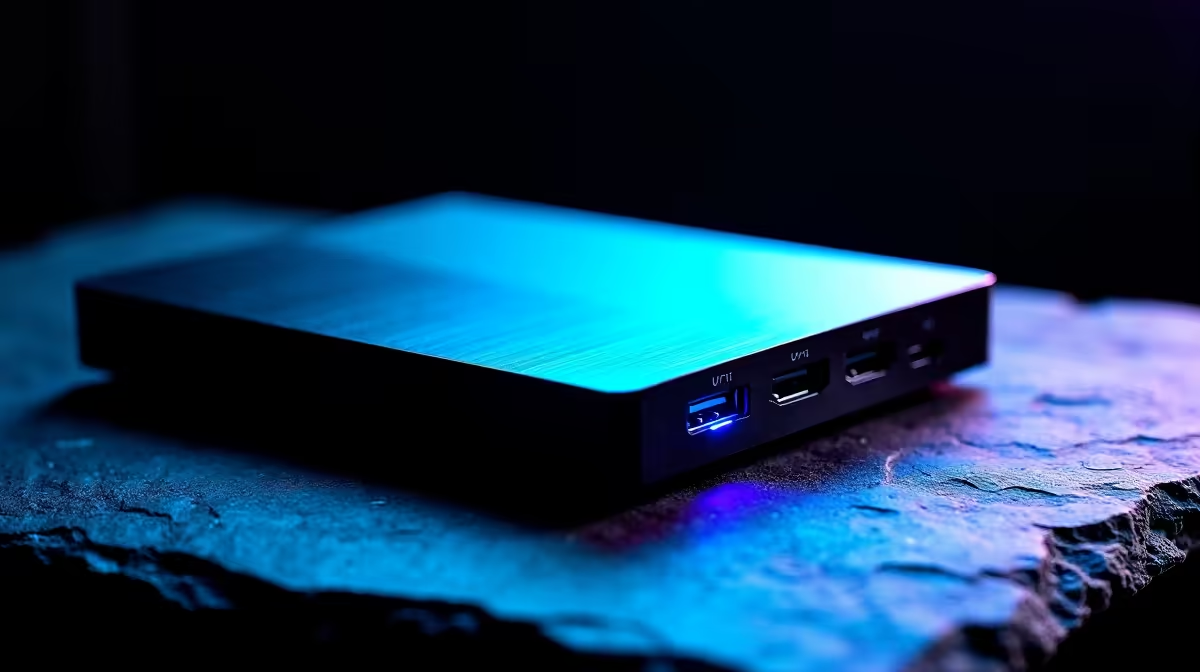
If raw external drive speed matters for your workflow - if you regularly work with files directly from an external drive rather than copying them to your internal SSD first - then an NVMe external SSD enclosure with a quality drive inside is worth considering instead of a conventional HDD. USB 3.2 Gen 2x2 and Thunderbolt 3/4 interfaces can sustain 700MB/s to over 2,500MB/s from an external NVMe drive, bridging the gap between internal SSD performance and external convenience.
In 2026, compact external NVMe SSDs with 1-2TB capacities have become reasonably accessible in the South African market. These are ideal for gaming laptop users who want to extend storage without sacrificing speed, or for content creators who need to work directly from portable storage. The cost per gigabyte is higher than a spinning HDD, but the performance argument is significantly stronger for active workloads.
For South African users deciding between an external HDD and an external NVMe SSD, the decision usually comes down to intended use. Large backup and archive needs, where speed is not critical - choose the HDD for its cost efficiency. Active working storage where files are accessed and edited directly - choose the external NVMe SSD for performance that does not bottleneck your workflow.
Practical Recommendations for SA Users
The most practical setup for most South African PC users in 2026 is a tiered storage strategy: a fast internal SSD (NVMe ideally) as the primary drive for the OS, applications, and active games, supplemented by an external hard drive for backups, archives, and bulk storage. This approach does not require you to choose one or the other - it uses each storage type where it performs best.
If you currently have a 1TB internal SSD that is running low on space, the solution is rarely to downgrade to an external HDD as a replacement. Instead, consider upgrading to a 2TB internal NVMe SSD for the speed-sensitive content, and adding an affordable external HDD for the files that do not need fast access. This two-drive setup costs less in total than a single large high-performance SSD but delivers the right performance profile for each workload.
South African pricing in 2026 makes this strategy viable. Entry-level 2TB external HDDs are available at prices that make them accessible for most budgets, while 2TB NVMe SSD prices have fallen considerably from their peaks. Building a storage strategy around both rather than treating them as interchangeable options is the approach that serves most users best.
Frequently Asked Questions
Q: Can I run games from an external hard drive?
A: Technically yes, but it is not recommended. Games stored on an external HDD will have significantly longer load times and may experience stuttering during asset streaming. For gaming, always use a fast internal SSD. An external HDD can store archived games that you reinstall when you want to play them.
Q: Is it safe to leave an external hard drive connected during load shedding?
A: It is safer to disconnect external hard drives before power goes out or when a loadshedding stage is active. Hard drives are susceptible to head crashes if power is cut while they are reading or writing. Disconnecting the drive or using a UPS with safe shutdown software protects against this risk.
Q: How long does a typical external HDD last?
A: External hard drives have an average lifespan of three to five years with regular use, though many last longer. SSDs are generally more durable for portable use because they have no moving parts. For important data, always maintain at least two copies - one on the external drive and one in cloud storage or another physical location.
Q: What is the difference between a 2.5-inch and 3.5-inch external hard drive?
A: 2.5-inch external drives are compact and bus-powered via USB, making them portable and convenient. 3.5-inch drives require a separate power adapter but offer much larger capacities and lower cost per gigabyte. For desktop backup use, a 3.5-inch drive is usually better value; for portability, a 2.5-inch or external SSD is preferable.
Also at Evetech: All SSDs | Graphics Card Deals
Ready to Find Your Perfect Match? Shop at Evetech