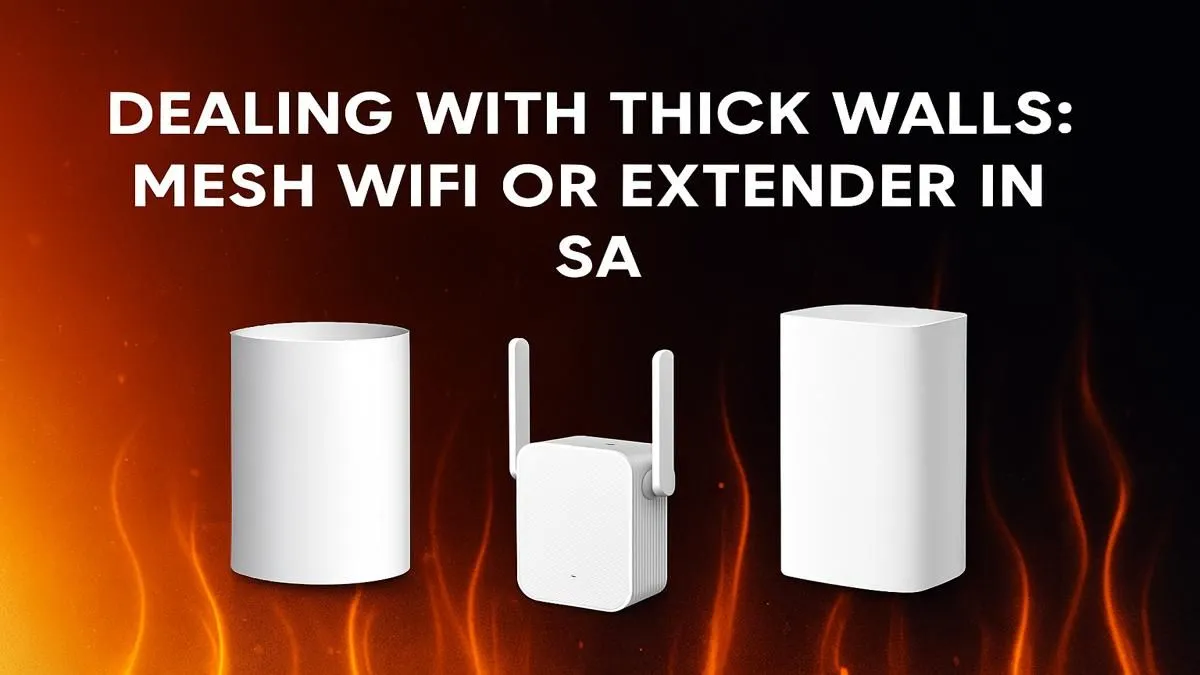
Is your WiFi signal weaker than a stage 4 outage schedule? You’re not alone. In South Africa, our solid, double-brick homes are brilliant for staying cool but terrible for WiFi. That dead spot in the braai room or home office is a classic problem. You’ve probably heard two solutions tossed around: a simple extender or a fancy mesh system. This guide settles the Mesh WiFi vs Extender South Africa debate, especially for homes with signal-blocking walls.
Understanding the WiFi Extender: The Quick Fix
Think of a WiFi extender as a simple signal booster. It captures the wireless signal from your main router and rebroadcasts it, extending its reach. It's like someone standing halfway down a passage and shouting what they hear from the other end.
It’s a straightforward and often budget-friendly solution. For a small flat or a single problematic room that’s not too far from the router, a WiFi range extender can be just the ticket. 🔧
The Catch with Extenders
However, this method has drawbacks. Firstly, it usually creates a new network name (SSID), so you have to manually switch between your main network and the extender's network as you move around. More importantly, an extender typically halves the available bandwidth because it has to receive and transmit data on the same channel. When you place it far from the router to cover a dead zone, the signal it's "extending" is already weak, leading to a slow, unstable connection.
Enter Mesh WiFi: The Smart Solution
A mesh WiFi system is a completely different beast. Instead of one device trying to shout louder, a mesh system uses a team of "nodes" that work together intelligently. You replace your existing router with a primary mesh node and then place other nodes around your home. They all talk to each other, creating a single, seamless, and powerful WiFi network that covers your entire property. ✨
This is the modern answer to the mesh vs extender question for larger or more complex homes. The system automatically routes your device's connection through the best possible path, ensuring you always have the strongest signal without any drop-offs or network switching. It’s a unified solution built from the ground up, often starting with one of these powerful wireless routers as its core.
Placement Pro Tip 💡
Don't hide your mesh nodes in cupboards or behind the TV! For the best performance, place them in open areas, about halfway between the main router and the dead zone. The nodes need to "see" each other clearly to create a strong network backbone. Use a WiFi analyser app on your phone to find the sweet spot.
The Verdict: Which is Best for Thick Walls in South Africa?
When thick walls are the enemy, the battle of Mesh WiFi vs Extender has a clear winner.
Mesh WiFi is significantly better for homes with thick walls.
Why? Because mesh nodes are designed to communicate with each other, creating multiple pathways for data to travel. If the signal between your office and the living room is blocked by a thick brick wall, the mesh system can intelligently reroute the signal via a third node in the hallway, bypassing the obstruction. An extender, on the other hand, just tries to brute-force a weak signal through the wall, resulting in poor performance.
For a reliable connection that blankets your entire property, exploring complete wireless networking solutions is the best long-term investment.
Quick Comparison: Mesh vs. Extender
- Performance: Mesh wins. It maintains high speeds throughout the house, while an extender degrades the signal.
- Coverage: Mesh wins. It eliminates dead spots with intelligent, overlapping coverage.
- Ease of Use: Mesh wins. One network name, seamless roaming, and simple app-based management.
- Cost: Extender wins. It's the cheaper upfront option, but you get what you pay for.
What About Other Networking Fixes?
Sometimes, the problem isn't just about range; it's about the device you're using. An older laptop or PC might have an outdated WiFi card that can't take full advantage of your router's speed. In some cases, upgrading with a wireless adapter can provide a surprising performance boost for a single machine without overhauling your entire network. 🚀
Ultimately, for conquering those stubborn walls and ensuring every corner of your South African home has fast, reliable internet, a mesh system is the undisputed champion.
Ready to Banish WiFi Dead Spots for Good?
Stop battling with buffering and dropped connections. A modern networking solution is the key to unlocking seamless streaming, gaming, and working from home. Explore our massive range of wireless networking gear and find the perfect fix for your home today.