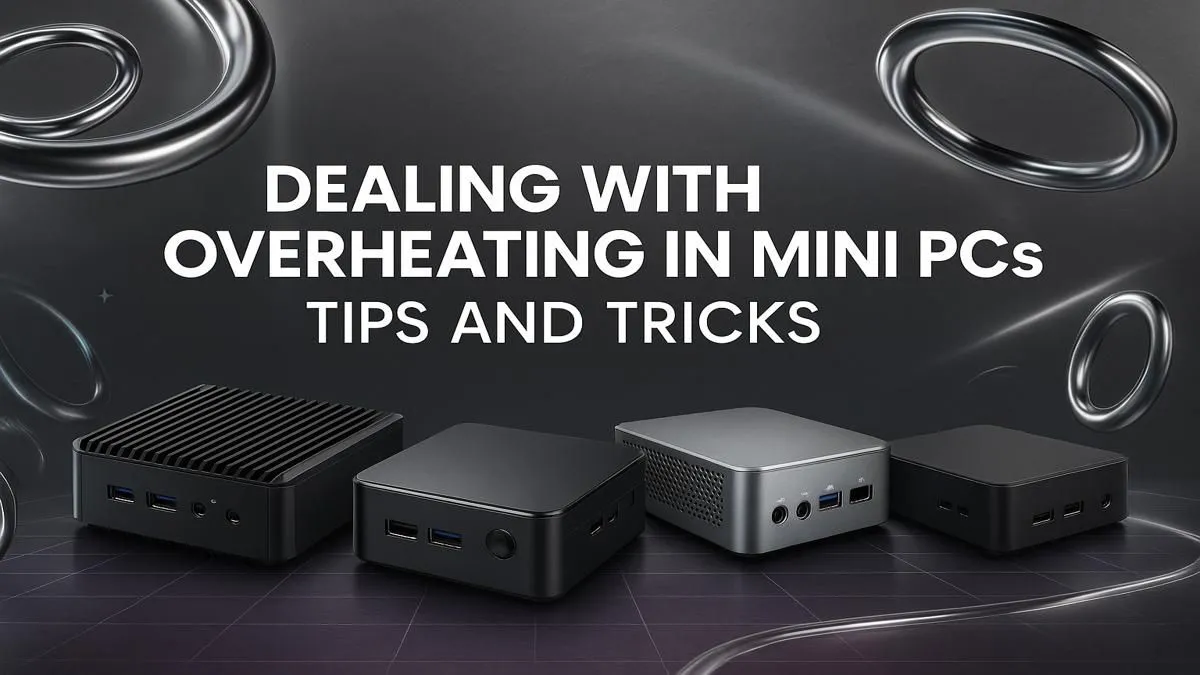
Is your tiny powerhouse turning into a tiny furnace? That sleek mini PC, perfect for your desk setup, is suddenly getting loud and hot during a work deadline or a gaming session. Don't stress. A mini PC overheating is a common issue, especially in the South African heat, but the fixes are often surprisingly simple. Before you start worrying about serious damage, let's walk through some easy tips to get your compact rig running cool and quiet again. 🚀
Understanding Why Your Mini PC is Overheating
Mini PCs are engineering marvels, packing serious performance into a small chassis. But that compact size is a double-edged sword. With components crammed so close together, there's less room for air to circulate compared to a traditional desktop tower.
Heat is the natural enemy of performance. When your CPU or GPU gets too hot, it engages a safety feature called "thermal throttling"—intentionally slowing itself down to prevent damage. This is why you might see sudden frame drops in games or sluggishness in apps. The good news is that most cases of a mini PC running hot can be solved without needing a technician. Many of these compact powerhouses are designed for easy maintenance.
7 Simple Fixes to Cool Down Your Mini PC
Ready to tackle the heat? Work through these steps, from the simplest to the more hands-on, to solve your mini PC overheating problems for good.
1. Give It Some Breathing Room
This is the easiest fix of all. Your mini PC needs to breathe. Check that its ventilation grilles aren't blocked.
- Don't cram it in a tight space: Avoid placing it in a packed bookshelf or a poorly ventilated cabinet.
- Keep it clear: Ensure there's at least 10-15 cm of clear space around the vents.
- Elevate it: Sometimes, simply raising the unit slightly on small feet or a stand can dramatically improve airflow underneath.
2. Clean Out the Dust Bunnies 🔧
Dust is a computer's worst enemy. It acts like a blanket, trapping heat and suffocating your components. A simple clean-up can work wonders.
- Power down and unplug: Safety first! Disconnect your mini PC from everything.
- Use compressed air: Take the unit outside and use short, controlled bursts of compressed air to blow dust out of the vents and fans.
- Deeper clean (if you're comfortable): For the more tech-savvy, opening the case (if your model allows) and carefully cleaning the internal fan and heatsink will be even more effective.
3. Optimise Your Software & Settings
Sometimes the problem isn't the hardware, but the software pushing it too hard.
- Close background apps: Use the Task Manager (Ctrl+Shift+Esc) to see what's eating up your CPU resources and close anything you don't need.
- Update drivers: Ensure your graphics and system drivers are up to date. Manufacturers often include performance and efficiency improvements in new releases.
- Adjust in-game settings: If overheating only happens while gaming, try lowering settings like shadow quality or anti-aliasing to reduce the load on the GPU.
Check Your Temps! 🌡️
Not sure if your PC is actually overheating? Use free software like HWMonitor or Core Temp to see real-time temperature data for your CPU and GPU. For most modern CPUs, anything consistently over 90-95°C under load is a cause for concern and a clear sign of a cooling issue.
4. Check Your Ambient Room Temperature
It sounds obvious, but we often forget it. If your room is hot, your PC will be too. A mini PC running hot in a 30°C room has a much harder job cooling itself than one in a 20°C air-conditioned office. If possible, improve room ventilation with a fan or air-con, especially during those intense summer months.
5. Re-apply Thermal Paste
This is a more advanced step. Thermal paste is a critical material that sits between your CPU and its heatsink, helping transfer heat efficiently. Over years, it can dry out and become less effective. If your mini PC is a few years old and the other tips haven't worked, replacing the thermal paste could be the ultimate fix. Proceed with caution and follow a guide for your specific model if you're new to this.
6. Manage Your Power Plan
Your operating system gives you control over performance. On Windows, you can switch from a "High Performance" to a "Balanced" power plan. This simple tweak can reduce the processor's idle power consumption and heat output without a noticeable impact on most day-to-day tasks.
7. Know When It's Time for an Upgrade
If you've tried everything and your older mini PC is still struggling, it might just be showing its age. Newer models often come with vastly superior cooling solutions and more power-efficient components. Technology has come a long way, and today you can find powerful yet affordable options under R22,000 that run circles around machines from just a few years ago. An upgrade not only solves overheating but gives you a massive performance boost. ✨
Ready for a Cool-Running Upgrade? If your old machine is still running hot, maybe it's time for a fresh start. For maximum power, compact designs, and incredible value in South Africa, a new rig is hard to beat. Explore our massive range of mini PCs and find the perfect machine to conquer your workload.