You've got a beast of a PC. Your NVMe SSD boots Windows before your monitor even wakes up, and game loading screens are a distant memory. So why would anyone in South Africa bother with a complex multi-drive setup? The quest for ultimate speed is relentless, and that brings us to a big question for 2025: is an NVMe RAID 0 setup still worth it? Let's dive into the raw performance and the real-world risks. 🚀
What is an NVMe RAID 0 Setup Anyway?
Before we get into whether an NVMe RAID 0 is worth it, let's quickly break down what it is. RAID stands for Redundant Array of Independent Disks. RAID 0, also known as "striping," is all about speed.
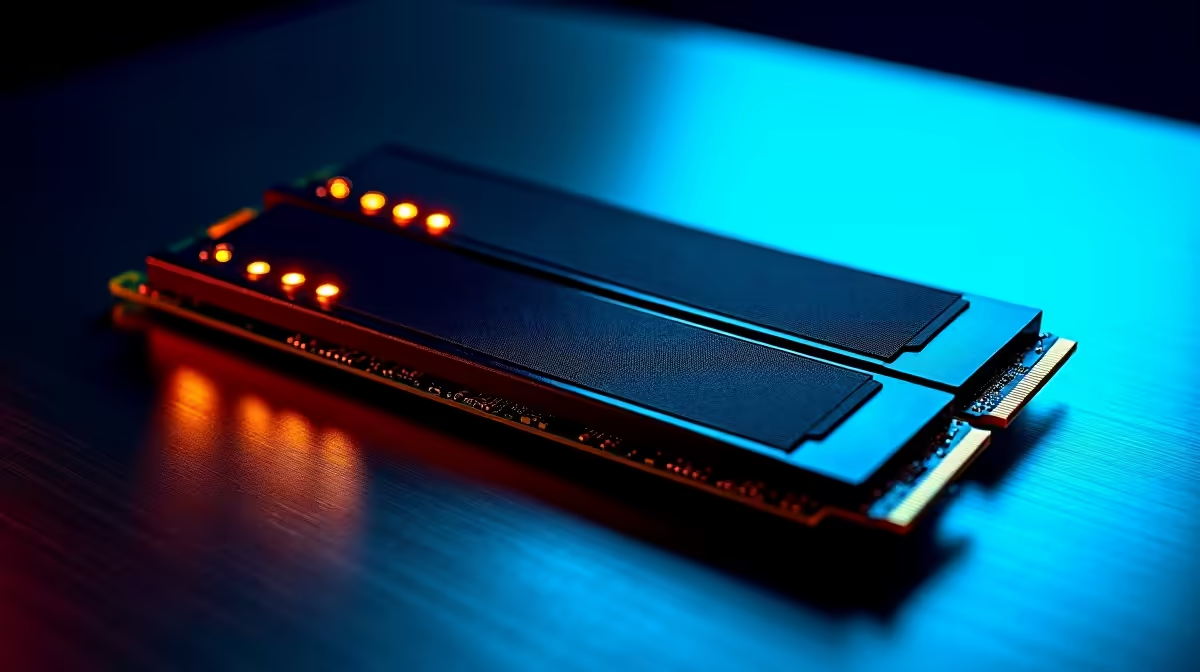
Imagine you have two identical NVMe drives. In a RAID 0 configuration, your PC treats them as one single, massive volume. When you save a file, the data is split and written across both drives simultaneously. This nearly doubles the theoretical read and write speeds. It's pure, unadulterated performance... but it comes with a serious catch.
The Performance Promise vs. Real-World Gains
On paper, the numbers are staggering. Two 7,000MB/s NVMe drives in RAID 0 could theoretically hit speeds approaching 14,000MB/s. This is a dream for professionals handling massive 8K video files or complex 3D rendering projects. Transferring a 100GB file could take seconds, not minutes. For these specific workloads, the performance boost from a multi-drive setup is undeniable and can significantly cut down project times.
But what about for gaming? The truth is, you'll see diminishing returns. Modern games are already optimised for the lightning-fast speeds of single modern solid-state drives. While a RAID 0 array might shave a fraction of a second off a loading screen, the difference is often unnoticeable compared to a single, high-quality Gen4 or Gen5 drive. The bottleneck usually lies elsewhere, like with your CPU or GPU.
Check Your Motherboard First! 🔧
Before you even think about buying a second NVMe drive for RAID 0, check your motherboard's manual or product page. You need a board that explicitly supports NVMe RAID (often called PCIe RAID). You'll also need to configure it in the BIOS UEFI, which can be a tricky process for beginners. Not all chipsets or M.2 slots support this feature!
The Big Risk: One Fails, All is Lost
Here's the critical trade-off with RAID 0: there is zero redundancy. Because your data is split across two drives, if just one of those drives fails, the entire array is corrupted and all your data is gone. Forever. It’s not a matter of recovering the data from the good drive; the complete files simply don't exist on a single drive.
This makes RAID 0 a risky choice for storing your OS, important documents, or precious family photos unless you have a rock-solid backup strategy. For many, the anxiety of potential total data loss outweighs the speed benefits. This is why having a reliable external SSD for regular backups is non-negotiable if you go down this path.
So, Is NVMe RAID 0 Worth It for You?
The answer truly depends on your specific needs. Let's break it down:
### For the Hardcore Gamer 🎮
Probably not. The real-world difference in game load times is minimal. You're better off investing that money in a single, larger, top-tier NVMe drive or putting it towards a better graphics card. You can always check out the latest SSD deals to get more capacity for your money.
### For the Content Creator & Video Editor 🎬
This is where it gets interesting. If you frequently work with massive 4K, 6K, or 8K video files, an NVMe RAID 0 setup can be a massive quality-of-life improvement. Scrubbing through complex timelines and rendering final cuts will be noticeably faster. For these users, the performance gain can justify the risk, provided they have a separate, robust backup system.
### For the Everyday User ✨
Absolutely not. A standard drive from our complete range of SSDs is more than fast enough for browsing, office work, and general use. The risk and complexity of a RAID 0 setup offer no practical benefit here.
Ultimately, while the idea of a multi-drive performance setup is exciting, the reality in 2025 is that single high-performance NVMe SSDs have become so incredibly fast that RAID 0 is now a very niche solution for users who need every last drop of sequential speed and are prepared to manage the risk.
Ready to Unleash Your PC's True Speed?
Whether you need a single, blazing-fast drive for gaming or a specialised setup for creative work, the right storage is key. Explore our massive range of NVMe SSDs and find the perfect drive to supercharge your system today.