Staring at a stuttering screen while you’re the last one left in your squad is a uniquely South African kind of pain. You’ve got the skill, the strategy… but your PC can’t keep up. Before you blame your hardware, what if the secret to smoother gameplay was hidden in plain sight? Learning how to optimize graphics settings for better PC performance can transform a choppy experience into a fluid, competitive advantage, often without spending a cent.
The Big Trade-Off: Visuals vs. Frames 🚀
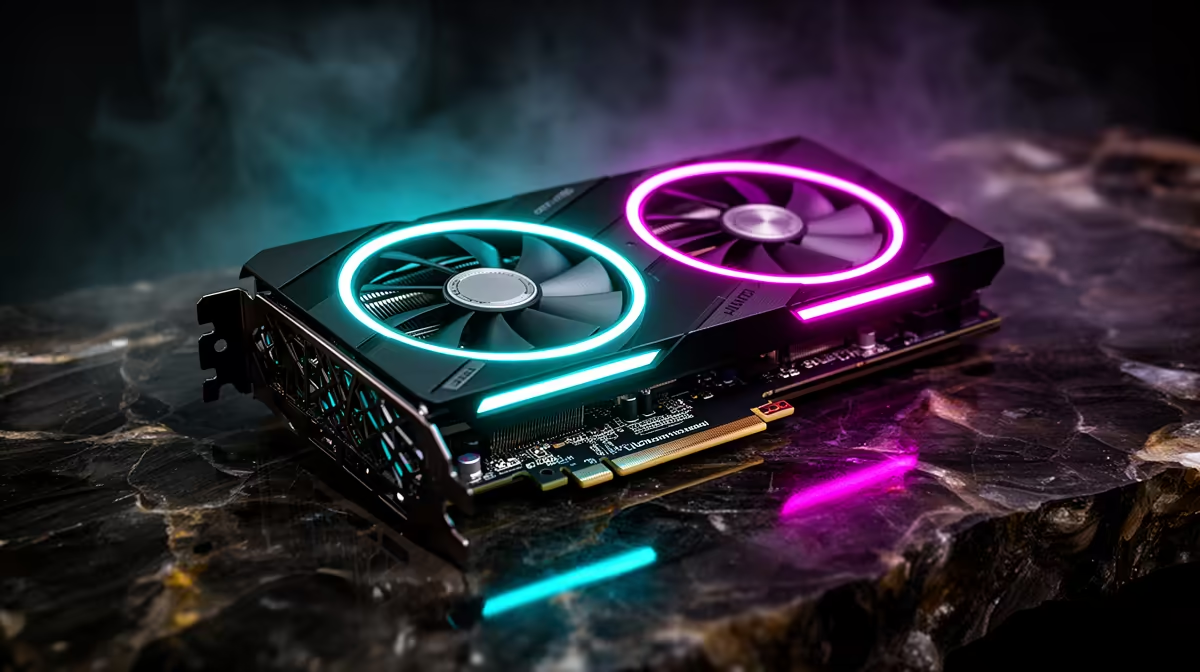
Every gamer wants their world to look stunning, but there's a constant battle happening inside your machine: the fight between eye-candy and frames per second (FPS). Think of your graphics card (GPU) as having a limited budget. Each graphical effect—like realistic shadows or razor-sharp textures—costs some of that budget. The more you spend on visuals, the less budget is left for generating frames.
The goal of graphics settings optimization is to find the perfect balance for your specific hardware. A high-end rig, like a powerful Lenovo Legion gaming laptop, has a much larger "budget" to play with, allowing for incredible visuals at high frame rates. But even on a more modest setup, smart tweaks can deliver a massive performance uplift.
Key Graphics Settings to Tweak for a Performance Boost
Diving into the settings menu can feel overwhelming. So many sliders, so many acronyms! Don't stress. Focusing on these key settings will give you the biggest bang for your buck when it comes to improving PC performance.
Resolution: The King of Performance Impact
This is the single most demanding setting. It determines how many pixels your GPU has to render for every single frame. Running a game at 1440p requires your GPU to work almost twice as hard as it does at 1080p.
- Pro Tip: Always try to run at your monitor's native resolution for the sharpest image. If you're struggling for frames, lowering the resolution is your last resort, but it offers the biggest potential performance gain.
Shadow Quality: The Sneaky FPS Thief
Realistic shadows look amazing, but they are incredibly taxing on your system. They require complex calculations for how light interacts with every object in the game world. Dropping shadows from 'Ultra' to 'High' or 'Medium' can often claw back 10-20% of your frame rate with only a minor visual downgrade. For competitive play, some pros even set them to 'Low' to reduce visual clutter.
Anti-Aliasing (AA): Smoothing Out the Edges
Ever notice those jagged, "stair-step" edges on objects? Anti-aliasing smooths them out. While it makes the image look cleaner, it can be a performance hog.
- FXAA: A lightweight option, but can sometimes blur the image slightly.
- MSAA: More demanding but produces a sharper result.
- TAA: A modern favourite, offering a good balance of quality and performance.
If you need more FPS, turning AA down or off is a quick and easy win across all kinds of hardware, from entry-level to high-end Lenovo gaming laptops.
One-Click Optimisation ⚡
't want to fiddle with individual sliders? Both NVIDIA GeForce Experience and AMD Software: Adrenalin Edition have features that can automatically optimize graphics settings for your specific hardware. It’s a great starting point, giving you a balanced profile that you can then tweak further to your liking.
Finding Your Sweet Spot: A Practical Method 🔧
The best way to optimize graphics settings for better PC performance is to test them yourself. Here’s a simple method:
- Start Low: Set the game's graphics to a global 'Low' or 'Medium' preset.
- Turn on the FPS Counter: Use the in-game option, or a tool like MSI Afterburner, to see your frame rate in real-time.
- Tweak One Setting at a Time: Play a demanding section of the game. Increase a single setting (e.g., Textures from Medium to High) and see how it affects your FPS.
- Rinse and Repeat: Continue increasing settings one by one, prioritising the ones that matter most to you (like Texture Quality) and sacrificing the ones that don't (like Shadow Quality or Motion Blur).
This hands-on approach ensures you get a personalised setup that works for you and your machine. It’s amazing how a well-configured Lenovo IdeaPad 3 Gaming laptop can deliver a super smooth experience in a game like Valorant or Fortnite with just a few smart adjustments.
When Optimizing Settings Isn't Enough ✨
Sometimes, you can tweak every setting down to the absolute minimum and still not get the performance you crave. This is often a sign that your hardware is the bottleneck. Keeping your graphics drivers updated is crucial, but it can't perform miracles.
If you're tired of being forced to play new releases on 'Low' and dream of buttery-smooth frame rates with stunning visuals, it might be time for an upgrade. The good news is that modern gaming laptops, like the fantastic value Lenovo LOQ gaming laptops, provide a massive leap in performance that will let you crank those settings back up.
Ready to Stop Tweaking and Start Winning?
Optimizing your settings is key, but nothing beats the raw power of a modern rig. If you're ready for ultra settings and high frame rates, explore our massive range of laptop specials and find the perfect machine to conquer your world.