Is your PC secretly cooking itself during those clutch moments in a match? That sudden, infuriating frame drop isn't just bad luck... it's probably thermal throttling. Before you blame your internet connection, it’s time to run a proper PC cooling test. This is the essential health check for any serious South African gamer's rig, ensuring your machine stays frosty when the action heats up. Don't let heat sabotage your victory. 🌡️
Why a PC Cooling Test is Non-Negotiable
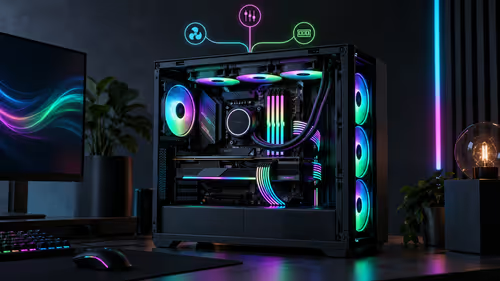
Think of your high-performance CPU and GPU as finely-tuned engines. When you push them hard, they generate a serious amount of heat. If your cooling system—your fans, heatsinks, and case airflow—can't get rid of that heat fast enough, your components will automatically slow themselves down to prevent damage. This is thermal throttling, and it's the number one cause of unexpected performance dips.
A thorough PC cooling benchmark doesn't just satisfy your curiosity; it's a preventative measure. Consistently high temperatures can shorten the lifespan of your expensive hardware. By learning how to benchmark your system for optimal temps, you ensure stability, maximise performance, and protect your investment, whether you're landing headshots in a custom Counter-Strike 2 PC or exploring vast open worlds.
Gearing Up: Your PC Cooling Test Toolkit
Before we begin, you'll need a few free, trusted software tools. No need for a complex lab setup; these utilities are the go-to for enthusiasts and pros alike.
- For Monitoring: HWiNFO64 or HWMonitor. These are your digital thermometers. They give you a real-time view of temperatures, fan speeds, and clock speeds for your CPU, GPU, and other components.
- For CPU Stress: Prime95 (use the "Small FFTs" test for maximum heat) or Cinebench R23. These programs push your processor to its absolute limit, simulating a much heavier load than even the most demanding games like Microsoft Flight Simulator.
- For GPU Stress: FurMark or Unigine Superposition. These are designed to make your graphics card sweat. They run intense graphical loops that push your GPU's temperature to its peak, perfect for seeing how your cooling handles the heat from a frantic Call of Duty: Warzone 2.0 session.
Getting these tools ready is the first step in a reliable PC cooling test, a must-do before you even think about overclocking your new rig built for Fortnite.
The Step-by-Step Guide to Benchmarking Your Cooling 🔧
Ready to see what your rig is made of? Follow these steps carefully for a complete system benchmark.
Step 1: Establish a Baseline
First, find out your PC's resting temperature. Close all non-essential programs, open HWiNFO64, and let your PC sit idle for about 10-15 minutes. Note down the "idle" temperatures for your CPU and GPU. This is your baseline.
Step 2: The CPU Stress Test
Now, let's turn up the heat on your processor.
- Keep HWiNFO64 open on one side of your screen.
- Run Prime95's "Small FFTs" test.
- Let it run for at least 20-30 minutes.
- Watch your CPU temperatures in HWiNFO64. They will climb quickly and then stabilise. This peak stable temperature is your "CPU load temp." Don't be alarmed if it gets hot, but if it approaches 95-100°C, it's best to stop the test.
Step 3: The GPU Gauntlet
Time to test the graphics card, a critical component for players who love visually stunning games on their Cyberpunk 2077 gaming PCs.
- Stop the CPU test and let the system cool for a few minutes.
- Run FurMark's preset benchmark at your monitor's native resolution.
- Let it run for 15-20 minutes.
- Monitor your GPU temperature in HWiNFO64. This will give you your "GPU load temp."
Real-World vs. Synthetic ⚡
benchmarks like Prime95 and FurMark are "worst-case scenarios" that push your hardware harder than most games. A great real-world PC cooling test is to simply play a demanding game for an hour while monitoring your temps. This shows you how your system performs under a load you'll actually experience, whether you're playing [Overwatch 2](https: www.evetech.co.za overwatch-2-gaming-pcs x 1404) or building worlds in [Minecraft](https: www.evetech.co.za minecraft-gaming-pcs x 1193).
Interpreting Your Temps: What's Hot and What's Not? 📈
So, you've completed the PC cooling test. What do the numbers mean? While every component is different, here are some general guidelines for optimal temps:
- Idle Temps (CPU & GPU): Anything between 30°C and 50°C is generally excellent.
- Load Temps (CPU): Under heavy load, anything below 85°C is considered safe and good. If you're creeping into the 90-95°C range, your cooling might be struggling.
- Load Temps (GPU): Modern GPUs are designed to run warm. Anything under 85°C during a stress test is typically fine. Many are designed to target a specific temperature, like 83°C, and will adjust their clock speeds to stay there.
If your temps are well within these ranges, congrats! Your cooling system is doing its job, ready for any marathon PUBG session.
Failing the Test? How to Improve Your PC Cooling
Did your system run hotter than a Durban summer day? Don't panic. If your PC cooling benchmark revealed high temperatures, here are some fixes:
- Clean It Up: Dust is the enemy. A simple clean-out of your PC's fans and filters with compressed air can dramatically improve airflow and lower temps.
- Check Fan Curves: Use your motherboard's BIOS or software to set a more aggressive fan curve, making your fans spin faster as temperatures rise.
- Reapply Thermal Paste: The paste between your CPU and its cooler can dry out over time. A fresh application can sometimes lower temps by several degrees.
- Upgrade Your Cooling: If the basics don't work, it might be time for a better cooler. A larger air cooler or an All-In-One (AIO) liquid cooler can make a massive difference, especially for high-end PCs built to run titles like GTA V at max settings.
Is Your Rig Running Hot? A failed PC cooling test is a clear sign it's time for an upgrade. From high-airflow cases to powerful AIO liquid coolers, we have the gear to keep your temps in check. Build your ultimate cool and quiet PC with Evetech and never let thermal throttling ruin your game again.