Quick Answer
For most South African gamers in 2026, a TV is the better choice over a projector due to superior brightness, lower input lag, and better performance during load shedding - but projectors have compelling advantages for large-screen cinematic gaming.
Image Quality: TV vs Projector for Gaming
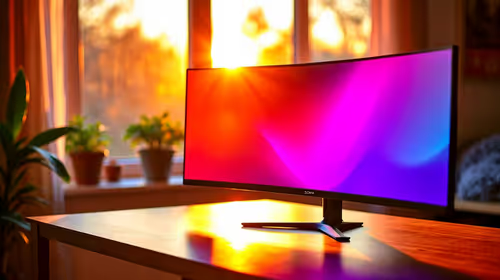
Modern TVs have reached a level of image quality that projectors struggle to match in typical room conditions. OLED TVs deliver perfect blacks, near-infinite contrast ratios, and vibrant colour accuracy without any compromise from ambient light. QLED and Mini-LED TVs achieve peak brightness levels of 1,500 to 2,000 nits or higher, remaining clearly visible even in bright South African living rooms during daylight hours.
Projectors face a fundamental challenge: they require a darkened environment to deliver their best image quality. Even mid-range laser projectors with 2,500 to 3,000 lumens brightness struggle against direct sunlight through windows - a common scenario in SA homes. Dedicated home theatre setups with blackout curtains solve this, but most gaming spaces are not purpose-built home theatres. Ultra-short throw laser projectors aimed at ambient light resistance have improved substantially in 2026, but they carry premium price tags that shift the value equation considerably.
For gaming specifically, HDR content - which is now standard in major game releases - displays far more impressively on a high-brightness TV with wide colour gamut support than on a typical projector, where HDR is either unsupported or delivers minimal real benefit due to brightness limitations.
Input Lag and Refresh Rate: Critical for Gaming
This is where TVs hold a clear, significant advantage for gaming. Modern gaming TVs feature Game Mode settings that reduce input lag to 1ms to 5ms at 4K resolution, with widespread 120Hz support and even 144Hz on some 2025 and 2026 models. VRR (Variable Refresh Rate) through HDMI 2.1 eliminates screen tearing across compatible consoles and gaming PCs.
Projectors traditionally lag behind on input lag performance. Most consumer projectors operate at 20ms to 50ms input lag even in their fastest game modes - manageable for casual cinematic gaming in single-player titles but noticeable in competitive multiplayer. High-refresh-rate projectors exist but are expensive and rare in the South African market. For esports or any game where reaction time matters, a TV is the clear choice.
For South African console gamers on a PS5 or Xbox Series X, taking full advantage of 4K 120fps output requires HDMI 2.1 bandwidth - available on modern gaming TVs but absent from most projectors in the accessible price range locally.
Load Shedding: A Key SA-Specific Factor
Load shedding makes power consumption a real consideration for South African gaming setups. A 55-inch OLED TV typically consumes 80 to 130 watts during gaming. A 65-inch QLED/Mini-LED consumes 100 to 200 watts. A typical home theatre projector with lamp technology consumes 300 to 500 watts, and laser projectors range from 250 to 450 watts.
This difference is significant when you are running your setup from a UPS during a two-hour load shedding block. A TV drawing 120 watts combined with a gaming PC or console gives your UPS far more runtime than a projector drawing 350 watts for the same visual output. South African gamers who have invested in battery backup solutions get substantially more uninterrupted gaming time with a TV setup.
Projectors also have warm-up and cool-down cycles - lamp-based models require cooling time after shutdown, and some should not be abruptly powered off. A sudden power cut during load shedding that catches a lamp projector mid-cooling cycle can shorten lamp life significantly. This is a practical maintenance consideration that South African projector owners deal with regularly.
When a Projector Wins for Gaming
Despite TVs holding the advantage in most categories, projectors have a genuine case in specific scenarios. If you want a screen size above 100 inches - something no TV can deliver at a reasonable local price - a projector is your only option. Cinema-scale gaming on a 120-inch or 150-inch screen is a genuinely immersive experience for single-player story games, racing simulators, and sports titles where the scale of the image matters more than pixel-perfect response times.
Dedicated gaming rooms or converted garage spaces with controlled lighting are where projectors shine - literally and figuratively. If you can commit to a darkened room with a quality projection screen or flat painted wall, a laser projector delivers a home cinema gaming experience that no TV can replicate. Long-throw projectors in this application are also easier to position than mounting a large-format TV, and the setup can double as a home movie theatre.
For group gaming sessions - local multiplayer with multiple players sitting around a large screen - a projector's scale advantage becomes socially meaningful in a way that a 65-inch TV does not fully replicate.
Frequently Asked Questions
Q: What input lag is acceptable for gaming on a projector?
A: Below 30ms is generally acceptable for single-player gaming and casual play. For competitive multiplayer or fast-paced action games, below 15ms is preferable. Check the specific projector's game mode input lag specification before purchasing if gaming is a primary use case.
Q: Can a projector handle load shedding better with a UPS in South Africa?
A: A projector can be run from a UPS, but its higher power draw means shorter runtime compared to a TV. A 1500VA UPS might power a TV gaming setup for 60 to 90 minutes during load shedding, while the same UPS running a projector setup may only provide 30 to 45 minutes. Properly shutting down a lamp projector when the UPS gives a low battery warning is important to protect the lamp.
Q: Is a 4K projector better than a 4K TV for gaming in 2026?
A: For pure gaming performance metrics - input lag, HDR quality, refresh rate support - a 4K gaming TV outperforms most 4K projectors at equivalent price points. A 4K projector excels in screen size and cinematic scale. Choose based on which advantage matters more for your gaming environment.
Q: What screen size should I get for comfortable dual-person couch gaming in a typical South African living room?
A: A 55-inch to 65-inch TV at a 2 to 2.5 metre seating distance provides comfortable immersion for two players on a couch. Beyond 65 inches, viewing distance should increase proportionally. A 75-inch TV at 3 metres works well in larger living rooms. A projector setup makes the most sense when you want 100 inches or more, which requires a living room with sufficient throw distance.
Also at Evetech: Projectors | Graphics Card Deals
Ready to Find Your Perfect Match? Shop at Evetech