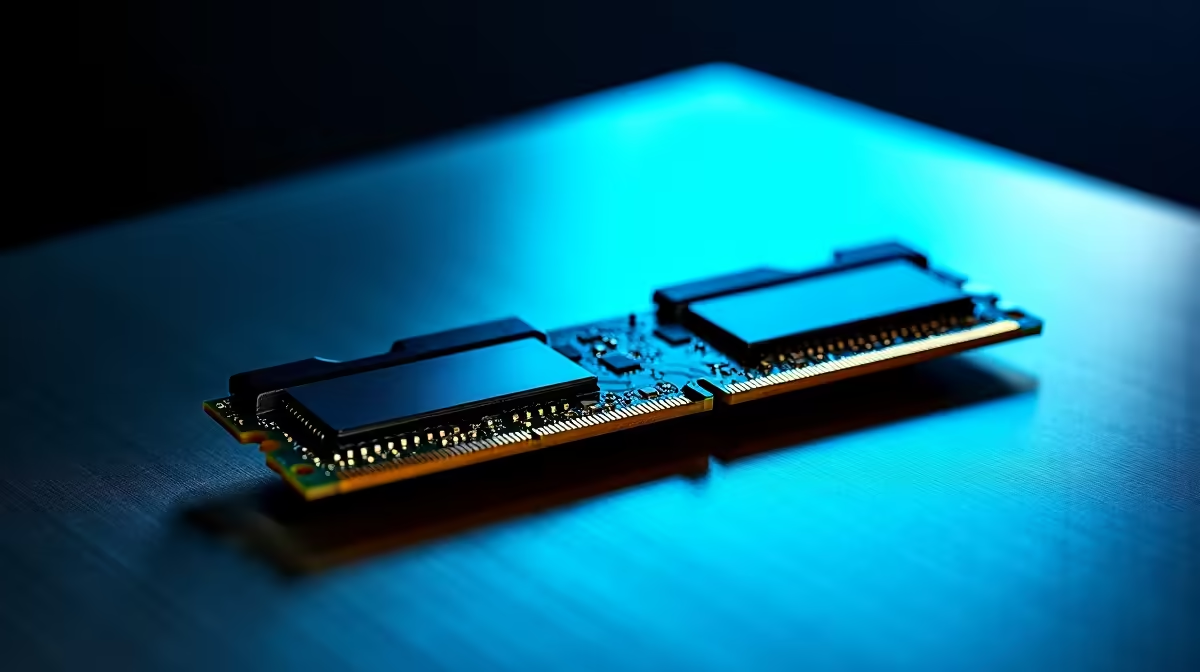
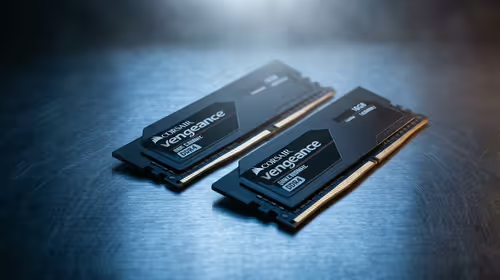
You're speccing out a new PC build, scrolling through pages of components. You see two RAM kits: one is 3200MHz, the other a blazing-fast 4000MHz… but it costs a whole lot more. Is that extra cash worth a few more frames in Sandton City? It’s a classic question for PC builders. So, we decided to run a virtual RAM speed test for South Africa to find out: does RAM frequency really matter for your gaming experience?
Understanding RAM Frequency ⚡
Before we dive into the numbers, let's quickly demystify what "RAM speed" or "frequency" means. Measured in megahertz (MHz), it's essentially how many times your RAM can access its data per second. Think of it like a highway. A higher frequency (e.g., 3600MHz) is like a higher speed limit, allowing data to travel between your RAM and CPU faster than a lower frequency (e.g., 2666MHz).
But a faster highway doesn't always mean a shorter trip, especially if there's traffic. That's where other factors come into play.
The Real-World RAM Speed Test: Gaming & Performance
So, what does our South African RAM speed test reveal for gaming? The answer is… it depends heavily on your other components, especially your CPU and GPU.
For high-end gaming rigs, the kind you'll find in our PCs above R20k, faster RAM can definitely provide a noticeable FPS boost. This is particularly true for modern AMD Ryzen CPUs, which are designed to take advantage of high-frequency memory. In CPU-intensive games at 1080p, jumping from 3200MHz to 3600MHz can squeeze out an extra 5-10% performance. 🚀
However, if you're gaming at 4K, the performance bottleneck usually shifts to your graphics card. In this scenario, the difference between RAM speeds becomes much smaller, often just a few frames per second. This balance is crucial, even when looking at more affordable gaming PCs under R20k, where every Rand spent needs to be justified.
Speed vs. Latency: The Other Half of the Story
Frequency is only one part of the performance equation. The other is CAS Latency (CL), which is the delay before your RAM starts responding to a command. A lower CL number is better. The trick is finding the sweet spot between high frequency and low latency.
Decoding RAM Specs 🔧
When you see RAM listed as 3200MHz CL16, it means it has a frequency of 3200MHz and a CAS Latency of 16. A 3600MHz CL18 kit might be faster in some tasks due to its higher frequency, but the 3200MHz CL16 kit could be quicker in others because of its lower latency. For most gaming builds, aiming for CL16 or CL18 is a solid choice.
A kit with super-high frequency but terrible latency can perform worse than a more balanced, moderately-priced option. It’s all about finding that efficient middle ground.
The Verdict: Is Faster RAM Worth the Price in South Africa?
So, should you spend more for faster RAM? Here's our final take.
For most gamers, especially those building powerful but sensible budget gaming PCs, the value sweet spot is a 16GB kit of 3200MHz or 3600MHz DDR4 RAM. This delivers excellent performance without breaking the bank. ✨
If you're an enthusiast chasing every last frame with a top-tier CPU, then investing in faster RAM makes sense. In this bracket, you'll see the most noticeable gains, making it a worthy upgrade in the best gaming PC deals available.
Ultimately, stability and compatibility are king. A mismatched, unstable RAM kit is useless, no matter how fast it is on paper. That’s why expertly configured pre-built PC deals are so popular; they guarantee a stable, optimised experience right out of the box. The results of any RAM frequency test point to balance being the most important factor for your build.
Ready to Find Your Perfect PC Balance?
Choosing the right RAM is just one piece of the puzzle. For a perfectly optimised system where every component works in harmony, let our experts handle the hard work. Explore our range of custom-built computers and get the performance you deserve, guaranteed.