Quick Answer
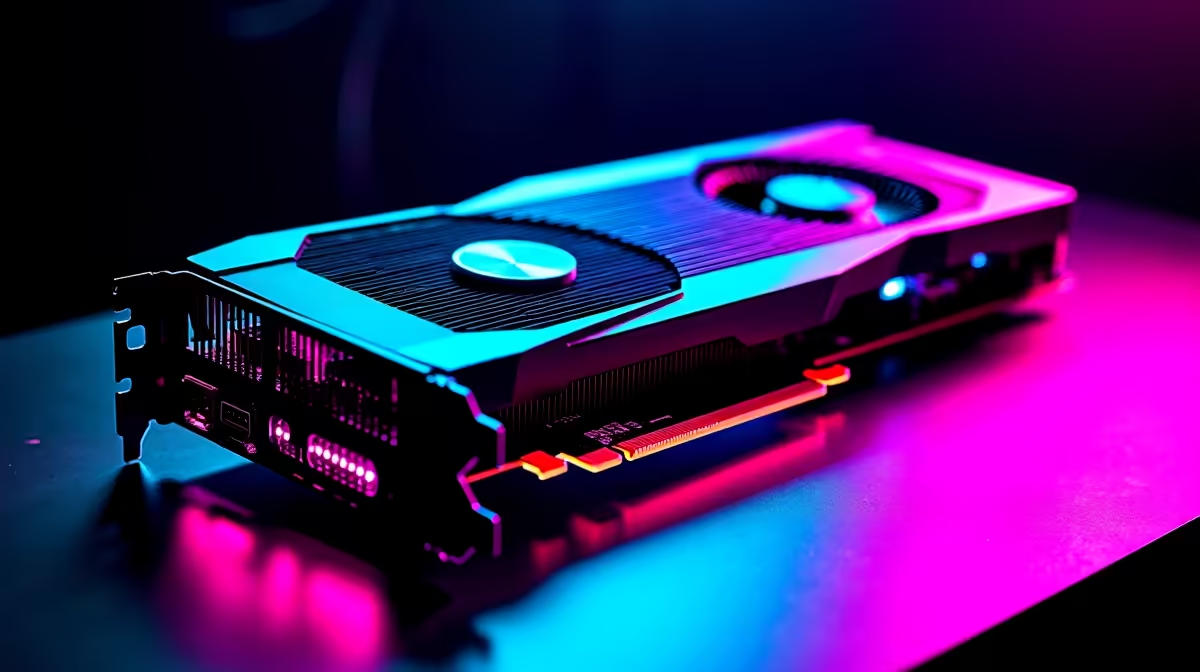
The RTX 5070 in Apex Legends at 1080p delivers extremely high frame rates, averaging 380 to 480 FPS on the recommended competitive settings, with peaks above 500 FPS in open outdoor zones. It is a dominant card for Apex Legends at any refresh rate up to 500Hz.
RTX 5070 Apex Legends FPS at 1080p: Benchmark Results
Apex Legends is well-optimised and scales efficiently with GPU power. At 1080p with Respawn's recommended high-performance settings (textures on High, shadows on Low, anti-aliasing on TSAA), the RTX 5070 averages 380 to 480 FPS across standard battle royale play. Storm Point and Broken Moon with their large open sightlines push frame rates toward the 450 to 500 FPS ceiling more consistently. Worlds Edge and Olympus, with more interior geometry and particle effects during team fights, pull averages toward the lower end of the range but remain well above 300 FPS throughout. Low 1% performance sits above 260 FPS across all scenarios, which eliminates perceptible frame drops even on 360Hz and 500Hz panels.
Optimal Settings for Competitive Apex Legends on RTX 5070
For the purest competitive experience with the RTX 5070, keep textures on High to maintain clean player model and environment visibility, set shadows to Low to eliminate shadow-cast visual clutter near corners, and disable ambient occlusion entirely. Anti-aliasing should use TSAA for the smoothest edge treatment at high frame rates, though some players prefer disabling it for maximum pixel sharpness. V-sync must be disabled. Frame rate cap should match your monitor refresh rate plus 10 to 20 percent to maintain frame time consistency ahead of the display sync cycle. With NVIDIA Reflex enabled and set to Enabled plus Boost, system latency reaches 3 to 7 milliseconds, which is excellent for a battle royale title where reaction time margins are decisive.
DLSS and Frame Generation in Apex Legends
Apex Legends supports DLSS Super Resolution and Frame Generation on RTX 40 and RTX 50 series cards. At 1080p where the RTX 5070 already produces 400-plus FPS natively, neither feature is needed for performance and Frame Generation adds latency overhead that is counterproductive for competitive play. The better use of DLSS in Apex at this resolution is for image stability: DLSS Quality at 1080p can reduce temporal shimmer on fine geometry like chain-link fences and foliage without the frame rate cost relevant at lower GPU tiers.
Frequently Asked Questions
What refresh rate monitor should I pair with the RTX 5070 for Apex Legends? A 360Hz 1080p monitor is the practical sweet spot. 500Hz panels exist and provide marginal additional motion clarity, but the perceptible benefit narrows considerably above 360Hz for most players. The RTX 5070 feeds either comfortably.
Does the RTX 5070 ever get CPU-bottlenecked in Apex Legends at 1080p? At very high frame rates, Apex Legends becomes partially CPU-limited by game engine simulation and draw call processing. A Ryzen 7 9800X3D or Core Ultra 9 285K minimises this bottleneck. With a slower CPU, frame rates cap below the GPU potential of the RTX 5070 in Apex.
Is NVIDIA Reflex worth enabling on RTX 5070 in Apex Legends? Absolutely. Reflex has negligible performance cost at the frame rates the RTX 5070 produces and measurably reduces click-to-display latency. It is one of the most impactful single settings changes for competitive Apex Legends and should always be enabled on RTX hardware.
Ready to Find Your Perfect Match? Shop RTX 5070 graphics cards at Evetech