Imagine walking through a misty forest in Elden Ring or the neon-soaked haze of Night City. That thick, atmospheric air makes or breaks your immersion. If you are debating the RTX 5070 vs RX 9070 volumetric fog performance, you are looking for more than just high frame rates. You want depth... you want realism that does not turn your PC into a heater during a Jo'burg summer. 🚀
Understanding the RTX 5070 vs RX 9070 Volumetric Fog Performance
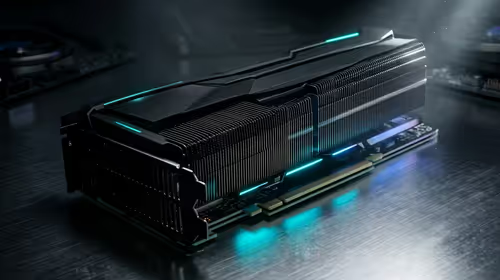
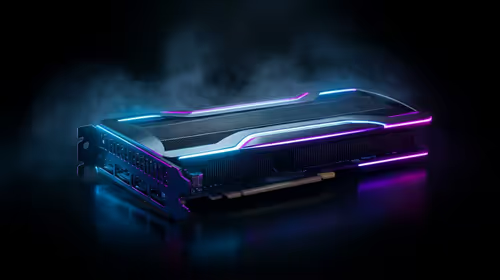
Volumetric fog is one of the most demanding settings in modern gaming. It requires the GPU to calculate how light scatters through particles in a 3D space. When comparing the RTX 5070 vs RX 9070 volumetric fog capabilities, we see two different philosophies. NVIDIA relies heavily on dedicated RT cores and AI-driven denoising. AMD focuses on massive raw compute and high memory bandwidth. You can find a wide variety of these NVIDIA and AMD graphics cards available locally to suit your specific budget.
NVIDIA’s architecture typically handles light scattering with more precision. This results in fog that looks less "pixelated" when moving the camera quickly. If you prefer a premium build, looking at MSI graphics cards often provides the cooling necessary to keep those boost clocks stable during intense rendering tasks. 🔧
Optimisation Pro Tip ⚡
To improve your "RTX 5070 vs RX 9070 volumetric fog" experience, try lowering the "Volumetric Lighting" setting from Ultra to High. Most modern games see a 15% FPS boost with almost zero visible loss in atmospheric quality... it is the easiest way to gain performance without spending an extra cent.
Why Volumetric Effects Matter for Next-Gen Gaming
As we move deeper into this console generation, developers are using "thick" atmospheres to hide level transitions and add mood. The RTX 5070 vs RX 9070 volumetric fog debate isn't just about aesthetics... it is about performance stability. AMD’s RX 9070 often wins on pure VRAM capacity, which helps when playing at 4K resolutions where fog buffers can eat up gigabytes of memory. You can check the latest AMD Radeon graphics cards to see how they stack up in terms of price-to-performance.
While the big two dominate the conversation, do not ignore the newcomers. Some Intel Arc graphics cards have shown surprising competence in modern APIs like DirectX 12 Ultimate, which handles volumetric scattering quite efficiently. However, for those doing professional rendering alongside gaming, workstation graphics cards might be the better choice for precision over raw speed. ✨
Which GPU Should You Choose?
If you value the most advanced light simulation and DLSS support, the RTX 5070 is likely your winner. If you want better value in terms of ZAR per frame and more VRAM for future-proofing, the RX 9070 is a beast. Both cards will handle volumetric fog far better than previous generations... making those misty mornings in-game look truly spectacular. ⚡
Ready to Find Your Perfect Match?
The RTX 5070 vs RX 9070 volumetric fog debate is complex, but for maximum power, choice, and value in South Africa, Evetech has you covered. Explore our massive range of graphics cards and find the perfect component to conquer your world.