Quick Answer
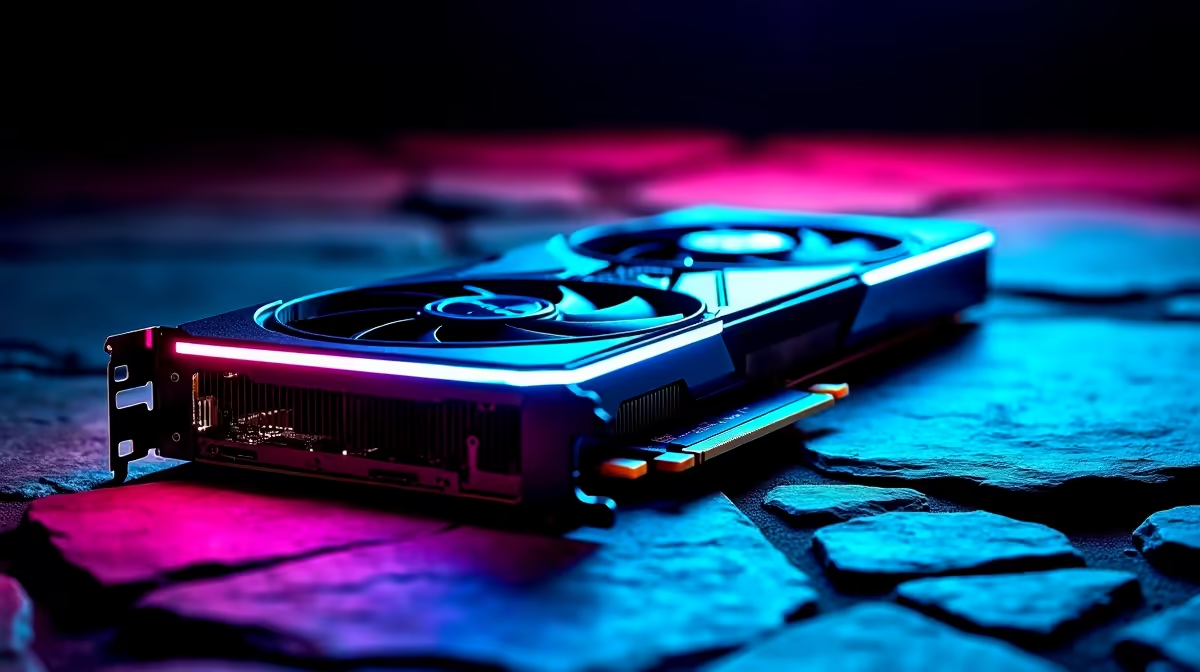
The RX 7900 XTX and RX 9060 XT target different buyer segments in South Africa in 2026. The RX 7900 XTX delivers flagship 4K and high-refresh 1440p performance with 24GB of GDDR6 VRAM, while the RX 9060 XT is a mainstream 1080p to 1440p card designed to offer competitive performance per rand at a significantly lower price point. For South African buyers, the decision comes down to the resolution you game at and what your budget allows in ZAR.
Performance Positioning: Where Each Card Excels in 2026
The RX 7900 XTX sits at the top of AMD's RDNA 3 lineup and remains a powerful card for 4K gaming and demanding 1440p workloads well into 2026. Its 24GB GDDR6 VRAM makes it future-proof for texture-heavy titles and gives it headroom for workloads like AI-assisted game upscaling at native 4K. At 1440p the RX 7900 XTX delivers frame rates that comfortably saturate 165Hz and 240Hz displays in most current titles, making it the right card for buyers with high refresh rate 1440p or 4K monitors.
The RX 9060 XT is AMD's RDNA 4 architecture mid-range entry in 2026, targeting the highly competitive 1080p and mainstream 1440p gaming segment. Built on a more advanced process node than RDNA 3, the RX 9060 XT delivers strong performance per watt and benefits from RDNA 4's improved ray tracing hardware and upgraded media engine for streaming and video encode tasks. At 1080p the RX 9060 XT is capable of sustaining high frame rates in demanding titles, and at 1440p it handles medium to high settings competently in most games released through 2025 and 2026.
In the South African gaming context, the RX 9060 XT's mainstream price positioning makes it a compelling option for the majority of local gamers who game at 1080p on 24-inch monitors or who are building their first dedicated gaming PC within a tight budget.
South African Pricing and Value in ZAR
The pricing gap between the RX 7900 XTX and the RX 9060 XT in the South African market reflects their positioning clearly. The RX 7900 XTX sits at a flagship price tier in the South African ZAR market, typically occupying the R16,000 to R22,000 range depending on the partner card and stock availability. The RX 9060 XT launches in the R6,000 to R9,000 range as a mainstream product targeted at the majority of the gaming market.
For South African buyers, that price gap represents a meaningful portion of a total build budget. A buyer spending R8,000 on an RX 9060 XT instead of R18,000 on an RX 7900 XTX retains R10,000 for other components like a faster CPU, more RAM, a larger SSD, or a better monitor, all of which contribute to the overall gaming experience. For buyers already running a capable system who need only a GPU upgrade, the R7900 XTX is the correct choice if gaming at 4K or on a 240Hz 1440p panel.
The rand-dollar exchange rate influences GPU pricing in South Africa more than any other component category. Buyers who monitor pricing over a period of two to four weeks often find that exchange rate movements create purchase windows where either card offers better-than-average value. The RX 9060 XT's lower absolute price makes it less sensitive to exchange rate swings in rand terms, while the RX 7900 XTX can swing several thousand rand across the same exchange rate movement.
RDNA 3 vs RDNA 4: Architecture Differences That Matter for SA Gamers
The RX 7900 XTX is built on RDNA 3 while the RX 9060 XT introduces RDNA 4. For South African gamers the most practical architectural difference is in the ray tracing hardware. RDNA 4 includes second-generation ray tracing accelerators that handle ray tracing workloads significantly more efficiently than RDNA 3. This means the RX 9060 XT can enable ray tracing in supported games at 1080p with less performance penalty than an RDNA 3 card at the same resolution.
The media engine in RDNA 4 also improves significantly for streamers. The RX 9060 XT encodes AV1 video with higher quality per bitrate than the RDNA 3 encoder in the RX 7900 XTX. For South African streamers with limited upload bandwidth on home fibre or LTE connections, AV1 encoding at lower bitrates with acceptable quality is a practical advantage of the newer architecture.
FSR 4, AMD's latest upscaling technology, launches with RDNA 4 hardware support and offers noticeably improved image quality over FSR 3 at equivalent performance modes. The RX 7900 XTX supports FSR 3 but not FSR 4's hardware-accelerated machine learning mode, which is exclusive to RDNA 4. This gives the RX 9060 XT a software-level advantage in titles supporting FSR 4 despite its lower raw performance tier.
Which Card Should South African Gamers Buy in 2026
The RX 7900 XTX is the right choice for South African gamers with a 4K monitor, a 240Hz 1440p display, or a creative workload that benefits from 24GB of VRAM. It is also appropriate for buyers who game in Valorant, CS2, Apex Legends at ultra-high frame rates and want headroom for next-generation titles at 1440p without needing to upgrade again in two years.
The RX 9060 XT is the right choice for the majority of South African gamers. It covers 1080p gaming at high refresh rates, 1440p gaming at medium to high settings, and brings RDNA 4's improved ray tracing and FSR 4 support in a price range accessible to buyers building their first gaming PC or upgrading from a several-generation-old card.
Loadshedding considerations apply to both cards. The RX 7900 XTX draws up to 355 watts under load and requires a PSU of 850 watts or more, which affects UPS sizing for South African gamers who want to stay online during load shedding. The RX 9060 XT's lower TDP of around 150 to 180 watts is more UPS-friendly, allowing a smaller and less expensive UPS to sustain the gaming setup through Stage 2 or Stage 3 load shedding slots.
Frequently Asked Questions
Is the RX 9060 XT worth buying in South Africa over the RX 7900 XTX?
For most South African gamers gaming at 1080p or mainstream 1440p, the RX 9060 XT delivers compelling performance at a fraction of the RX 7900 XTX's price. The budget difference can fund meaningful upgrades elsewhere in the system. The RX 7900 XTX is justified only for 4K gaming or very high refresh rate 1440p where the additional GPU headroom is actually used.
Does the RX 9060 XT support FSR 4 while the RX 7900 XTX does not?
Yes. FSR 4's hardware-accelerated machine learning upscaling mode is exclusive to RDNA 4 architecture, which means the RX 9060 XT supports it and the RX 7900 XTX does not. The RX 7900 XTX continues to support FSR 3, which is a strong upscaling solution, but FSR 4 in supported titles produces noticeably higher image quality at equivalent performance modes.
How does the RX 9060 XT perform for South African streamers?
The RX 9060 XT's RDNA 4 media engine produces high-quality AV1 encoded streams at bitrates practical for South African upload speeds. Streamers using OBS Studio with AMF AV1 encoding will see improved stream output quality compared to H.264 at the same bitrate, which directly benefits viewers on slower connections and the streamer's upload capacity.
Which card is better for loadshedding-aware South African gaming setups?
The RX 9060 XT's lower power draw makes it more UPS-compatible for South African gamers who want to continue gaming during load shedding. A 1000VA UPS can sustain a mid-range gaming PC with an RX 9060 XT for longer than the same UPS running a system with the RX 7900 XTX, because the total system draw is significantly lower.
Ready to Find Your Perfect Match? Compare the full AMD Radeon GPU range with South African pricing and delivery available nationwide. Shop Graphics Cards at Evetech