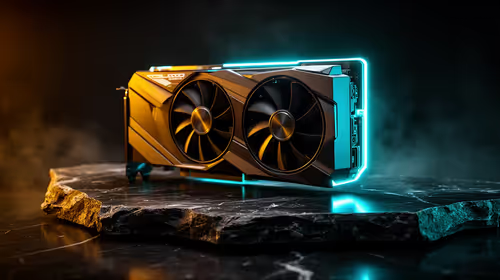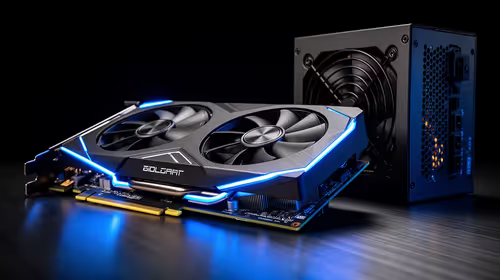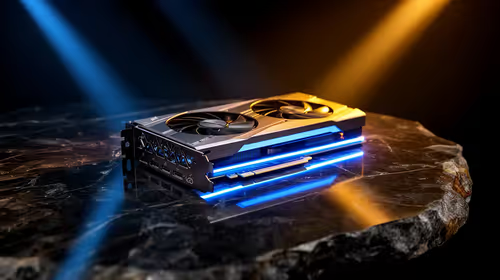
South African gamers shopping for a mid-range GPU in 2026 face a genuinely interesting choice between AMD's RX 9070 and Intel's Arc A770. Both cards target the 1080p and 1440p sweet spot, but they take very different approaches to performance, driver maturity, and value for Rand spent.
Quick Answer
RX 9070 vs Intel Arc A770 - which wins for SA gaming? The RX 9070 leads in rasterisation performance and driver reliability, while the A770 punches above its price in ray-traced and compute-heavy workloads. For most SA gamers, the RX 9070 delivers a more consistent all-round experience, but the A770 can be compelling if its price undercuts the AMD card significantly at your time of purchase.
🔧 Architecture and Raw Performance
The RX 9070 is built on AMD's RDNA 4 architecture, bringing improved compute units, a revamped media engine, and meaningfully better ray-tracing hardware compared to the RDNA 3 generation. In rasterisation - the bread-and-butter of most gaming workloads - the RX 9070 consistently posts frame rates 10–18% ahead of the A770 at 1440p in titles like Cyberpunk 2077, Hogwarts Legacy, and Forza Horizon 5.
Intel's Arc A770 is based on the Xe-HPG (Alchemist) architecture. It ships with 16 GB of GDDR6 VRAM, which is a genuine differentiator at the price point - more headroom than competing AMD and Nvidia cards when running memory-hungry titles or modded games. The A770 also features XeSS upscaling, Intel's AI-powered super-sampling technology that has matured considerably and now delivers quality comparable to AMD's FSR 3.
In ray tracing benchmarks the gap narrows considerably and occasionally inverts, with the A770 leveraging its dedicated ray-tracing units more efficiently. However, very few SA gamers prioritise RT at this tier, where maintaining high frame rates at quality settings matters more.
📊 SA Value Analysis
Value in South Africa is heavily influenced by import pricing, VAT, and currency fluctuation. The RX 9070 typically lands at a higher price point than the A770, which has been available locally for longer and has seen its street price drop. Here is how they compare across key metrics:
| Metric | RX 9070 | Intel Arc A770 |
|---|---|---|
| Architecture | RDNA 4 | Xe-HPG (Alchemist) |
| VRAM | 8–16 GB (model dependent) | 16 GB |
| 1440p Rasterisation | Faster (~15% avg) | Strong baseline |
| Ray Tracing | Competitive | Slightly stronger |
| Driver Maturity | Excellent | Improved, good |
| Price Tier (SA) | Higher | Lower/mid |
If the A770 is priced R1,500–R2,000 less than the RX 9070 at the time you're shopping, the performance deficit is acceptable for a 1080p or light 1440p build. If pricing is within R500 of each other, the RX 9070 is the smarter long-term buy.
SA gamers should also factor in warranty and after-sales support. AMD's ecosystem has wider local recognition, and software support through AMD Software: Adrenalin Edition is consistently rated more stable than Intel's Arc Control suite, though Intel has closed the gap substantially through driver updates.
💡 Which Should You Buy in 2026?
For the majority of SA gamers targeting 1440p at 60–120 Hz, the RX 9070 is the stronger recommendation. Its driver stability, performance headroom, and FSR 3 support make it a dependable pick for popular titles in the SA gaming scene - from Valorant and CS2 to AAA open-world games.
The A770 earns its place as a budget-conscious alternative, especially if you run memory-heavy workloads alongside gaming or if you want to experiment with AI-accelerated features. It is also a solid choice for a secondary rig or LAN party build where budget is tight.
If you run both cards on an older PCIe 3.0 platform, note that the A770 shows a slightly larger performance drop than the RX 9070 when bandwidth is constrained - keep this in mind if your motherboard is from an older generation.
❓ Frequently Asked Questions
Does the Intel Arc A770 work well with AMD CPUs? Yes. Early compatibility issues between Arc GPUs and AMD platforms have been resolved through driver updates. The A770 runs stably on both Intel and AMD systems in 2026.
Is 16 GB VRAM on the A770 a real advantage? At 1080p and standard 1440p gaming it rarely matters today, but the extra VRAM buffer is useful for texture-heavy mods, 4K texture packs, and future-proofing as game assets grow. It is a genuine differentiator if you also use the card for content creation.
Which card has better upscaling - FSR or XeSS? Both FSR 3 and XeSS deliver strong results in 2026. XeSS runs better on Intel hardware, while FSR 3 with Frame Generation is available on the RX 9070 and works across a wider range of supported titles. For SA gamers playing the latest AAA releases, FSR 3 currently has broader game support.
Evetech stocks All Graphics Cards and Graphics Card Deals — browse current SA pricing and availability online.
Ready to Find Your Perfect Match? Shop at Evetech