Just slotted a new AMD Ryzen 5 5500 into your PC? Lekker! It’s a fantastic budget CPU, but if you haven’t visited your motherboard’s BIOS, you’re leaving free performance on the table. Many crucial settings are disabled by default. Don’t worry, you don’t need to be a pro overclocker. A few simple tweaks can unlock smoother frame rates and a more responsive gaming experience. Let’s get your rig running at its full potential. 🚀
First Things First: Why Tweak Your BIOS?
Your motherboard’s BIOS (or UEFI, the modern version) is the control centre for your hardware. Manufacturers ship boards with ultra-safe, one-size-fits-all defaults designed to work with any component you might install. These are not optimised for your specific hardware.
By adjusting the Ryzen 5 5500 BIOS settings, you're simply telling your system it's safe to run your components at the speeds they were designed for. It's the difference between a good PC and a great one. Getting this right is key, whether you're building from scratch with one of Evetech's AMD barebone kits or just upgrading your processor.
Update Before You Tune! 💡
Before changing any settings, visit your motherboard manufacturer's website and download the latest BIOS version. Updates often include crucial stability fixes, better memory compatibility, and improved performance profiles for CPUs like the Ryzen 5 5500. It's the most important first step for a stable and speedy system.
The Two Essential BIOS Settings for Your Ryzen 5 5500
For 90% of gamers, these two adjustments will deliver the biggest and most noticeable performance boost. You can find them in almost any B450, B550, or X570 motherboard.
1. Enable Your RAM's True Speed with XMP/DOCP
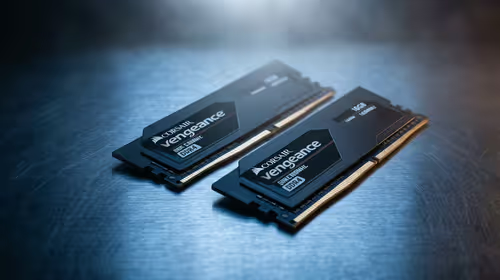
This is the big one. Your RAM kit might be advertised as 3600MHz, but it will run at a much slower default speed (like 2133MHz) until you tell it otherwise. Ryzen CPUs, in particular, love fast memory.
- What to do: Reboot your PC and enter the BIOS (usually by pressing DEL or F2 on startup). Look for a setting called XMP (Extreme Memory Profile), DOCP (Direct Overclock Profile), or A-XMP. Enable it, save, and reboot. That's it! Your memory will now run at its full rated speed, giving your Ryzen 5 5500 the bandwidth it needs to shine. Ensuring your parts are compatible from the start is easy with pre-configured motherboard and CPU bundles.
2. Unleash the CPU with Precision Boost Overdrive (PBO)
Think of PBO as a smart, automated overclocking tool built into your CPU. Instead of manually setting voltages and frequencies (which can be risky), PBO allows the Ryzen 5 5500 to boost its clock speeds higher and for longer, as long as your cooling can handle it.
- What to do: In your BIOS, find the "AMD Overclocking" or a similar advanced CPU section. Set Precision Boost Overdrive to "Enabled" or "Advanced". This simple change lets the CPU intelligently manage its own performance based on temperature and power, giving you more speed when you need it most.
Going Further: Optional Tweaks for Enthusiasts 🔧
Once you've nailed the basics, a couple of other settings can refine your experience. While some builders prefer the straightforward nature of Intel barebone kits, the extra tweaking potential is where AMD systems can really be optimised.
Smart Fan Control (Q-Fan / Fan-Tastic Tuning)
Is your PC getting a bit loud under load? Your BIOS gives you full control over your fan speeds. Look for a setting like "Smart Fan" or "Q-Fan Control." Here you can create a custom fan curve, telling your fans to stay whisper-quiet during desktop use and only ramp up when you're deep in a gaming session. A smooth, gradual curve provides the best balance of cooling and acoustics.
Enable Resizable BAR
If you have a compatible graphics card (generally an NVIDIA RTX 30-series, AMD RX 6000-series, or newer), make sure Resizable BAR (sometimes called Clever Access Memory) is enabled. This feature lets your CPU access your GPU's entire video memory buffer at once, rather than in small chunks, providing a small but welcome performance boost in many modern games.
Your Quick-Start Performance Checklist ✅
Feeling ready to dive in? Perfecting your Ryzen 5 5500 BIOS settings is straightforward.
- Update BIOS: Flash the latest stable version from your motherboard's support page.
- Enable XMP/DOCP: Let your RAM run at its full advertised speed.
- Enable PBO: Unlock your CPU's automatic boosting potential.
- Enable Re-Size BAR: If your GPU and motherboard support it.
- Save & Exit: Lock in your changes and enjoy the extra performance!
These simple tweaks will ensure you’re not leaving any performance on the table. If you find your CPU is still the bottleneck in the latest AAA titles, it might be time to consider upgrading to a powerful Ryzen 7 for more cores and even higher clocks.
Ready to Build Around the Ryzen 5 5500?
Record the stable BIOS settings, then compare AMD processors if your next upgrade needs more CPU headroom.