Quick Answer
The Ryzen 9 10900X has a rated TDP of 170W with a peak power draw that can exceed 230W under all-core load when PPT limits are unrestricted. For a stable build in South Africa, a quality 850W to 1000W PSU is recommended when pairing this CPU with a mid-to-high-end GPU.
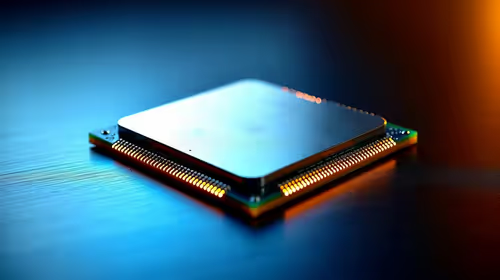
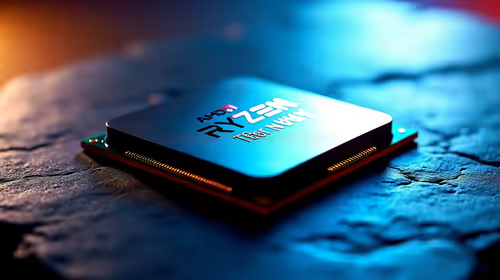
The Ryzen 9 10900X is AMD's high-core-count workstation and gaming CPU built on the Zen 5 architecture. On paper its TDP sits at 170W, but AMD's power packaging limits mean real-world wattage under sustained all-core loads regularly climbs well above that figure. If you are building around this chip in South Africa - where PSU prices range from around R1,200 for budget 650W units to R3,500+ for premium 1000W+ models - choosing the right power supply the first time saves you a costly swap later.
Real-World Power Draw Under Load
In stock configuration with PPT (Package Power Tracking) limits set to auto in BIOS, the Ryzen 9 10900X can draw between 200W and 230W at the CPU socket during intensive all-core workloads like video rendering, 3D compilation, or heavy multitasking. Gaming workloads are lighter, typically landing between 120W and 160W since most games do not fully saturate all cores. Idle power is low - around 10W to 20W at the desktop. If you manually cap PPT in BIOS to 170W, you trade a small percentage of peak performance for meaningfully lower temperatures and reduced PSU stress, which is a worthwhile trade-off for most non-professional workloads.
PSU Sizing: What You Actually Need
The CPU alone is not the only consumer in your system. A full gaming build with the Ryzen 9 10900X paired with an RTX 4080 or RX 7900 XT will see combined peak draw of 450W to 550W under gaming load and potentially 600W+ during combined stress tests. Adding storage, fans, RAM, and motherboard overhead brings realistic system peak draw to around 700W. For a comfortable safety margin of 20% to 30% above expected peak - which also keeps the PSU in its efficient operating range - target an 850W unit at minimum. A 1000W PSU is the sensible choice if you plan to overclock or add a high-end GPU. Stick to 80 Plus Gold or Platinum certified units for efficiency and long-term reliability.
Cooling and Power Interaction
Power draw and thermals are directly linked on Ryzen 10000 series. If your cooler cannot keep pace, AMD's thermal throttling will automatically reduce power draw to protect the chip - but performance drops with it. A 240mm AIO is the minimum recommended for the 10900X; a 360mm AIO or high-end air cooler like a Noctua NH-D15 will let the chip run closer to its full power budget without throttling. South African summers, especially in Johannesburg and Durban, push ambient temperatures higher, so cooler headroom matters more locally than in cooler climates.
Frequently Asked Questions
Q: Will a 750W PSU run a Ryzen 9 10900X system? A: It depends on your GPU. Paired with a mid-range GPU like an RTX 4070, a quality 750W unit can handle the system. With a high-end GPU like an RTX 4090 or RX 7900 XTX, 750W is too tight and risks instability under combined load.
Q: Does the Ryzen 9 10900X need more power than the 10900? A: The X variant has a higher TDP ceiling and more aggressive boost behaviour, so yes, it can draw more power at peak. The difference matters mainly in sustained all-core workloads rather than lightly-threaded gaming.
Q: Can I reduce power draw without losing much performance? A: Yes. Setting a PPT cap of 170W to 180W in BIOS typically costs less than 5% in heavy multi-core tasks while reducing thermals and PSU load noticeably. For gaming, the impact is even smaller.
Ready to Find Your Perfect Match? Find AMD Ryzen 10000 series CPUs and matched PSUs at Evetech.