That brand-new graphics card should be crushing frames, right? Yet here you are, dropping into a hectic firefight in Apex Legends and watching your FPS tank. Before you blame your GPU, look at its partner in crime: your processor. For many South African gamers, an older chip is the real culprit. A Ryzen CPU bottleneck can silently sabotage your performance, turning your powerful gaming rig into a stuttering mess. Let's diagnose the problem.
Understanding the CPU Bottleneck 🤔
So, what exactly is a Ryzen CPU bottleneck? Think of your PC as a production line. Your GPU (Graphics Processing Unit) is a super-fast worker, rendering beautiful graphics. Your CPU (Central Processing Unit) is the manager, preparing and sending tasks (draw calls, game logic, physics) to the GPU. If the manager is too slow, the super-fast worker ends up waiting around with nothing to do.
That's a bottleneck. Your expensive GPU's potential is wasted because the CPU can't feed it information fast enough. This is especially common when pairing a new, powerful graphics card with a first or second-generation Ryzen processor.
Key Signs Your Ryzen CPU is Holding You Back
Is your processor the weak link in your gaming setup? Here are a few tell-tale signs that point towards a CPU bottleneck:
- High CPU, Low GPU Usage: This is the classic symptom. If your CPU is running at 90-100% load during gaming while your GPU is chilling at 50-60%, it's struggling to keep up.
- Inconsistent Frame Rates: You experience frustrating stutters and massive frame drops, especially in chaotic scenes with many characters or physics calculations (like big explosions).
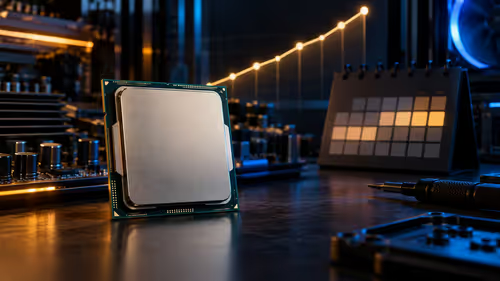
- Poor 1080p Performance: At lower resolutions like 1080p, the CPU has to work harder to prepare frames for the GPU. If your performance doesn't improve much when you lower the resolution, your CPU is likely the problem. You can browse a wide variety of modern CPU processors online to see what a modern chip offers.
- Struggles in Certain Game Genres: CPU-heavy games like Civilization VI, Microsoft Flight Simulator, or large-scale battles in Total War will expose a weak processor very quickly.
Diagnose Your Bottleneck 🔧
The best way to check for a CPU bottleneck is with an on-screen display (OSD). Use a tool like MSI Afterburner with RivaTuner Statistics Server. In-game, watch your CPU and GPU usage percentages. If your CPU usage is consistently hitting 90-100% while your GPU usage is much lower, you've likely found your performance culprit.
The Generational Leap: Why an Upgrade Matters 🚀
The difference between an early Ryzen 5 1600 and a modern chip like a Ryzen 5 5600X or 7600X is massive. It's not just about more cores or higher clock speeds. AMD made huge architectural improvements, leading to a dramatic increase in IPC (Instructions Per Clock). This means each core can do significantly more work at the same speed.
This IPC uplift directly translates to higher and more stable frame rates in games. For anyone still running a Zen or Zen+ chip (Ryzen 1000/2000 series), upgrading to a newer AMD CPU on the AM4 or AM5 platform will feel like a night-and-day difference, finally letting your graphics card stretch its legs.
Is It Time to Upgrade Your Processor?
Deciding when to pull the trigger on an upgrade comes down to your specific situation. If you're happy with your performance, there's no need to rush. But if you're experiencing the symptoms above, an upgrade is one of the most impactful changes you can make.
Consider an upgrade if:
- You recently bought a new GPU (RTX 3060 / RX 6600 XT or better).
- You want to take advantage of high refresh rate monitors (144Hz+).
- You want to stream your gameplay or run other apps in the background.
While Ryzen offers incredible value, it's always smart to survey the entire market. Sometimes, a competing Intel CPU might offer the perfect price-to-performance ratio for your specific build and budget. The goal is always a balanced, optimised system.
Ready to Unleash Your PC's True Power? ⚡ A Ryzen CPU bottleneck can silently steal your frames and ruin your immersion. Don't let an outdated processor hold your high-end GPU hostage. Explore our massive range of CPUs and find the perfect upgrade to get your rig running at peak performance.