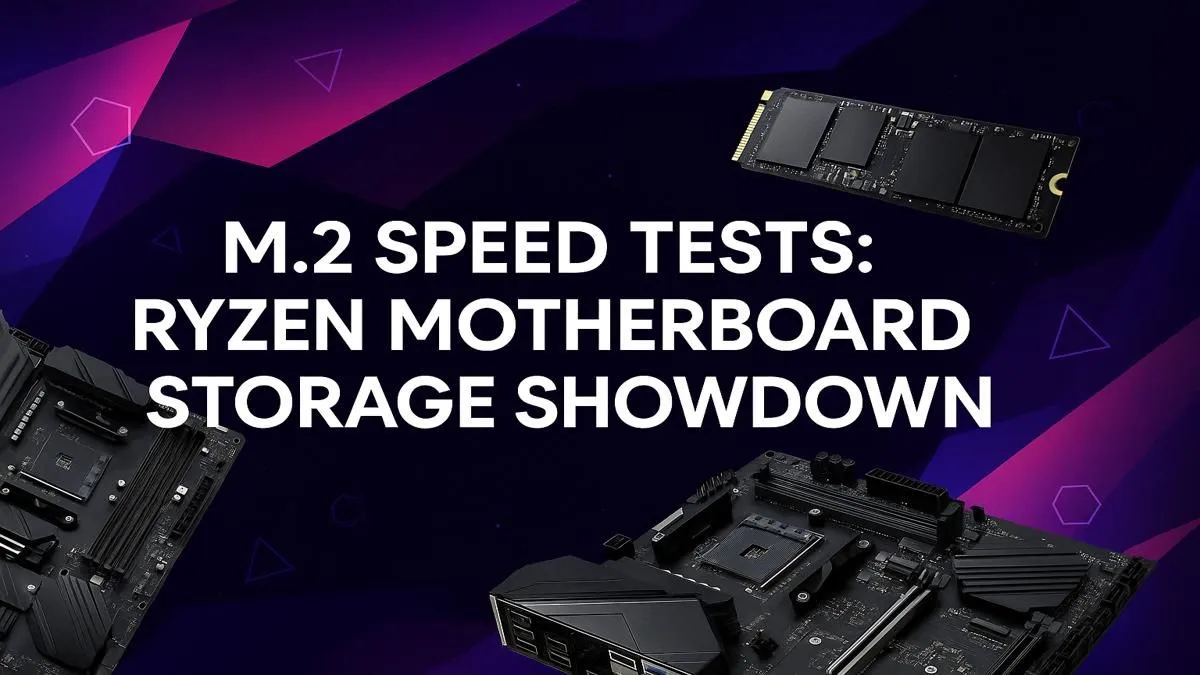
Staring at a loading screen while your mates are already dropping into the action? It’s a uniquely South African frustration. That lag isn't always your internet… it could be your storage. The secret to instant game loads and a snappy PC often lies in unlocking your Ryzen motherboard M.2 speed. This isn't just about plugging in a fast drive; it's about giving that drive the superhighway it needs to perform. Let's dive in.
Understanding the Ryzen & M.2 Speed Connection
At the heart of modern PC performance is the M.2 slot, a tiny connector on your motherboard that allows for blisteringly fast solid-state drives (SSDs). But not all M.2 slots are created equal. Their speed is determined by the "PCIe Generation" they support.
Think of it like this:
- PCIe Gen 3: An older, reliable highway. Still fast, but can get congested.
- PCIe Gen 4: A wider, faster highway. This is the sweet spot for most gamers today, offering a massive leap in performance for loading games and transferring files.
- PCIe Gen 5: The brand-new autobahn. It's incredibly fast, future-proofing your rig for next-gen games and applications that don't even exist yet. 🚀
The key is that your Ryzen motherboard M.2 speed is directly tied to which generation of PCIe its M.2 slots and chipset support.
Does Your Chipset Bottleneck Your M.2 SSD?
You can have the fastest M.2 SSD in the world, but if your motherboard's chipset can't keep up, you're leaving performance on the table. The chipset is the traffic controller of your motherboard, and its capabilities define your storage potential.
The AM4 Sweet Spot: B550 & X570
For a massive number of Ryzen gamers, the AM4 platform is still a powerhouse. A motherboard built on the B550 chipset, for instance, typically offers at least one PCIe 4.0 M.2 slot. This provides a huge performance uplift over older SATA SSDs and is perfect for today's gaming demands. If you're building a value-packed rig, exploring solid B550 motherboards is an excellent starting point.
The AM5 Future: B850 & X870 ⚡
With the arrival of AMD's AM5 platform, the game has changed. The latest chipsets are built to handle the insane throughput of PCIe 5.0.
- B850 Chipsets: These are the new mainstream champions, offering a blend of modern features like PCIe 5.0 support for at least one M.2 slot, making them a smart, future-facing choice. Keep an eye out for the new B850 motherboards as they hit the market.
- X870 Chipsets: For the enthusiast who wants it all. These boards offer the best Ryzen motherboard M.2 speed possible, often with multiple PCIe 5.0 slots for both your graphics card and NVMe SSDs, plus enhanced connectivity. If you demand zero compromises, the top-tier X870 motherboards are where you should be looking.
Check Your Lanes! 🔧
Before buying, always check the motherboard's manual online. Some boards share PCIe lanes between M.2 slots or with the main graphics card slot. Populating a second M.2 slot might sometimes reduce your GPU's bandwidth from x16 to x8. For most gaming, this isn't a major issue, but it's a "gotcha" worth knowing!
Real-World Impact: What Does Faster M.2 Speed Mean?
So, what does all this tech talk mean for your Friday night gaming session?
Imagine launching Cyberpunk 2077 or Starfield and getting from desktop to gameplay in seconds, not minutes. Picture your game textures in Warzone loading instantly as you drop from the plane, giving you a competitive edge. That’s the power of optimised Ryzen M.2 speed.
Beyond gaming, it means your PC boots up in a flash, large video files transfer without a long wait, and your whole system just feels more responsive and alive. While a PCIe Gen 5 drive might be overkill for many today, choosing a motherboard that supports it ensures you're ready for whatever comes next. ✨
Finding the Right Motherboard for Your Build
Choosing the right board is about balancing your budget with your performance goals. Are you building a cost-effective 1080p gaming machine, or a 4K content creation beast? Answering that question will guide your decision. Whether you need a budget-friendly hero or a top-of-the-line flagship, you can browse the entire range of AMD motherboards to find the perfect foundation for your rig.
Ready to Unleash True Speed? Your motherboard is the foundation, but the M.2 SSD is the rocket fuel. Now that you know how to match them, it's time to pick your drive. Explore our huge range of M.2 NVMe SSDs and leave those loading screens in the dust.