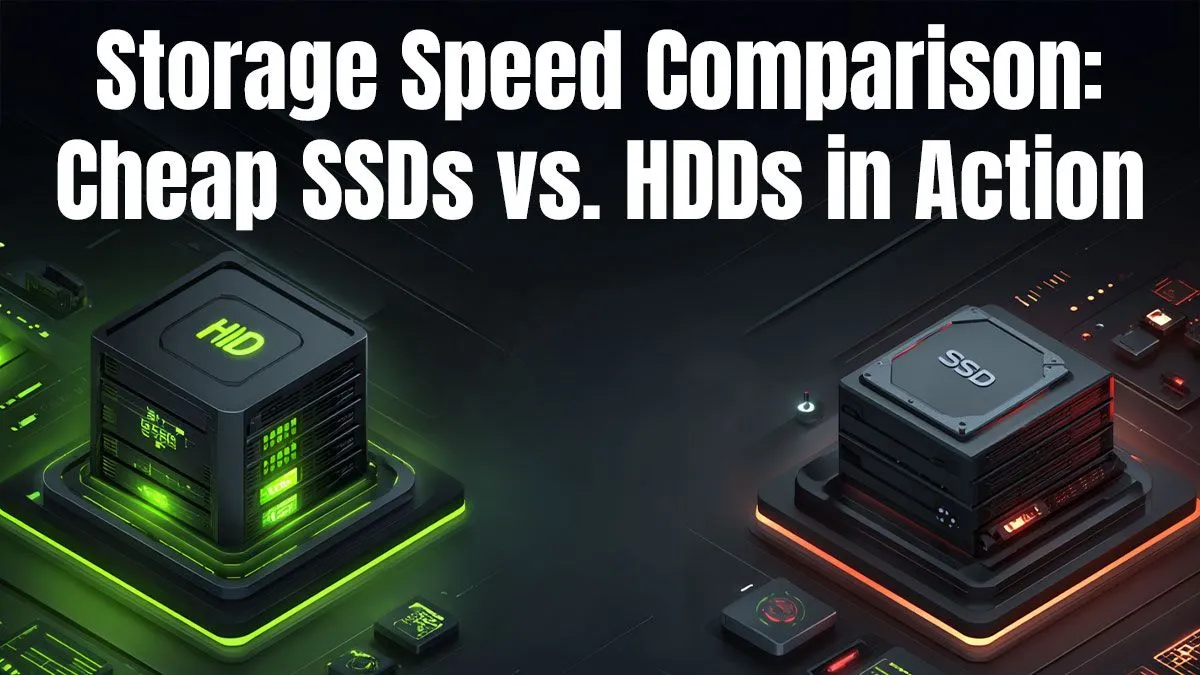
Staring at another loading screen while your mates are already dropping into Caldera? We’ve all been there. That painful wait is often the biggest bottleneck in your rig, and the culprit is usually your old-school hard drive. The big question for South African gamers on a budget is simple: how much difference does a modern drive make? Let's dive into the real-world SSD vs HDD speed battle and see why even cheap SSDs win every time. ⚡
The Core Difference in SSD vs HDD Speed
At its heart, the performance gap comes down to mechanics. A Hard Disk Drive (HDD) is a mechanical device. It uses a spinning platter and a moving read/write head to find your data, kind of like a tiny, super-fast record player. A Solid-State Drive (SSD), on the other hand, has no moving parts. It uses flash memory chips, accessing data almost instantly.
Think of it this way: an HDD has to physically search for the data, while an SSD knows exactly where it is and zaps it over. This fundamental difference is why the SSD vs HDD speed debate is so one-sided. It's not just a small improvement; it's a revolutionary leap that affects everything from booting up your PC to loading the next level in Elden Ring. This is the foundation of a responsive system, just as The right motherboard is the foundation of your entire build.
What This Speed Advantage Means for You
Okay, so the tech is different... but what does that feel like? The real-world impact of superior SSD speed is massive.
- Blazing Boot Times: An SSD can take your Windows boot time from a minute or more down to under 15 seconds. That’s less time making coffee and more time gaming.
- Vanishing Loading Screens: This is the big one for gamers. Games installed on an SSD load dramatically faster. Asset-heavy games that require loading new areas or textures benefit hugely, keeping you immersed in the action. This works in tandem with powerful graphics cards that render those textures instantly.
- System Snappiness: Everything just feels faster. Opening applications, transferring files, and even browsing the web is more responsive because the system isn't waiting for a mechanical drive to catch up. For a truly smooth experience, you need the trifecta: a fast drive, a good CPU, and enough gaming RAM.
The "Cheap SSD" Revolution: Is It Worth It?
Here’s the best part: you don't need to spend thousands of Rands on a top-tier NVMe SSD to feel the difference. The debate over cheap SSDs vs. HDDs in action is already over. Even a budget-friendly 2.5" SATA SSD, which might cost just a few hundred Rand, will absolutely demolish the fastest, most expensive consumer HDD in boot times and game loading. 🚀
For many South African builders, the sweet spot is a hybrid approach: a smaller, cheaper SSD (like a 250GB or 500GB model) for your operating system and favourite games, and a larger, traditional HDD for mass storage of movies, photos, and files you don't access often. This gives you incredible performance where it counts without breaking the bank. Your system will run cool and quiet, especially with a solid CPU cooler and a reliable power supply keeping things stable.
Cloning Tip 🔧
Upgrading from an HDD to an SSD? You don't have to reinstall Windows from scratch! Use free software like Macrium Reflect or CloneZilla to clone your entire HDD contents to your new SSD. It copies everything over perfectly, so you can boot up from your new, faster drive in under an hour.
The Verdict: A Non-Negotiable PC Upgrade
Ultimately, the SSD vs HDD speed comparison isn't really a competition anymore. For your main drive, an SSD is the single most impactful upgrade you can make for your PC's overall performance and quality of life. The boost in responsiveness is something you feel every single second you use your computer.
While HDDs still offer fantastic value for high-capacity storage, they simply can't keep up as a primary drive in a modern gaming rig. When planning your next build inside a sleek new computer case, prioritising even a small SSD for your OS is essential. Or, if you're looking for a wider refresh, our upgrade bundles often pair the latest components for maximum performance out of the box. Stop waiting and start playing. ✨
Ready to Ditch the Loading Screens?
The speed difference between an SSD and an HDD is the single biggest upgrade you can feel. Stop waiting and start playing. Explore our massive range of SSDs and find the perfect drive to unleash your PC's true potential.