Quick Answer
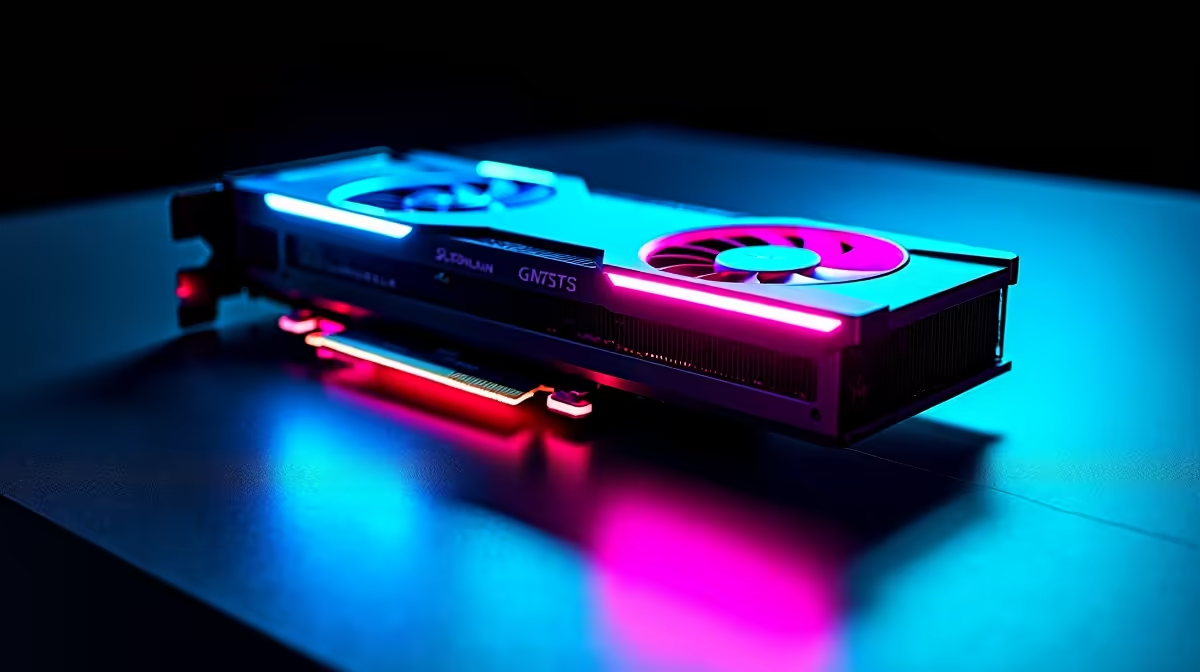
Upgrading from an RTX 3060 to an RX 7800 XT is a worthwhile upgrade in South Africa in 2026, delivering roughly 40 to 60 percent better rasterisation performance at 1080p and genuine 1440p capability. Whether it makes financial sense depends on the price gap and your current monitor resolution.
Performance Gain: What to Expect
The RX 7800 XT is a significantly faster card than the RTX 3060 in rasterisation workloads, which is where most gaming performance is measured. At 1080p, the RTX 3060 already produces strong frame rates in most titles, so the 7800 XT's biggest gains are realised at 1440p where the 3060 begins to show its limits.
If you are still running a 1080p monitor, the upgrade is harder to justify purely on FPS numbers because you are already getting playable and often high framerates with the 3060. The real argument for upgrading at 1080p is future-proofing and headroom for more demanding upcoming titles.
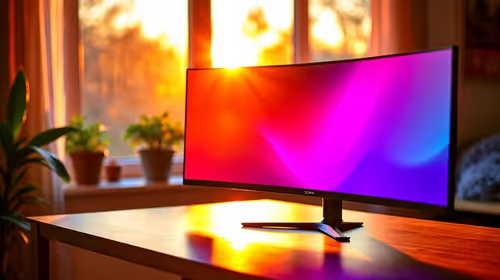
At 1440p, the upgrade argument is much stronger. The RTX 3060 struggles to maintain smooth high-refresh framerates at 1440p in demanding titles. The RX 7800 XT is designed around 1440p as its primary resolution and handles it well, opening up the possibility of pairing it with a 1440p 165Hz monitor for a meaningful visual step up.
ZAR Price Consideration in 2026
In South Africa, GPU pricing is affected by the rand-dollar exchange rate, import duties, and local retailer margins. The RX 7800 XT sits in the R7,000 to R10,000 range depending on availability and specific model. The RTX 3060 in the used market can fetch R3,000 to R4,500 depending on condition and whether you can sell yours locally.
Factoring in selling your 3060, the net upgrade cost is typically in the R4,000 to R7,000 range. Whether that delta is worth it depends on how much gaming you do and whether your current setup actually feels limiting. If you are playing at 1080p on a 60Hz monitor, upgrading to a 7800 XT without also upgrading your monitor means you will not see the full benefit.
Platform Considerations: NVIDIA vs AMD Ecosystem
Moving from NVIDIA to AMD means leaving NVIDIA's feature ecosystem, including DLSS, NVIDIA Reflex, and Shadowplay. AMD's FSR upscaling technology is available in the 7800 XT and is competitive, but DLSS still holds a quality advantage in supported titles. If you rely on DLSS-supported games, factor this into your decision.
Driver stability on AMD's RX 7000 series has improved significantly since launch. The current driver state is mature and generally reliable. If you had driver concerns about AMD cards from older generations, the current situation is meaningfully better.
Frequently Asked Questions
Is the RX 7800 XT better than the RTX 3060 in every game?
In rasterisation performance, yes, the 7800 XT is consistently faster. In ray tracing workloads, NVIDIA's architecture still holds an advantage, so in RT-heavy titles the gap narrows compared to rasterisation-only comparisons.
Should I upgrade my monitor when I get the 7800 XT?
If you are on a 1080p 60Hz monitor, upgrading to at least 1080p 144Hz or ideally 1440p 165Hz makes the most of what the 7800 XT offers. Staying on 60Hz means you will not feel the performance difference as dramatically.
Does the RX 7800 XT work well with Ryzen CPUs?
Yes. AMD's Smart Access Memory (SAM) works with Ryzen CPUs and 500-series or newer motherboards, providing a small but measurable performance uplift that makes the combination slightly better than the card paired with Intel.
Ready to Find Your Perfect Match? Check current GPU pricing and availability in SA. Browse graphics cards at Evetech