Is your brand-new VR headset delivering a choppy, stuttering mess instead of buttery-smooth immersion? You're not alone. Many South African gamers invest in powerful graphics cards, only to be held back by an unseen performance thief. You might be facing a classic VR CPU bottleneck. Here in South Africa, where every component is a considered purchase, fixing this is essential to unlocking the incredible virtual worlds you paid for. Let's get your rig sorted. 🚀
Understanding the VR CPU Bottleneck
So, what is a CPU bottleneck, especially in VR? Think of your PC as a high-tech kitchen. Your GPU is the master chef, cooking up stunning visuals. Your CPU is the prep-cook, getting all the ingredients (game data, physics, tracking info) ready. If the prep-cook is too slow, the master chef has to wait around, and the whole production line grinds to a halt.
In VR, this problem is amplified. Your PC has to render two separate images—one for each eye—at a very high and stable frame rate (usually 90fps or more). Any drop feels instantly jarring and can even cause motion sickness. A VR CPU bottleneck happens when your processor can't feed the graphics card data fast enough to maintain that crucial frame rate, causing stutters and lag.
Diagnosing a CPU Bottleneck in Your VR Setup
Before you rush out to buy new hardware, you need to confirm the CPU is the culprit. Guessing is an expensive game. Here’s how to properly check for a CPU bottleneck in VR:
- Fire Up Monitoring Software: Tools like MSI Afterburner with RivaTuner Statistics Server or the dedicated FPSVR app on Steam are your best friends.
- Jump Into a Demanding Game: Pick a title known for heavy physics or lots of on-screen characters, like Blade & Sorcery or Half-Life: Alyx.
- Watch Your Vitals: Play for a few minutes and keep an eye on the performance overlay. If you see your CPU usage hitting 90-100% across several cores while your GPU usage is sitting much lower (e.g., 60-70%), you've found your bottleneck. The CPU is maxed out and can't keep up.
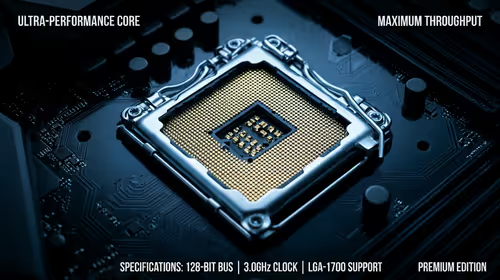
If your diagnostics confirm the processor is the weak link, it's time to start thinking about an upgrade. A quick look at the latest CPU processors available online will give you a clear idea of the performance leap you can expect from a modern chip.
Pro Diagnosis Tip 🔧
In SteamVR, you can enable the Advanced Frame Timing graph (under Settings > Video). If you see lots of pink or red spikes in the CPU graph, it’s a clear sign your processor is struggling to prepare frames in time, confirming a bottleneck.
How to Fix a VR CPU Bottleneck in South Africa
Once you've diagnosed the problem, you have two paths forward: optimisation or upgrading.
First, Try Software and Game Optimisation
Sometimes, you can squeeze a bit more performance out of your current setup without spending a Rand. Try these steps:
- Close Background Apps: Shut down web browsers, Discord, and any other non-essential programs before launching VR.
- Lower CPU-Intensive Settings: In your game's graphics options, look for settings like "Physics Quality," "Shadows," "View Distance," or "Number of NPCs." Lowering these can significantly reduce the load on your CPU.
- Update Your Drivers: Ensure your chipset drivers and BIOS are up to date. These updates can sometimes include crucial performance optimisations.
The Ultimate Fix: A Strategic CPU Upgrade ✨
While software tweaks can help, they are often just a temporary fix for a severe VR CPU bottleneck. The most effective, long-term solution is a hardware upgrade. For smooth VR gaming, you need a CPU with strong single-core performance and a healthy number of cores.
Today's market offers incredible options. For years, gamers have relied on the raw single-thread power of Intel CPUs to deliver high, stable frame rates that are perfect for VR. On the other hand, the fantastic multi-core value and efficiency from the latest AMD CPU lineup make them a brilliant choice for gamers who also stream or multitask.
Unchain Your VR Headset
Don't let an outdated processor ruin your virtual reality adventures. By correctly identifying and fixing a VR CPU bottleneck, you ensure your entire system works in harmony to deliver the breathtaking, fluid experience you deserve. A balanced PC is the key to unlocking the true potential of your VR headset.
Ready to Smash That Bottleneck? Fixing a VR CPU bottleneck can feel complex, but the reward is flawless, immersive gameplay. A powerful new processor is the most direct path to VR paradise. Explore our massive range of CPUs and find the perfect heart for your gaming rig today.