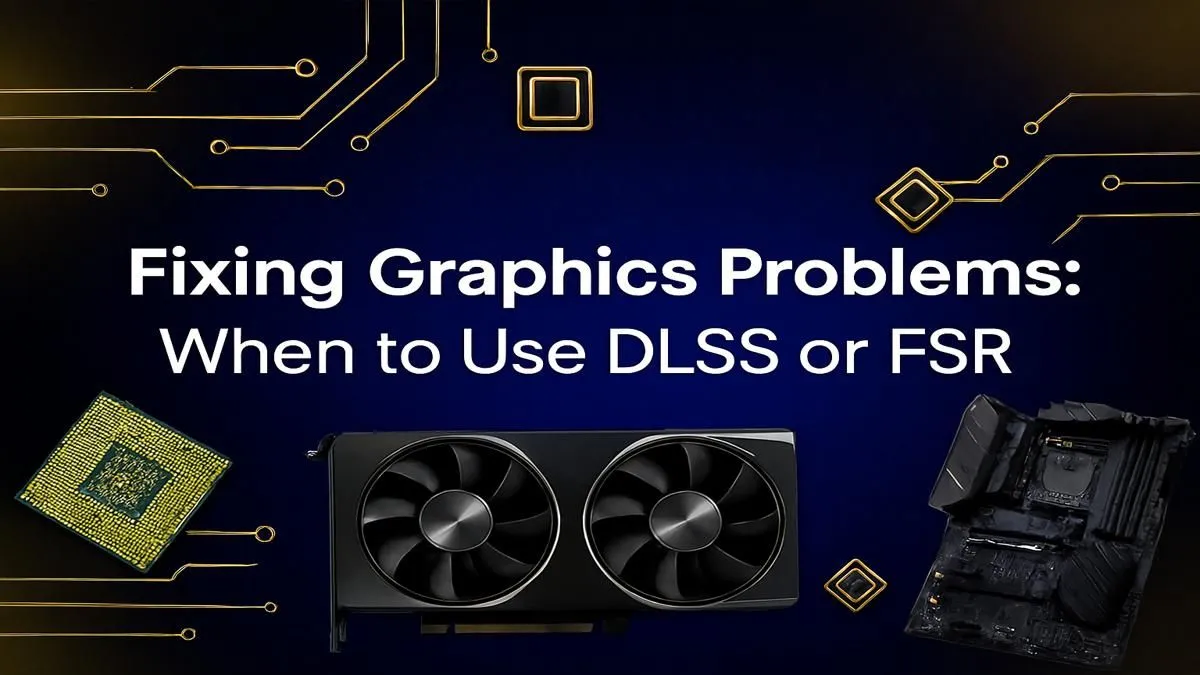
Staring at your FPS counter, wishing it would climb just a little higher? We've all been there. In South Africa, getting the most bang for your buck from your gaming rig is crucial. Luckily, you don't always need a pricey upgrade. Technologies like NVIDIA's DLSS and AMD's FSR can give you a massive performance lift for free. But knowing when to use DLSS or FSR is the key to unlocking that smooth, high-frame-rate bliss. Let's dive in. 🚀
What Are DLSS and FSR, Anyway?
Before deciding between them, it helps to understand what these acronyms actually mean. Think of them as smart upscaling technologies. They render your game at a lower internal resolution (which is easier for your GPU) and then use clever algorithms to scale the image up to your monitor's native resolution, like 1080p or 14K. The result? More FPS!
NVIDIA DLSS (Deep Learning Super Sampling)
DLSS is NVIDIA's secret sauce, exclusive to their RTX graphics cards. It uses dedicated AI hardware called Tensor Cores to reconstruct the image with incredible detail. Because it uses machine learning, the image quality is often shockingly close to native resolution, and sometimes even better. It's a fantastic tool if you own one of the latest NVIDIA GeForce RTX graphics cards and want to boost your gaming FPS without a noticeable visual downgrade.
AMD FSR (FidelityFX Super Resolution)
FSR is AMD's answer, but with a key difference: it's open-source. This means it works on almost any modern graphics card, including a wide range of AMD Radeon graphics cards, older NVIDIA GTX cards, and even Intel's Arc GPUs. It doesn't use AI in the same way as DLSS, relying instead on a high-quality spatial upscaling algorithm. While its image quality has improved massively with FSR 2 and beyond, DLSS often still has the edge in pure visual fidelity.
The Big Question: When to Use DLSS or FSR
Making the right choice comes down to your hardware and your goals. Here’s a simple breakdown to help you decide which upscaler to enable to boost your gaming FPS.
Driver Duty 🔧
Always make sure your graphics card drivers are up to date! Both NVIDIA and AMD frequently release updates that improve the performance and image quality of DLSS and FSR. A quick update can often give you a free, noticeable performance boost.
Choose DLSS If...
- You have an NVIDIA RTX Card: This is the main requirement. If you have a GeForce RTX 20, 30, or 40-series GPU, DLSS is almost always your best bet.
- Image Quality is Your Priority: Especially in "Quality" or "Balanced" modes, DLSS 2 and the latest DLSS 3 with Frame Generation offer outstanding visuals that are often indistinguishable from native resolution.
- You're Pushing Ray Tracing: Ray tracing is incredibly demanding. Using DLSS is practically essential to get playable frame rates with all the beautiful lighting effects turned on in games like Cyberpunk 2077 or Alan Wake 2.
Choose FSR If...
- You Don't Have an RTX Card: This is FSR's superpower. If you're running an AMD card, an older NVIDIA GTX card (like the popular GTX 1660 Super), or an Intel GPU, FSR is your go-to option.
- A Game Doesn't Support DLSS: While DLSS support is widespread, some games only offer FSR. In that case, the choice is made for you!
- You're on a Tight Budget: FSR can breathe new life into older or more affordable hardware. It can be the difference between a game being a stuttery mess and a smooth, enjoyable experience, helping you get more value from great graphics card deals without breaking the bank. ✨
Ultimately, the best way to know when to use DLSS or FSR is to experiment. Try both in your favourite games (if supported) and see which one gives you the ideal balance of performance and visual quality for your specific setup. Happy gaming!
Ready to Supercharge Your FPS? Whether you're Team Green with DLSS or Team Red with FSR, the right graphics card is your ticket to smoother gameplay. Explore our incredible graphics card deals and find the perfect GPU to unlock a new level of performance today.