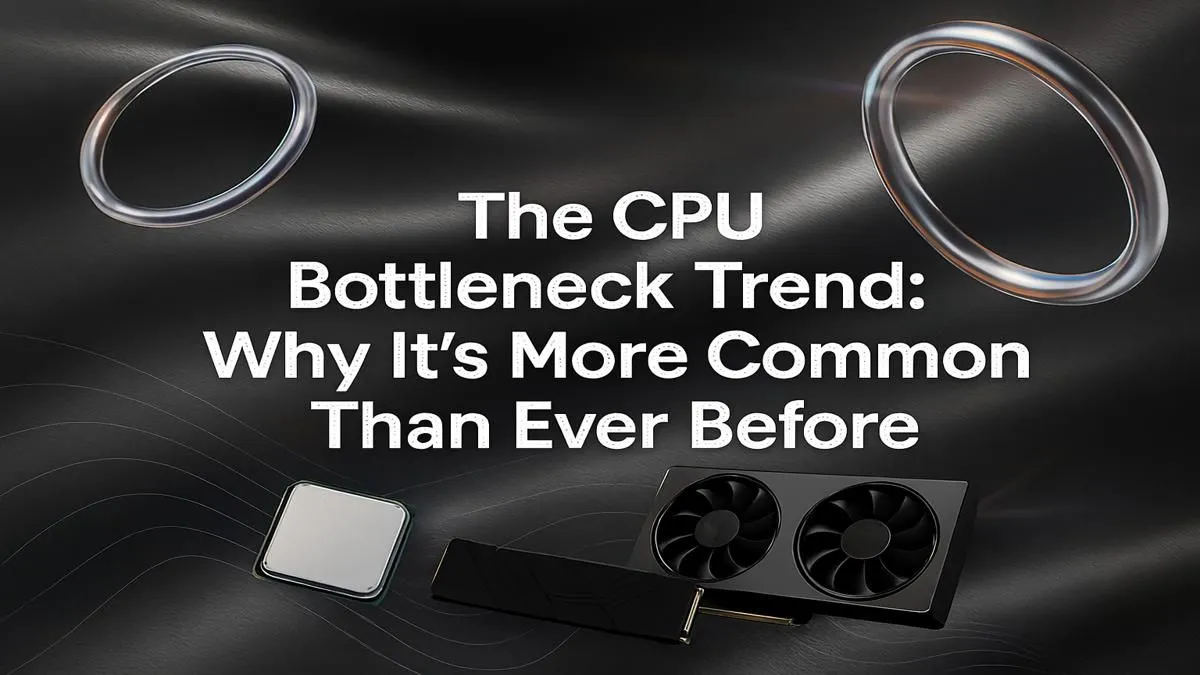
Ever splurged on a beastly new graphics card, only to find your frame rates are... disappointing? You're not alone. That frustrating stutter or underwhelming performance, even with a top-tier GPU, often points to a single, sneaky culprit that's holding your whole system back. We're talking about a CPU bottleneck, and in today's world of lightning-fast tech, it's a more common problem for South African gamers than ever before.
Understanding the CPU Bottleneck
So, what exactly is a CPU bottleneck? Think of your PC as a high-speed assembly line. Your CPU (Central Processing Unit) is the manager, preparing tasks (like game logic, physics, and AI) and sending them down the line. Your GPU (Graphics Processing Unit) is the specialised worker at the end, taking those instructions and rendering the beautiful images you see on screen.
A CPU bottleneck happens when the manager (CPU) can't prepare tasks fast enough for the worker (GPU). Your powerful graphics card ends up waiting around, unable to use its full potential. The result? Lower frame rates, annoying stutters, and a gaming experience that doesn't live up to your hardware's promise. 🚀
Key Symptoms of a CPU Bottleneck
Not sure if a processor limitation is your problem? Your PC will give you clues. The most telling sign is monitoring your hardware usage while in-game. Using tools like MSI Afterburner or even the built-in Windows Game Bar overlay, look for this pattern:
- High CPU Usage (90-100%)
- Low GPU Usage (well below 90%)
If your CPU is constantly maxed out while your shiny new GPU is barely breaking a sweat, you've almost certainly found your bottleneck. This is especially common in CPU-intensive games like Cyberpunk 2077 (in crowded city areas), Microsoft Flight Simulator, or strategy games with thousands of units on screen.
Why Is This Happening More Often?
It feels like the term CPU bottleneck is everywhere these days. There are a few key reasons for this trend.
1. GPUs Are Getting Faster... Much Faster
Graphics card technology has taken a massive leap forward. A mid-range card today can outperform a high-end card from just a few years ago. Gamers often upgrade their GPU first, plugging a powerful new card into a system with an older processor. This imbalance is the number one cause of a CPU bottleneck.
2. High-Refresh-Rate Gaming is the Norm
Playing at 144Hz or even 240Hz is incredible for competitive shooters. But to generate that many frames per second, your CPU has to work overtime. Pushing for high frame rates at 1080p resolution is one of the most demanding scenarios for a CPU, making any weakness much more obvious.
3. Games Are More Complex
Modern game worlds are bigger, more dynamic, and filled with more complex systems than ever before. All that data for physics, AI, and environmental interaction has to be processed by the CPU before the GPU can even think about drawing it. This is why a simple processor upgrade can often feel like a whole new PC. The most direct path to fixing a severe CPU bottleneck is to invest in a modern processor. Browsing the latest CPU processors available online is the best place to start your upgrade journey.
Balance is Everything ⚖️
Before you buy a new CPU, always check your motherboard's compatibility! You need to make sure the CPU socket (e.g., AM5 for AMD, LGA 1700 for Intel) matches your board. You might also need to update your motherboard's BIOS for the new chip to work. A quick search of your motherboard model online will save you a massive headache.
How to Reduce a CPU Bottleneck
While a hardware upgrade is the ultimate fix, you can take steps to lessen the impact of a CPU bottleneck without spending a Rand.
Software Tweaks & Settings
- Increase Your Resolution: This sounds counterintuitive, but it works. Bumping your game from 1080p to 1440p or 4K puts more stress on the GPU. This allows it to work harder, balancing the load and often resulting in a smoother (though lower-framerate) experience.
- Lower CPU-Intensive Settings: In your game's graphics menu, look for settings like "object detail," "shadow quality," "physics," and "population density." Lowering these can significantly reduce the load on your CPU.
- Close Background Apps: Make sure you close unnecessary programs like web browsers (especially with many tabs), Discord, and other apps before launching a demanding game. Every bit of CPU power helps. 🔧
The Upgrade Path
When software tweaks aren't enough, it's time to look at new hardware. A balanced PC is a happy PC. Whether you're eyeing the incredible multi-core value of a new AMD CPU for productivity and gaming... or the blistering single-core speeds found in a top-tier Intel CPU for maximum competitive frames, the right choice will unlock your GPU's true power.
Ready to Unleash Your PC's Full Potential? A CPU bottleneck can be frustrating, but the right upgrade makes all the difference. Stop leaving performance on the table. Explore our massive range of CPU processors and find the perfect heart for your gaming rig today.