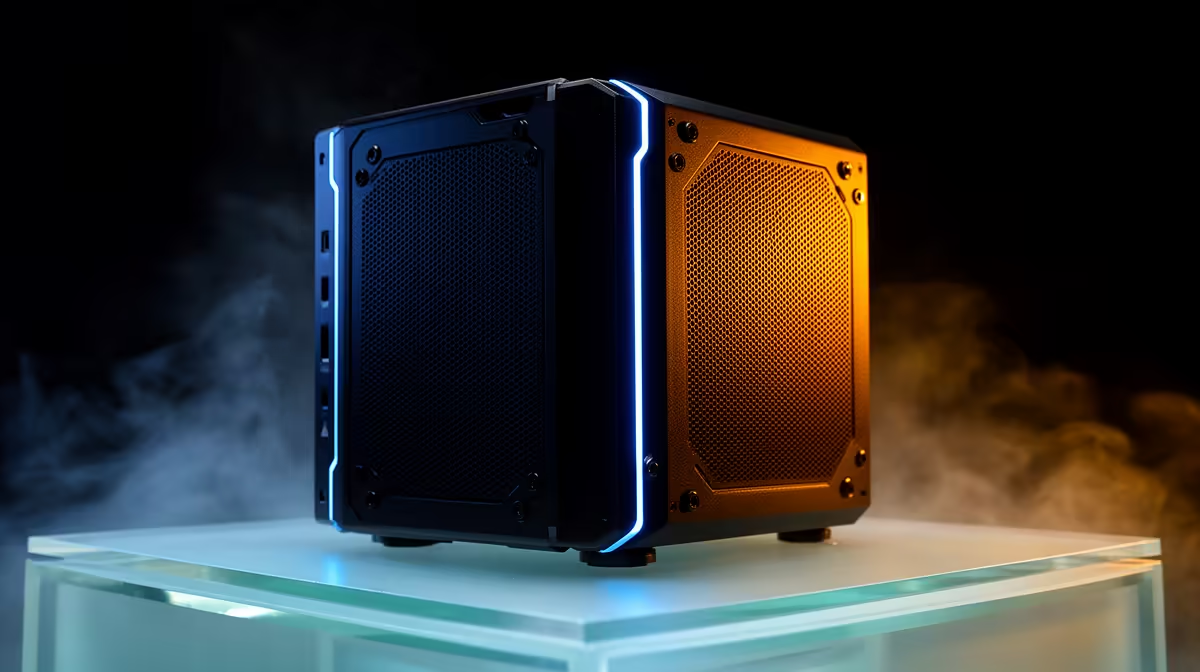
A Blackwell GPU sitting on your desk sounds like the ultimate gaming rig, but the DGX Spark was never built to run games. NVIDIA designed this compact GB10 Grace Blackwell box as an AI inference and development appliance, and almost every decision about it, from the operating system to the ports on the back, points away from gaming and towards model work.
Quick Answer
No, the DGX Spark is not a gaming machine. It ships with DGX OS (a Linux-only build), has no DisplayPort or HDMI output aimed at a gaming monitor, and runs zero of the Windows game ecosystem. Its Blackwell silicon and 128GB of unified memory are tuned for AI inference, not frame rates. For gaming, a standard RTX desktop or laptop is the right call.
Why the hardware says "AI lab," not "gaming PC"
The DGX Spark is built around the GB10 Grace Blackwell Superchip, pairing a 20-core Arm CPU (10 Cortex-X925 plus 10 Cortex-A725) with a Blackwell GPU and 128GB of unified memory at roughly 273 GB/s of bandwidth. Those numbers are excellent for holding large language models resident in memory, which is exactly the workload NVIDIA markets it for: up to 1,000 TOPS of FP4 inference.
Gaming asks for something different. Games want very high memory bandwidth feeding a wide graphics pipeline, mature display outputs, and a driver stack that recognises thousands of titles. The Spark's bandwidth, while generous for inference, sits far below what a discrete gaming GPU delivers, and its memory is shared across CPU and GPU rather than dedicated VRAM tuned for rendering.
DGX OS is Linux only, and that closes the door
The Spark runs DGX OS, NVIDIA's customised Linux distribution with platform-specific drivers and diagnostic tooling for AI work. There is no Windows here. The overwhelming majority of PC games, anti-cheat systems, launchers, and storefronts target Windows first, and many never get a working Linux build. Even where compatibility layers exist, you would be fighting an appliance that was never meant for that job, on an Arm CPU where x86 game binaries do not run natively.
The display story
The Spark's monitor support exists for setup, dashboards, and development, with recent updates improving compatibility with TVs and monitors and adding multi-monitor and non-native resolution handling. That is a world apart from a gaming output path designed for high refresh rates and low latency. If your goal is 144Hz at 1440p in your favourite shooter, this is the wrong tool, full stop.
What to buy instead
If you genuinely want both AI experimentation and gaming, a conventional RTX-equipped PC handles both: it games natively on Windows and still runs local models on its GPU. The local AI workstation range at Evetech covers the AI and creator PC builds that double as capable machines, and if the priority is pure frame rate, the current top-selling graphics cards are a faster, cheaper path to a gaming setup than repurposing an inference appliance.
Frequently Asked Questions
Can I install Windows and games on a DGX Spark?
It is not supported and not practical. The Spark ships with DGX OS on an Arm-based Grace CPU, so x86 Windows games would need emulation on a device with no gaming-grade display path. Treat it as an AI appliance, not a gaming PC.
Does the Blackwell GPU in the Spark mean it games like an RTX card?
No. It shares the Blackwell architecture name, but it is configured for AI inference with unified memory and inference-focused throughput, not the dedicated VRAM and display pipeline a gaming RTX card uses.
What is the DGX Spark actually good for?
Running and developing local AI models. The 128GB unified memory lets large language models stay resident without swapping to disk, and recent DGX OS updates have pushed inference speedups for that exact use case.
What should a South African gamer buy instead?
A standard gaming PC or laptop with an RTX GPU and Windows. It games natively and can still run smaller local models, giving you both worlds in one machine.
Chasing high frame rates rather than AI inference? Skip the appliance and browse the current best-selling gaming graphics cards at Evetech to build a rig that actually plays games.