Quick Answer
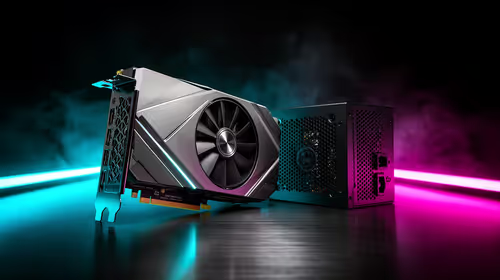
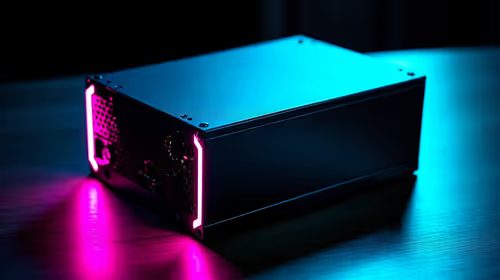
For premium buyers, yes, wattage matters, but size for transient spikes, not just the rated average. A Core i9 plus RTX 4080 averages around 450W yet can spike far higher for milliseconds, so a 1000W 80+ Gold or Platinum ATX 3.x unit (R2,800-R5,500 at Evetech) is the right call. That keeps the supply in its quiet, efficient band and absorbs the spikes a flagship GPU produces.
Why Flagship Builds Need Generous Wattage
High-end GPUs draw clean average power but produce sharp transient spikes that a tightly-sized PSU can struggle with. An ATX 3.x unit is designed to handle these, and sizing to 1000W for a 450-500W build keeps you near the 50% load point where 80+ Platinum is quietest and most efficient. That headroom also leaves room for a future GPU generation without a PSU swap.
For a premium rig kept across two GPU upgrades, generous, efficient wattage is the foundation everything else sits on.
How to Size a Premium PSU
Take your CPU and GPU board power, add for drives and a custom loop if fitted, then target roughly 50% PSU load. A 450-500W flagship system points cleanly to a 1000W unit.
FAQ
Why size a premium PSU to 50% load?
Because that band is where 80+ Gold and Platinum units are quietest and most efficient, and it leaves transient headroom for a flagship GPU's power spikes. For a 450-500W build that means a 1000W unit.
Do I need ATX 3.x for a high-end GPU?
An ATX 3.x unit with a native 12V-2x6 lead handles the steep transients of a 300W-plus card cleanly and removes adapter clutter, so it is the cleaner choice for a flagship build. A quality existing 850W Gold unit with the right lead can still serve.
Is 1200W ever justified?
Only for dual-GPU or extreme overclocked builds. For a single flagship GPU plus a high-end CPU, 1000W is ample and keeps the unit in its efficient band rather than an idle low-load zone.
ATX 3.x 1000W 80+ Gold or Platinum unit and confirm it ships with a native 12V-2x6 GPU lead, so your flagship card runs clean transients without a daisy-chain adapter.