Quick Answer
Replacing thermal pads on an RTX 5060 takes about 45 minutes and costs roughly R250 to R400 for quality pads. You will drop VRAM and VRM temps by 8 to 15 degrees, which matters in SA's warm summers and inside cramped mid-tower cases.
What You Need Before You Start
Grab a magnetic Phillips PH1 screwdriver, a plastic spudger, isopropyl alcohol 99 percent, lint-free cloths, fresh thermal paste like Arctic MX-6 or Thermal Grizzly Kryonaut, and a thermal pad kit. For the RTX 5060 you want 1.5mm pads for the VRAM and 2mm pads for the VRMs, both rated 12.8 W/mK or higher. Gelid GP-Extreme or Thermalright Odyssey pads work well and ship from Evetech for around R300 with same-day Gauteng dispatch.
Discharge static by touching a bare metal point on your case before handling the card. Lay everything out on a clean desk with good light, ideally on a non-static work mat. Take a photo of the card from every angle before you start so you remember exactly where each pad sits, which screw belongs to which mounting hole, and how the fan and RGB cables are routed. Some builders also keep a small pill organiser or magnetic mat handy to keep the screws sorted by location.
Disassembling the RTX 5060 Safely
Remove the card from your PC, unplug the fan header, and flip it upside down. Most RTX 5060 partner cards from MSI, Gigabyte, ASUS, and Zotac use four spring-loaded screws around the GPU die plus six to ten more securing the backplate and shroud. Loosen the four core screws in a star pattern, then take out the perimeter screws. Keep the screws in two separate piles so you do not mix the longer shroud screws with the shorter core screws when you put it back together.
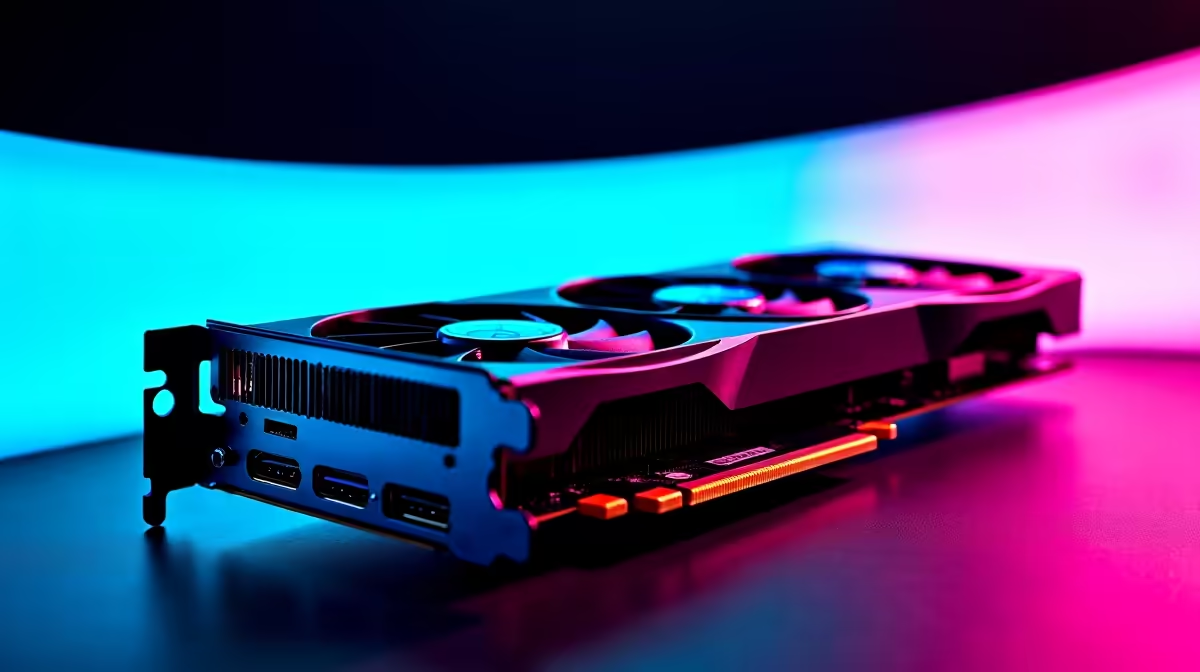
Lift the cooler straight up. If it sticks, twist gently rather than prying because the old paste acts like glue. Disconnect any RGB or fan headers running between the cooler and the PCB. Set the cooler aside with the cold plate facing up so the old paste does not transfer onto your desk. Now you can see the GPU die, surrounding VRAM modules, and the VRM components down the right side of the PCB. Take a second photo at this stage so you have a reference for the exact thermal pad positions.
Replacing the Pads and Paste Step by Step
Peel off every old pad with the spudger and wipe the residue with isopropyl on a lint-free cloth. Clean the GPU die with a fresh cloth and fresh alcohol, working from the centre outwards in small circles. Measure each pad spot if you are unsure, but most RTX 5060 layouts use 1.5mm on the VRAM chips and 2mm on the VRM stack near the power connector. Cut new pads to size with a clean blade, peel both protective films, and press them firmly onto the cooler in the same positions. Avoid stretching or bunching the pads because that creates air gaps that ruin heat transfer.
Apply a rice-grain blob of thermal paste to the centre of the GPU die. Lower the cooler back on, line up the four core screws, and tighten them in a diagonal star pattern, two turns at a time, until they bottom out. Reattach the perimeter screws, plug the fan and RGB cables back in, and reinstall the card into your PC. Double-check that you have not pinched any cables and that the card seats fully in the PCIe slot.
Boot up, run FurMark or 3DMark Steel Nomad for 15 minutes, and watch HWiNFO64. You should see VRAM and VRM temps noticeably lower than before, often back into the safe 70 to 80 degree range even on a 32 degree Joburg afternoon. If temps spike or stay high, you likely have a missed pad or insufficient mount pressure and need to redo the job.
Frequently Asked Questions
Will replacing the pads void my RTX 5060 warranty?
Yes for most South African distributors. Check your specific warranty terms before opening the card and only do it on units already out of warranty or where you accept the risk. Some brands honour pad replacements if a security sticker is intact, but most do not.
How often should thermal pads actually be replaced?
On a stock RTX 5060 the factory pads are good for 4 to 6 years. Only replace early if you see VRAM temps above 95 degrees under load or you bought a second-hand card with unknown history.
Can I reuse the original thermal pads?
No, never. Once compressed they lose their conductivity and shape. Always fit new pads of the correct thickness and W/mK rating.
Ready to Find Your Perfect Match? Pick up the right thermal pads and paste before you crack the cooler open. Shop GPU cooling supplies