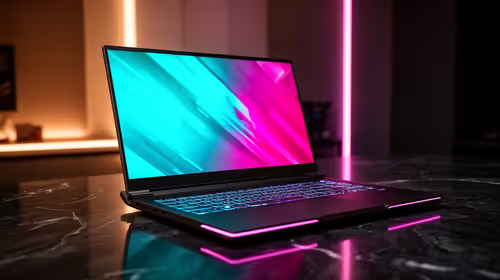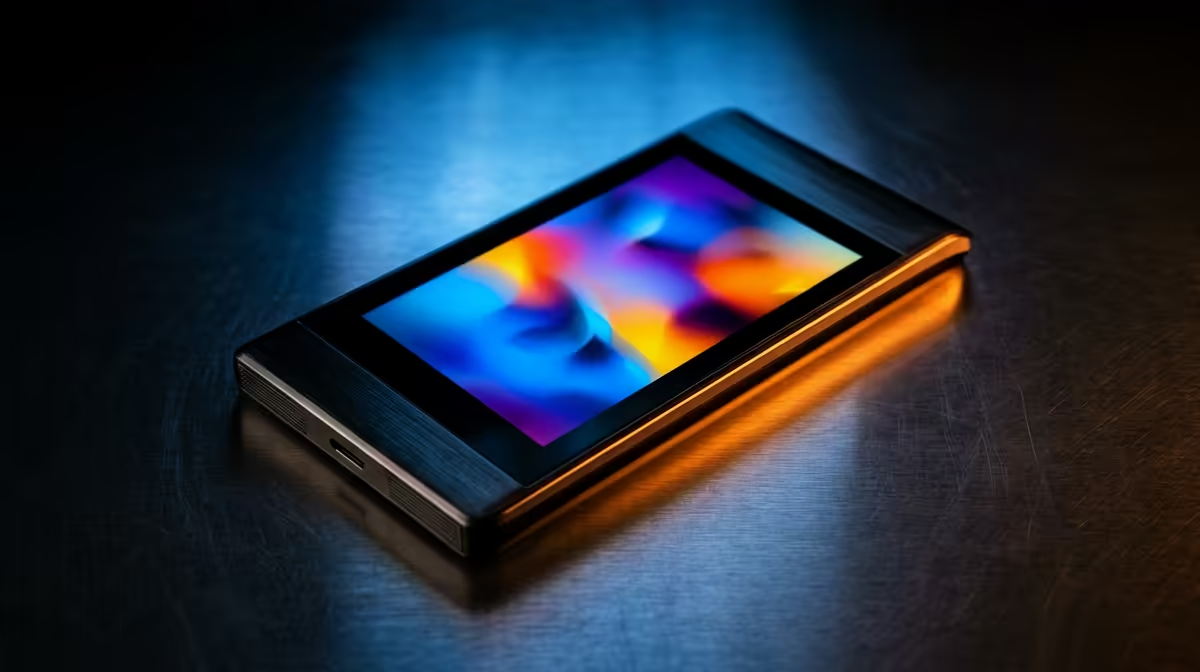
Pick up two portable monitors side by side and the gap between them is obvious the moment a dark scene appears. An OLED portable monitor lights every pixel individually, so black means truly off, which gives inky shadows and punchy contrast. An IPS panel shines a backlight through the whole screen, trading that perfect black for higher peak brightness and a lower price.
Quick Answer
OLED portable panels deliver true blacks and vivid contrast because each pixel emits its own light. IPS panels are brighter at their peak and cost less, but cannot match OLED's deep shadow detail. Choose OLED for film and creative colour work; choose IPS for bright rooms and tighter budgets.
How the Two Panels Actually Differ
The whole comparison comes down to how each panel makes light. OLED pixels generate their own light and switch fully off for black, so a night sky or a dark film scene shows genuine depth with no grey haze. Contrast is effectively limitless because the difference between a lit pixel and an off pixel is total.
IPS uses a constant backlight behind a liquid-crystal layer. Even the darkest part of the image still has that backlight leaking through, so blacks read as very dark grey rather than true black. What IPS gives back is brightness: it can push higher sustained peak luminance, which helps in a sunlit room or a coffee shop near a window. IPS panels also tend to cost less at the same screen size, which keeps them popular for everyday portable use.
Which One Suits Your Use
If you edit photos or video, grade colour, or watch a lot of film on the move, OLED is the panel that rewards you. The contrast and colour saturation make creative work and cinema feel richer, and the per-pixel control gives accurate dark tones that IPS simply cannot reproduce.
If you mostly run spreadsheets, code or browser windows in bright environments, IPS is the sensible buy. The extra peak brightness fights glare better, the lower price frees up budget, and there is no risk of static interface elements sitting on screen for hours, which is a consideration unique to self-lit panels. To weigh up sizes, resolutions and panel types together, the portable monitor range at Evetech lays the options out clearly, and the monitor best sellers at Evetech show which models South Africans reach for most.
Frequently Asked Questions
Why are OLED blacks better than IPS?
OLED pixels switch off completely for black, so there is no light at all in dark areas. IPS keeps its backlight on behind the whole screen, so blacks always carry a faint glow.
Is IPS brighter than OLED?
Generally yes for sustained full-screen brightness, which makes IPS easier to read in direct sunlight. OLED can hit bright highlights but is better suited to controlled lighting.
Which is better value?
IPS usually costs less at the same size, making it the value choice for office and general use. OLED commands a premium for its contrast and colour, justified mainly for media and creative work.
Does OLED have any downside for desk work?
Static elements like taskbars shown for very long periods are a consideration on self-lit panels. For mixed everyday use this is rarely an issue, but it is a reason heavy office users sometimes prefer IPS.
Which should I pick for watching films?
OLED, without hesitation. The true blacks and high contrast make dark and cinematic content look far more immersive than an IPS panel of the same size.
Trying to decide between true-black contrast and bright, affordable clarity? Compare both panel types in the portable monitor range at Evetech and pick the one that matches how and where you work.